
Everyday Stories #23
Do cities really exist?
When we look for something, we are building it
Part I
Let me take you by the hand. You and I come from different cities. We decided together: What we call a city is really nothing more than the heterogeneous whole of our vicissitudes. My city is a linen shirt, a wolf tamed by the fear of being alone. Yours is a wedding, a thinking jasmine.
Let me take you by the hand. You and I come from different cities. And now we are here. We walk slowly. We linger.
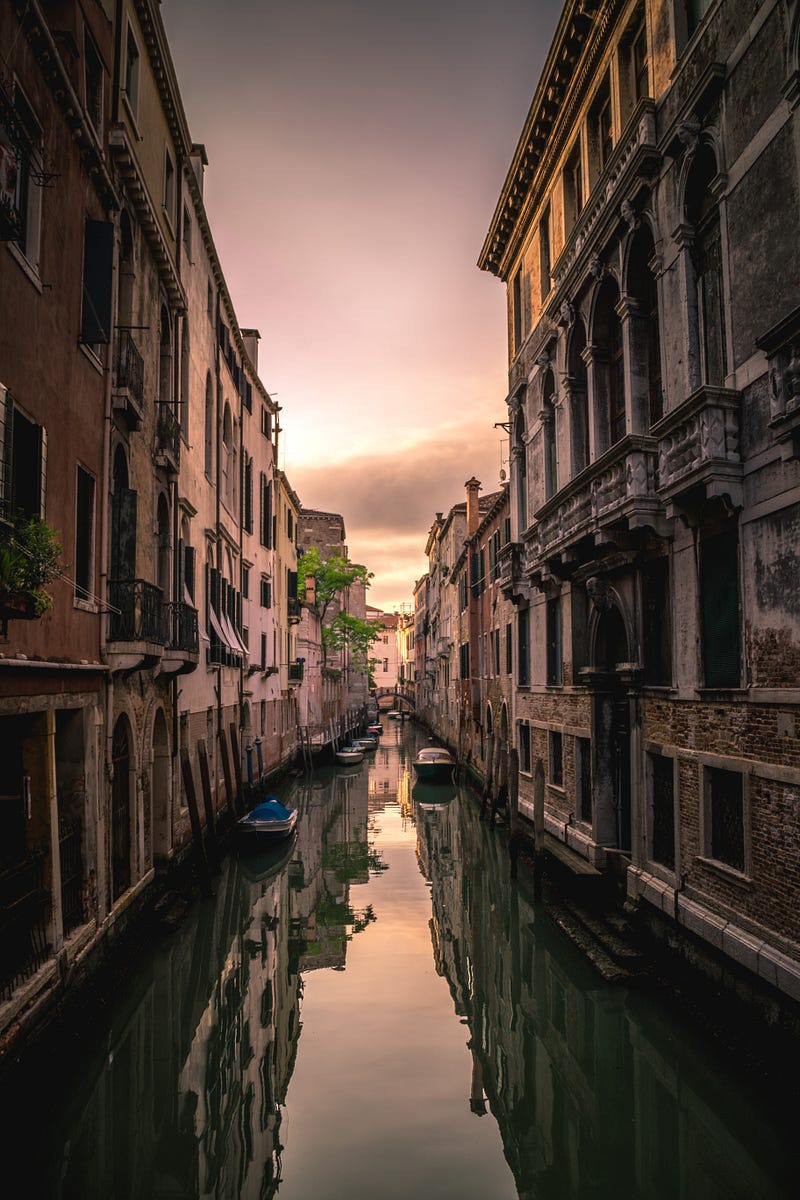
Venice, you know, is not a single city. There are at least two of them. One built by man and one that is reflected in the water.
In Venice you always fall in love with someone, or something. If that doesn’t happen it’s because, in that sunset, you are the object of love.
It’s easy to understand why. We are made of water. Emotions are water. When the tide rises, and the reflected city submerges the real city, and wets the books and boots and people’s moods, the water inside us rises too and the heart doesn’t breathe. Then the tide recedes, and the city returns solid and bare, and likewise our heart.
Part II
Is Venice really a city? Or is it just a dream kept alive by water? The baroque architecture of a mangrove forest. Can you touch Venice? It has the consistency of a symphony.
Marco Polo’s nostalgia was so vivid to invent a city. Venice exists only in his tales.
And we who walk in them, we are nothing more than words, nocturnal shelters, fantasies of a traveler.
We do not know how to escape from romanticism, from melancholy that drags us through the alleys, for furtive encounters, hands that touch and would like to touch more, unexpected bridges, moons floating on the water of the canals.
We fall in love with the tale. Or the tale falls in love with us, kidnaps us to real life, to lead us from the water to the desert, reverent at the court of golden curtains of Kublai Khan.
Part III
Do cities really exist?
Or there is only one, underground, that emerges from time to time, in time and space, and creates mirages of smoke and lava, of pink limestone concretions, windows, towers and cornices?
A city never built, unconscious, moldable. Substance of the imagination. Nourishment of the unicorn that lives on its own representation.
Is Havanun a city?
Or is it but a vessel in the belly of a whale? Or is it just what I am, put in order, by square and compass and protractor? A drawing sheet presented to heaven so that it can spread over and color it.
Is Havanun a city? The search for the answer to this question builds the city of Havanun.
When we look for something, we are building it. When we look for love we are perhaps not like the birds that build the most beautiful nest for the coming spring? When we look for the meaning of existence aren’t we building a sense of our existence?
Part IV
What we seek, invisibly builds what we are. What we are looking for is the invisible city.
An invisible ox with an invisible plow draws an invisible circle. It delineates the boundaries of the city that is to be. The stones line up on that circle, the streets follow the rays, such as migrant species that recognize magnetic meridians.
Ours is the visible hand that guides the invisible plow. Ours is the visible writing that builds the invisible city.
Part V
Thanks to Trisha Traughber for proposing this prompt. For several reasons.
I feel a bit at home with Italo Calvino, although this is not a guarantee of knowledge of the subject :)
“Invisible cities” is a book that continues to fascinate me. It is a book that seems to have neither a beginning nor an end. It wraps around like a Möbius strip, It is reflected in the reader’s mind as a Gestalt image. Its structure resembles that of a complex molecule. And it is able to bind to our receptors. And it becomes part of us.
But that applies to all books.
Because words are invisible cities. What we write builds a city that is invisible and yet lived. By us and by others. Daring the comparison, Medium, or that part of Medium that I know here, made up of attempts at poetry and storytelling, is an invisible city.
And if Medium, as well as our family lunches, our offices, our factories, the benches where we kiss, newspapers, the parties, the places where we pray, the mountains we contemplate, so, if Medium is also an invisible city, then here too it is valuable to transcribe, to keep in mind, to relive, the concluding remark of Marco Polo:
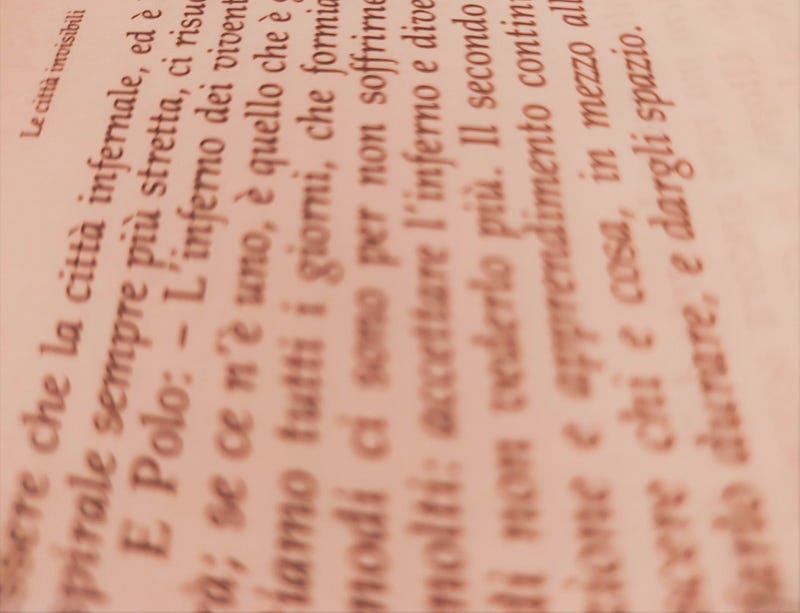
L’inferno dei viventi non è qualcosa che sarà; se ce n’è uno, è quello che è già qui, l’inferno che abitiamo tutti i giorni, che formiamo stando insieme. Due modi ci sono per non soffrirne. Il primo riesce facile a molti: accettare l’inferno e diventarne parte fino al punto di non vederlo più. Il secondo è rischioso ed esige attenzione e apprendimento continui: cercare e saper riconoscere chi e cosa, in mezzo all’inferno, non è inferno, e farlo durare, e dargli spazio.
The inferno of the living is not something that will be; if there is one, it is what is already here, the inferno where we live every day, that we form by being together. There are two ways to escape suffering it. The first is easy for many: accept the inferno and become such a part of it that you can no longer see it. The second is risky and demands constant vigilance and apprehension: seek and learn to recognize who and what, in the midst of inferno, are not inferno, then make them endure, give them space.
The inspirational prompt:
An invisible place of an invisible city: