
Do Childhood Spankings have an Impact on Adult Relationships?
Childhood Lessons on Love
“Let the punishment fit the crime” was a common refrain in our household. A disciplinary she was not, my mother would constantly tell my dad all the happenings that occurred while he was away at work.
As a stay-at-home mom, with four young girls, and no life outside of the home, I’m sure that most times, she was stressed and all too glad to release her anguish on our father.
Just as soon as his foot landed on the living room carpet, my mom would let loose — all the irritations and grievances of the day.
Being that he just got off of work, tired and spent, and perhaps without anyone to unpack his frustration on, hearing all this negativity immediately upon entering meant automatic frustration and fury.
Let the whooping commence!
I regularly received spankings, mostly because of my mouth. I was always “getting smart,” and I persistently wrestled for the last word.
Every. Single. Time.
There used to be a family joke that I would be a lawyer someday because I could and would argue a point into the ground, relentlessly.
This defiance didn’t serve me well in a household where talking back was the greatest offense.
But spankings never stopped me.
They hurt, but, I had figured out a long time ago that physical punishment was a lot better than other forms of punishment because, after a short while, the pain would disappear.
No one wants to think of their family of origin as dysfunctional.
Especially not me.
Considering that compared to many of my peers, we had it fairly well. My parents stayed married until my father died, there were no half-siblings, family secrets, or real abuse.
And what is real abuse?
It’s so uncomfortable — this topic.
I grew up during a time when spankings weren’t bad, they were common. Spare the rod and all that.
And spare the rod, they did not. At least not with me and the next eldest.
When I think of defining real abuse, my mind clenches.
There’s a strong inclination to protect my dad by monitoring my words because he was great in so many ways. And as an adult, I understand he was fighting against his own disregarded trauma. He did the best he could, or at least he did the best he knew.
What’s funny though is that the one person I never had a hard time blaming was my mom.
I always wondered why she would tell my dad things as soon as he came in the door, knowing his temper would flare, and knowing she would start loudly trilling “let the punishment fit the crime, Dear!”
Though the punishment rarely ever fit the crime.
— Before continuing, I’d like to pause to go back to real abuse. —
When I had my son, I was married to his father. Two years after my son’s birth, he left us both, and I found myself with a new identity — a single mother.
Single motherhood was hard! I was stressed, uneducated, impatient, and emotionally ruined, and my son was a “wild cat,” as my mom used to say, who would've benefited from having a mother with much more patience and understanding than I had to give at that time.
The only way I knew to tame the wildness in him was to spank him. To me, time out was just ridiculous. Not even worth considering. Plus, I got spankings growing up, and I turned out just fine —
Growing up, we would go outside and pick a switch or my dad would retrieve one and light our legs up. I remember having welts on my legs afterward that would rise, sting, and bleed. But that wasn’t abuse. It was discipline. And, it was normal.
And, that’s what I knew.
So one day, while at church, my son was running around during the service, being loud, and causing distraction. I had been receiving heat from other members of the congregation about his “home training,” or rather, lack thereof. After trying to get him to sit down and be quiet, I took him outside to the back of the church, plucked a bendy branch off the tree, and swung at his legs.
When the welt formed, I felt like a monster.
Immediately, I could say to myself that my behavior was abusive and extreme. Yet, when I thought about what that meant in regard to my parents and my experience as a child, it somehow seemed, and seems, both different and unfair.
Unrelated.
Looking back to a particular spanking incident from my childhood saddens me now because my thoughts were truly disturbed; At the time, I remember being proud of myself for figuring out what I thought to be a great truth in life.
At some time during my youth, I had decided that parents only whooped their children to make them cry, to hurt them. So, I decided at that moment that I would never cry again. No matter what.
One day, I was about to get spanked and I suppose I mentally checked out.
In my mind, I remember my dad being something like a robot, his mechanical arm rocketing up and down at the joint, striking my skin.
I sat there — stoic. Sucking it all in. Every hit was lost within me, somewhere out of reach.
It hurt, I’m sure, but I did what I told myself I would do — and that was to not shed one tear.
Eventually, the robot arm ran out of steam and stopped operating, and then I was left alone. And I just remember sitting there. Thinking.
Impact on Adult Relationships
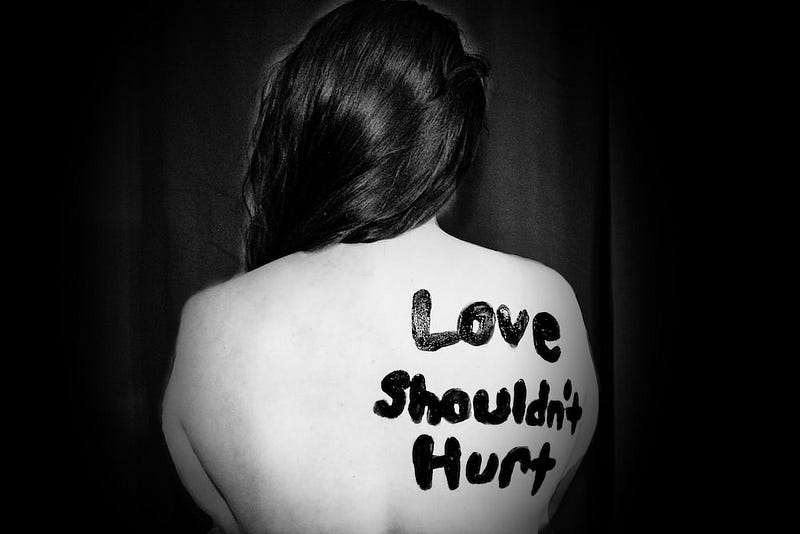
Presently, when I think about my family, and the paths I took and my sisters took, I think it can't be a coincidence that we have all fallen prey to a man who feels it's okay to apply abusive hands to our bodies.
It can’t be a coincidence that being knocked around a little bit never lead us to believe that maybe we weren’t loved by these abusive men.
Though I always fought back, I was in an abusive relationship in my first marriage for five years.
Some people stay a lot longer, some people leave abusive situations a lot earlier. Either way, to me, five years is too much time to be in an unhealthy abusive relationship.
It truly makes me wonder if perhaps having a parenting adult that loves you, but also hurts you, imprints the message that sometimes pain feels like love.
All About Love by bell hooks
“Love is as love does, and it is our responsibility to give children love. When we love children we acknowledge by our every action that they are not property, that they have rights — that we respect and uphold their rights. Without justice there can be no love.”
— bell hooks
In bell hooks’ book, she states that it’s possible to be in a caring relationship that isn’t a loving relationship — to have caring parents that arent necessarily loving parents.
To me, that was mind-blowing!
“No one can rightfully claim to be loving when behaving abusively.”
“Children are told that they are loved even though they are being abused.”
— bell hooks
Perhaps the issue with being loving towards children, towards others, and even towards ourselves is that we do tend to have a mixed view of what loving is and what loving does.
In the book, bell hooks mentions a common phrase I was used to hearing before a spanking would begin — “this is going to hurt me more than it hurts you,” and I knew that wasn’t right.
How is it going to hurt you more, when I’m the one getting hit?
Or “I’m going to give you something to cry about” or “this is for your own good.”
All this mixing of love with pain under the guise of necessity.
bell hooks stresses in All About Love, that this is the type of confusion that should be avoided. We have to be careful not to associate and weave being loving with being harmful.
Where do we go from here?
Being a loving parent, a loving partner, a loving friend, or just a loving person, is hard. Real love and real loving require real work.
It’s the path of most resistance.
As a parent, I can’t help but think of the many many times I’ve messed it up, especially with my son, and I also wonder how he will remember those early years.
What will be said about me?
My husband, when I met him, told me he had never spanked his children. Ever. I was shocked. I remember discussing this with him, curious as to what he did do to discipline them, or if they were just allowed to be untamed“wild cats.”
His life-changing method? Communication.
What?!
We didn’t talk or get talked to as children as a form of discipline. There was no getting an understanding — this talking thing was foreign to me.
But after more exposure to his methods, and education around early childhood, I changed paths.
My girls have never had a spanking. Not once.
I discovered there are other ways to discipline a child that don’t involve a heavy hand, tree limb, or belt. After all, spankings are so ineffective, when you think about it.
Getting a whooping doesn’t teach you anything besides maybe the importance of not getting caught next time. Spankings also don’t cause real change, only obedience out of fear. I also can see how these things would easily encourage unhealthy secrets and silences.
So, where do we go from here?
The best answer I can think of is we should go and grow in grace and think more deeply about how we actually are with people in our care and at our service.
We can start practicing loving kindness by doing some inner work. Possibly meditation, prayers, deep breathing, being in community, finding outlets, checking yourself, dealing with your stress, taking a time out, finding joy, scheduling fun, and doing whatever else you need to do to be able to present yourself to others in a loving way.
I don’t know any professional, any student, any teacher, any friend, parent, or person, who wouldn’t benefit from practicing being loving — including myself.