
DMX Made Hip-Hop Feel Invincible Again
At the height of the shiny suit era, the original Ruff Ryder conquered hip-hop with raw intensity
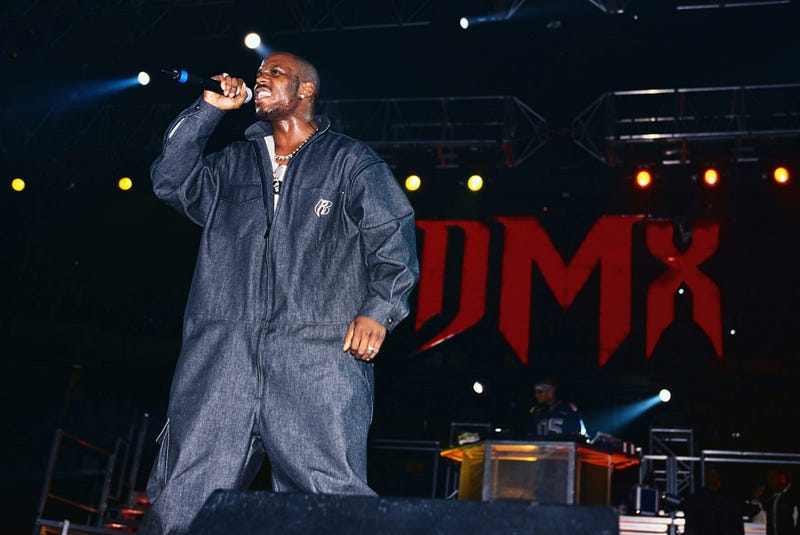
DMX was the rapper who made us feel invincible again.
The experience of cranking a DMX track is exhilaratingly visceral. The gravelly rawness of his voice reverberates through your spine. The staccato cadence of his machine gun delivery rattles your bones. The live wire energy of his vocal presence ignites your nervous system like an adrenaline shot, whether he’s barking out threats, plumbing the darkest depths of this soul, or commanding the club the “stop, drop, shutdown ’em down, opening up shop.”
Within the four-minute confines of a song, DMX is an indestructible force laying waste to every obstacle, competitor, or inner demon in his path. And we’re right there with him.
While DMX’s music was one of the definitive sounds of hip-hop’s post-Golden Age transitional period of the late ’90s and early 2000s, the feeling he gave us was a throwback to an earlier time - a simpler one. Despite the dark savagery of many of his lyrics, the feeling he harkened back to came from a time of innocence. It’s the feeling we got when LL Cool J sliced through the guitar stabs of “Rock the Bells” proclaiming his intention to “battle anybody, I don’t care who tells.” It’s the feeling we got when Chuck D boomed “the rhythm, the rebel.” It’s the feeling that shot through us when N.W.A let us know that real ones don’t die, and we believed them with every fiber of our being.
We fell in love with hip-hop because our rap superheroes imbued their powers into us one bar at a time. They gave us agency, transforming the powerless - whether because of race, economic status, or simply being kids - into the powerful. With its beat in our heart, its flow in our step, we could take on the world. And we did. The ’90s bore the fruit of our triumphs as the first generation of hip-hop babies stormed into adulthood, kicking down doors to every enclave of society from sports and fashion to politics and academia.
As we grow, we also tend to mellow, and hip-hop was no exception. Slower, more musically sophisticated tracks lent themselves to intricate rhyme schemes and measured conversational deliveries. The cerebral replaced the visceral as rappers explored the nuances of society, relationships, and artistry itself in carefully constructed couplets. At its best, it was mesmerizing; some of the best music the genre has produced. But the blunt force, the beat- your- chest -and -spit- on -the -floor aggression, often got buried in the innovation.
It’s hard to feel invincible while blasting a song reminiscing over dead homies or pining for the girl who keeps passing you by. Not to mention, we witnessed two larger-than-life figures gunned down in cold blood, and another succumbed to AIDS. Apparently N.W.A was wrong. Not only could real ones die, they were dying at a suddenly steady clip. Just as hip-hop had infused a generation with fearlessness, suddenly it was forcing us to confront our own mortality.
DMX exploded into the malaise that followed 2Pac and Biggie’s murders with the force of a surface-to-air missile. His debut single, “Get at Me Dog,” was like nothing else on the radio at the time. The track was edgy, it was aggressive, and just a little unstable. But it was the voice that hooked you. The moment you first heard it, equal parts rebel yell and feral growl, you were out of your seat regardless of whether it was as a nightclub barstool, living room sofa, or grade school desk. There wasn’t an ounce of Bad Boy sheen or down south bounce to the record. It was a bar room brawl on wax, and it was exactly the catharsis we didn’t know we had been craving.
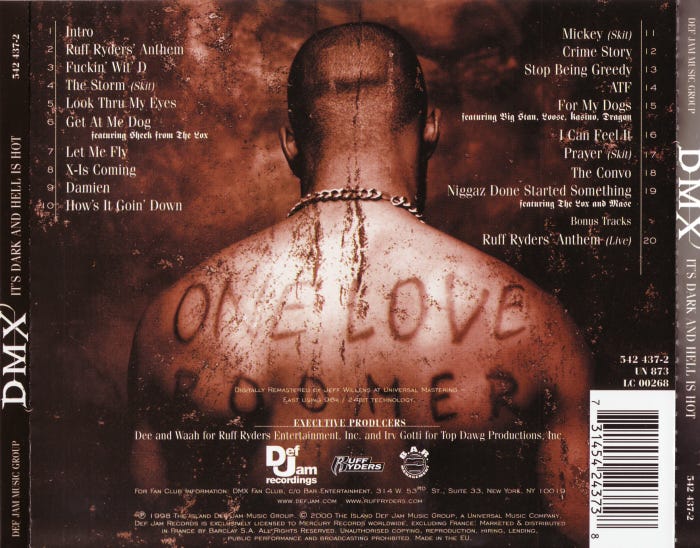
The album that followed, It’s Dark and Hell is Hot, was inescapable for the better part of 1998. It was every bit as likely to be heard blaring from a low rider in Los Angeles or slab in Atlanta as rumbling from beneath a pair of headphones on the New York City subway - a herculean feat on the tail end of an era marked by regional rivalries. Despite being unmistakably New York in its production, the album connected because of DMX. His rawness, his bombast, his aggression tapped into something universal. It opened the flood gates for us to flex again after a year and a half of shiny suited indulgences and booty-shaking escapism. Through him, we were once again invincible.
But DMX’s aura of invincibility was different from that of previous rap superheroes. His power came not from having conquered, but from the struggle itself. That struggle was ongoing and all too real. As 1998 wound to a close, he surprised the world by dropping Flesh of My Flesh, Blood of My Blood, his second album in 8 months. Even more surprising was the lead single, “Slippin’,” a gut-punch of a deep dive into DMX’s tumultuous past and ongoing battle with depression. Despite the slow tempo and pensive aesthetics of the track, DMX’s delivery is as intense as ever and he drags us through a struggle more harrowing than any rap battle or street skirmish. The song doesn’t end in a triumph, but rather a resolution to keep fighting.
It’s that combination of raw honesty and defiant resilience that kept audiences captivated by DMX long past his years of chart dominance. We knew he wasn’t perfect. We knew he was prone to backsliding. But he never stopped fighting.
In the end, DMX was not invincible. The very same demons he’d battled for decades ultimately claimed him at the age of 50. But he leaves behind a stellar catalogue of timeless music, a beacon of light shining through the darkness that ultimately engulfed him. His music will undoubtedly continue to soundtrack the struggle for future generations, empowering them to experience the feeling of invincibility, even if only for a fleeting moment.