
PSYCHELDELICS
DMT and the Search for Meaning
The Drug of a Generation
For those who have heard of it, DMT is a substance with quite a reputation. A member of the tryptamine family, DMT has a close chemical relationship to psilocybin, the primary psychoactive ingredient of “magic mushrooms.” But the experience that it offers varies significantly.
While the typical mushroom experience will last for a duration of three to six hours, DMT differs here. A typical experience with DMT will last little more than ten minutes. But according to many, condensed into these brief ‘trips’ are powerful opportunities for growth and self-examination.
Unlike psilocybin, DMT is an endogenous substance, meaning that it occurs naturally within our bodies. It doesn’t need a lab to be produced and it’s a substance that occurs throughout nature — but we’re not sure why. PhD candidate of the University of Michigan Nick Glynos explains that “science currently has almost no grasp about what DMT might be doing in the body, but the fact that it’s withstood generations of human evolution and remained a part of our own physiology to this day… suggests that it’s here for a reason.”
While the substance’s purpose is unclear, neuroscientist Christopher Timmerman at Imperial College London believes that the popularity of DMT speaks to the times in which we live.
“Because DMT gives you the full sense of emerging into an alternate reality, it is in a way resonant with the ‘spirit of the age’ — the need to escape our current situation,” Timmerman states. It doesn’t take a keen observer to notice that we’re living through tumultuous times; the climate is changing, a pandemic is still raging and we’re all glued to pocket-sized internet machines.
“[these visions] seem more tangible than everyday reality, which can feel more uncertain than ever right now. I honestly think the drug’s rise might have to do with a crisis of meaning,” he continues.
Oftentimes, proponents of psychedelics will liken a standard ‘trip’ to years, or even decades spent in therapy. It’s true that psychedelics can be powerful tools of introspection. Psychiatrist Stanislav Grof goes even further and argues that, “Psychedelics are to the study of the mind what the microscope is for biology and what the telescope is for astronomy.”
But where LSD and Psilocybin will affect the user for a six to twelve hour timespan, DMT is an experience that begins and ends within only ten to fifteen minutes. Its onset is immediate and within thirty minutes users will hardly be able to tell that they’ve taken a substance. Something that’s unique to DMT is the sheer brevity of the experience that it offers.
And yet, in many cases, these brief experiences can help people to reexamine their entire lives — even their place in the universe. They can help others to understand how small their worries are and reconsider their priorities. But even simply trying to explain why it does this for people proves tricky.
Another unique aspect to DMT is just how little of the experience can be adequately communicated. Psychedelic experiences can be notoriously difficult to describe, but the DMT experience for many is something that’s a challenge to even conceptualize.
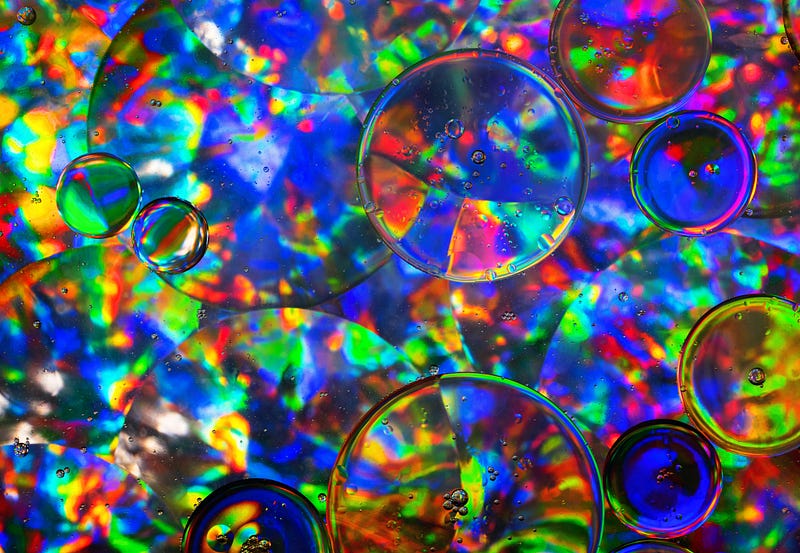
It’s hard for people to address any of the visuals encountered on this substance in ways that are very useful. But many have tried. According to Glynos, “Within less than 30 seconds of DMT ingestion, the user is catapulted through a visually immersive, kaleidescopic labyrinth of vibrant and shifting geometry, and then plunged into a seemingly alternate and otherworldly dimension — a realm of space that was previously unfathomable to the mind.”
It’s true that there’s usually a geometric element to what I’ve seen those few times I’ve tried it myself. But mere descriptions of it fall spectacularly short of capturing why these occurrences can be so meaningful for people in the first place. Language is the only mechanism that we have to make sense of these experiences, but language falls short.
I heard an analogy that may be useful here: if a caveman were suddenly transported from his time and into a city of the 21st century, he simply wouldn’t have the vocabulary to describe it. Back home, if he tried to explain what he’d seen to his contemporaries, he might be able to communicate that it was, “bright,” or that it was “large,” but, nothing of the sprawling towers in every direction, nor the billboards, the airplanes — nothing of the internet and nothing of the world lit up with electricity.
To make sense of the complicated world we’ve built around us would demand a vocabulary he simply wouldn’t have had. We don’t yet have the words to make sense of these puzzling places within our minds — the vessels on which these psychedelics act. It’s for exactly this reason that people struggle to communicate the value of these psychedelic experiences.
“Only the most intrepid can form any coherent impression whatsoever of what’s going on if it’s a strong trip,” explains renowned ethnobotanist, Terrance Mckenna.
It’s not unusual for people on DMT to report getting glimpses into the beyond — reunions with lost loved ones, confrontations with death and communions with deities. It’s simply bizarre to think that DMT is a substance that occurs on its own within nature. But it’s stranger still to think that this largely unrecognized substance is one that can be found within our own bodies.
It’s a fact that can hardly be overstated: the substance that offers one of the most profound psychedelic experiences known to man is something that’s innate to us.
“We’re all ‘holding’,” as McKenna points out.
Another feature to DMT that’s mystifying for many is its sheer ubiquity and accessibility.
“It’s just a long toke away for an ordinary human being!? How could something that titanic and beautiful and cosmic and alien be kept secret? [DMT] is more stunning than the rise of Atlantis… more appalling than the arrival of alien star fleets in the skies of our planet… and yet — it’s here…. The indescribable falls into [our] lap,” explains McKenna.
To those who have experience with the substance, it’s difficult to deny its therapeutic value. The DMT experience is one that speaks to the colossal randomness of being alive. It speaks to the unmitigated overflow of the people, places and things of our lives. It speaks to the very reasons we exist and our dire search for meaning in this impossibly strange universe of ours.
“The mystery of DMT deserves the attention of scientists, philosophers, psychologists, therapists and anyone trying to make sense of this situation we call reality… The presence of naturally occurring DMT in the body represents a great unsolved mystery and a tangible link between altered states of consciousness and human physiology… let’s determine if DMT, the only psychedelic known to be produced by humans, plays a role in the most fundamental mystery of science — human consciousness.”
— Nick Glynos
You know what costs just over 3/5 of a gum ball per day? Supporting the aspiring writer whose article you just finished! Additionally, by the powers vested in me, I’ll grant you unlimited access to the work of all the writers on this platform. All you have to do is sign up through this link here! Can you spare the equivalent of just over 3/5 of one gum ball per day? 🧐


