
Division of Labour Killed the Polymath
A story of one man, two swords, and ten thousand lessons
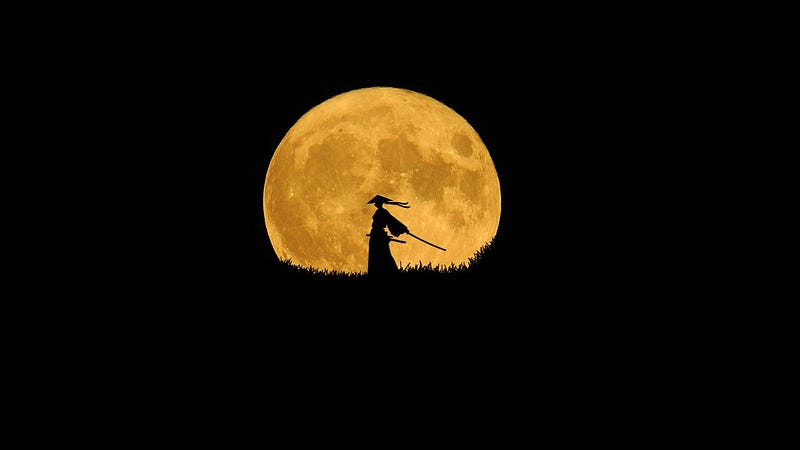
“From one thing, know ten thousand things. To know ten thousand things, know one well.” — Miyamoto Musashi
Musashi was a master swordsman. Probably the best that ever lived. His undefeated record of 61 duels is almost double that of the next contender. And they were not friendly duels. No, they were very often to death. Even those that weren’t, were often fatal. Musashi unintentionally killed a handful of opponents with wooden practice swords. He was so confident of himself, he faced his biggest rival in a match to the death with a sword carved from an oar. His technique was unique and original.
But what made Musashi special wasn’t his swordsmanship. Rather, his capricious approach to it. He famously took lessons from tea ceremonies, farming, and even painting. All of which revealed a new secret about swordsmanship that his opponents were unlikely to access. This was his edge.
“You must understand that there is more than one path to the top of the mountain”. — Miyamoto Musashi
Many of the greatest thinkers that ever existed — Da Vinci, Marcus Aurelius, Aristotle, Galileo Galilei—shared this edge. They didn’t specialise as the modern career suggests. Rather, they took a keen interest in diverse subjects and found breakthroughs in their intersections.
Alas, the age of the polymath is over. Division of labour killed them.
Today, specialisation is valued above diversity; the mastery of a single subject is considered more valuable than an eclectic grasp on the world. Which is interesting in of itself — all of the thinkers mentioned above, including Musashi, had an area of speciality despite being proficient in multiple disciplines. Da Vinci in art, Aurelius in stoicism, Aristotle in mathematics, Galileo in astronomy, and Musashi in martial arts. Yet they didn’t focus at the expense of other interests and often described how those pursuits paid dividends in their respective fields.
But why does casting a wide knowledge net bring in so much value?
The answer lies in abstraction. If there is one thing that humans are good at, it’s the abstraction of knowledge. Interestingly, abstraction is both the problem and the solution.
The problem is created when abstraction is at the expense of reality. We categorise things and introduce arbitrary separations in the process. But, truthfully, everything is connected. Not as some platitude, there is literally no separation between things. The interdependencies that are littered through nature are evidence of this.
These interdependencies exist because of the way the world evolved. Nothing is created, nor exists, in true isolation. Everything in the natural universe touches something else within it and, often, with an indispensable reliance. It is only due to its supreme complexity, and sheer expansiveness, that extinction doesn’t bring the entire system down. But it can’t occur without at least affecting several other components.
The only place separation exists is the mind of man.
It’s how we have come to categorise the world. It’s how we have come to create institutions and laws. It’s how we can learn and communicate. It is an indispensable aspect of knowledge transfer.
But this isolation doesn’t always come with a grounded representation of the relationships between abstractions. We miss a lot. It’s the price we pay for our place at the top of the food chain.
Polymaths intrinsically understand this. They are constantly searching for the principles that exist beneath the abstractions. And that is precisely where innovation occurs. It is seeing a connection that hasn’t been seen before. Innovation cannot exist in isolation either. Polymaths are skilled at abstracting the essence of one subject and apply it to another.
But how does this relate to Musashi’s quote?
He didn’t say “to know one thing, learn ten thousand things.” But, he points to the same truth from the other side. Both polymaths and Musashi are describing the relationships that exist between things. The connections, the interdependencies, the similarities, the patterns. They seek the principles beneath knowledge, that never change and apply broadly.
For me, evidence was discovered in the concept of free will. I spent years thinking about it. Trying to understand if it did exist, if it could exist. Until I realised that my perspective was wrong. It doesn’t matter if it exists or not. But our experience of it does.
I then realised that free will isn’t binary. It shifts as we do, expanding and contracting with our circumstances. It is connected to everything we experience. I had been thinking about free will as if it was deterministic. But it’s probabilistic. It isn’t definite, it’s relative.
Then I started to see the same pattern everywhere. The dichotomy between probabilistic and deterministic models existed as an underlying principle across multiple subjects. Emotions are probabilistic, yet reason is deterministic. Groups are probabilistic, yet individuals are deterministic. Creativity is probabilistic, yet the execution of that creativity is deterministic. Darkness is probabilistic, yet light is deterministic. The future is probabilistic, yet the present is deterministic.
Probabilistic models are potential. Deterministic models are existence.
The key here is to realise that neither is better than the other. Nor are they separate. Like yin and yang, they exist in some kind of cosmic dance, always in harmony but never the same. Probability gives rise to existence and existence to probability. Quantum theory agrees.
Which brings us back to polymaths. They do not specialise at the expense of everything, nor do they study everything at the expense of one. They leverage both in a symbiotic relationship, with dramatic results.
Musashi used two swords when he fought. Unlike his opponents, he realised that the katana, a samurai’s long sword, and the wakizashi, his short sword, could be used together to maximise the impact of defensive and offensive positions. He saw that a samurai had two hands that could be used for independent movements, but that these movements were more effective if they were connected in a rhythm.
Lessons from studying a drummer at a temple.
Sign up to our newsletter if you like these posts.