
Visual Frameworks
Dive Deep with the Iceberg Framework: A Visual Approach to Problem Solving.

What is the Iceberg Framework?
Systems Thinking is an “approach to problem solving which takes into account the overall system as well as it’s individual parts.”
The Iceberg Framework — shown below — is a systems thinking tool. It’s constituent parts help us to understand the problem, through origins, motivations, causes and beliefs.
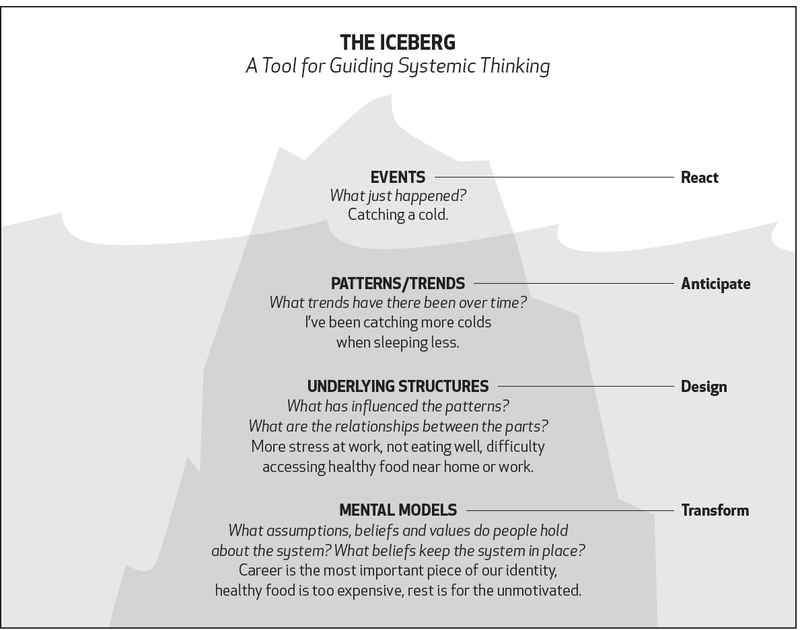
The constituent parts are:
- Events: What happened, what can be observed, what can be seen?
- Patterns / Trends: Are there recurring behaviours / patterns?
- Structures: Identify causes and influences, e.g. location, environment
- Mental Models: The beliefs and values motivating the behaviour
Let’s see it in action
I need a topic. Let’s go for a business topic, something current, global and happening now. The FTX trial fits the bill, I’m aware of the case, but not following it.
I chose the embedded Guardian article as it’s recent, lengthy with several timed updates.
The next step is to identify the constituent parts. I read the article and then used a prompt to categorise the parts. The prompt, results and a summary follow.
The Prompt
I prefer using Claude. I pasted the article into Claude, followed by the below prompt.
From the pasted text, I want you to produce a categorised bullet point list
identifying the events, patterns of behaviour, structures and mental models.

Below are definitions and examples of all four.

1. An event can be defined in the following ways:

- a thing that happens or takes place, especially one of importance.

- a planned public or social occasion.

2. A pattern of behaviour can be defined in the following way:

- a recurrent way of acting by an individual or group toward a given object or in a given situation

3. Structures looks at what's influencing the patterns, for e.g.

- PESTLE factors

- What are the connections between patterns?

4. Mental Models are values, beliefs or assumptions that shaped the structures.

Additionally create a category titled "Miscellaneous" for any items
in the pasted text that you weren't able to classify.

Explain why they are in the Miscellaneous category.
The prompt defines the constituent parts. There’s also a category for Miscellaneous — I wanted to understand what Claude considered irrelevant.
The Results
Events
- FTX exchange collapsed and went bankrupt
- Bankman-Fried testified at his criminal fraud trial
- Claims he did not commit fraud or take customer funds
- Admits to mistakes in risk management and oversight
Patterns of Behavior
- Bankman-Fried portrays himself as overwhelmed CEO
- Seeks to shift blame to Caroline Ellison and Alameda
- Claims deleted messages were standard practice
- Describes unorthodox living situation as accidental
Structures
- Cryptocurrency industry growth and lack of regulation
- Relationship between FTX and Alameda hedge fund
- FTX organizational structure and controls
- Executive decision-making processes
Mental Models
- Prioritizing innovation and rapid growth over governance
- Underestimating risks and need for oversight
- Assuming lawyers approved problematic practices
- Valuing unconventional approaches in startup culture
Miscellaneous
- Details about SBF’s personal relationships
- Minor details about courtroom logistics
Claude provided the following explanation for the Miscellaneous bullet points:
These minor personal and logistical details do not directly relate to analyzing the key events, behaviors, structures and mental models.
Summary
Overall, it’s a pretty good summary from one article.
Its given me the constituent parts, I can see connections between them.
By adding the “Miscellaneous” category to the prompt, I can also catch anything that could fall into either of the parts. In this case, I agree with Claude and it’s assessment of Miscellaneous, the below details don’t add anything to the story — for me.
Courtroom Logistics
- Bankman-Fried started testifying on Thursday
- The courtroom was packed with reporters and public
Personal Relationships
- He lived in a “nerdy” group house at MIT (personal background not directly relevant)
- Bankman-Fried chuckled when asked about his card shuffling habit (minor personal detail)
Actions
This is a great model for problem solving.
However, in this example, I’m using it to provide an overview.
I’m not a member of US legal or regulatory bodies, so I won’t be making legal judgements or precedents. I am an interested party though, with the information categorised, I can make my own judgements.
I recommend the following actions for your use case:
- Collate the information
- Use your LLM of choice to do the heavy lifting
- Update the prompt where needed e.g. the definition of events for your use case
- Review against your manual notes
- What did the LLM miss? What did it have that you didn’t?
Balanced research will be the benefit of using both manual and automated process. With your domain knowledge / interest you’re free to solve a problem or utilise the balanced overview.
Either way, the Iceberg framework is a worthy addition to your toolkit.
If you found the prompt in this post useful, check out my post on Chain of Density and the “Visual Frameworks for series”.
If you enjoyed the post, clap for it, highlight and share your perspective.


