
Distributed Bloom Filters: Scaling Modern Architectures Efficiently
In the era of big data and microservices, efficient data management is more crucial than ever. One tool that stands out for its efficiency and effectiveness is the Bloom filter, a probabilistic data structure that offers a fast and space-efficient way to determine if an element is part of a set. Let’s explore why Bloom filters are indispensable in modern software architectures, how they work, and how they can be implemented and used in a distributed system using Redis.
Introduction: The Brilliance of Bloom Filters
Bloom Filters offer a remarkably efficient way to check the presence of an element in a set, with a small trade-off in accuracy. Let’s take an example of web crawler, a tool designed to systematically browse and index the content of the web. Web crawling at scale involves managing millions, if not billions, of URLs. Keeping track of which URLs have been crawled and which haven’t is a daunting task, especially when considering the memory and computational overhead. Here, the Bloom filter, a space-efficient probabilistic data structure, shines by allowing web crawlers to quickly and efficiently determine whether a URL has already been visited.
The Algorithm Behind Bloom Filters
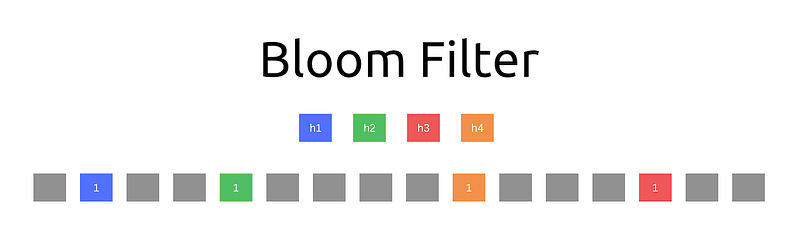
At its core, a Bloom filter is a bit array of m bits, all initially set to 0. It uses k different hash functions, each of which maps some input to one of the m bit positions. Here’s how it works:
- Adding Elements: When adding an element, the Bloom filter computes all
khash functions on the element and sets the bits at the resulting positions to 1. - Checking Membership: To check if an element is in the set, the filter computes the same
khash functions and checks the bits at these positions. If all bits are 1, the element might be in the set; if any bit is 0, the element is definitely not in the set.
The beauty of this system lies in its speed and space efficiency. However, it introduces a possibility of false positives but guarantees zero false negatives.
Guarantee of Zero False Negatives:
A false negative would occur if the Bloom filter says an element is not in the set when it actually is. However, by the design of the Bloom filter, this situation is impossible. Here’s why:
- When an element is added, the bits at the positions indicated by the hash functions are set to 1.
- These bits stay at 1; they are never turned back to 0 (in a standard Bloom filter implementation).
- Therefore, when checking for an element’s presence, if it has been added, all the bits at the indicated positions will still be 1, ensuring that the Bloom filter will correctly report that the element might be in the set.
Layered Approach: Because of this in-accuracy, Bloom filters are often used as an initial, quick check, followed by more accurate but resource-intensive methods if necessary. This two-tier approach balances efficiency and accuracy.
Central Bloom Filters in Microservices Architecture
In a microservices architecture, where services are often distributed and need to share state or data, a central Bloom filter can be incredibly useful:
- Shared State: A centralized Bloom filter allows different services to check data without maintaining their own copy of the entire dataset.
- Scalability: It supports horizontal scalability as services grow and demand increases.
- Network Efficiency: Reduces network overhead by preventing unnecessary data requests across services.
Implementation and Explanation Using Redis
Redis, with its support for bit arrays and atomic operations, can be an excellent choice for implementing a distributed Bloom filter. Below is a simplified Node.js implementation using Redis:
const redis = require('redis');
const crypto = require('crypto');

class RedisBloomFilter {
    constructor(redisClient, key, size, hashCount) {
        this.client = redisClient;
        this.key = key;
        this.size = size;
        this.hashCount = hashCount;
    }

    _hash(item, seed) {
        const hash = crypto.createHash('md5');
        hash.update(item + seed);
        return parseInt(hash.digest('hex').slice(-8), 16) % this.size;
    }

    async add(item) {
        const pipeline = this.client.pipeline();
        for (let i = 0; i < this.hashCount; i++) {
            const position = this._hash(item, i.toString());
            pipeline.setbit(this.key, position, 1);
        }
        await pipeline.exec();
    }

    async contains(item) {
        const pipeline = this.client.pipeline();
        for (let i = 0; i < this.hashCount; i++) {
            const position = this._hash(item, i.toString());
            pipeline.getbit(this.key, position);
        }
        const results = await pipeline.exec();
        return results.every(([err, bit]) => bit === 1);
    }
}

// Usage
(async () => {
    const client = redis.createClient();
    await client.connect();

    const filterSize = 1000;
    const hashFunctions = 4;

    const urlFrontier = new RedisBloomFilter(client, 'url-frontier', filterSize, hashFunctions);
    await urlFrontier.add('https://example.com');
    console.log(await urlFrontier.contains('https://example.com')); // true
    console.log(await urlFrontier.contains('https://another-example.com')); // false (most likely)

    await client.quit();
})();
How This Implementation Works
- Redis Client: We use a Redis client to interact with the Redis server.
- Bloom Filter Operations: The
addmethod sets bits in the Redis bit array, and thecontainsmethod checks if the bits are set. We use Redis'setbitandgetbitcommands for these operations. - Hashing: The
_hashmethod generates hash values for the given item, which are used as positions in the Redis bit array. - Pipelining: To improve performance, especially when multiple Redis operations are involved, we use Redis pipelining.
Use Cases
Bloom filters are versatile and have various applications:
- Web Crawling: Avoid re-crawling the same URLs.
- Cache Checking: Quickly check if data is in cache before expensive database lookups.
- Fraud Detection: Check if a transaction is potentially fraudulent.
- Network Security: Identify known malicious IP addresses.
Conclusion
Bloom filters are a powerful tool for modern software architectures, particularly useful in distributed and microservices environments. Their ability to quickly check membership while being space-efficient makes them ideal for scenarios where performance, scalability, and efficient data management are priorities. Implementing a Bloom filter using Redis further enhances these benefits by providing a robust, scalable, and easy-to-use platform for managing shared states across various services.


