
Distance Learning? Virtual Classroom? Online Classes?
Call it whatever you want, but for teachers, students, and parents, it can be a nightmare. There may be hope…
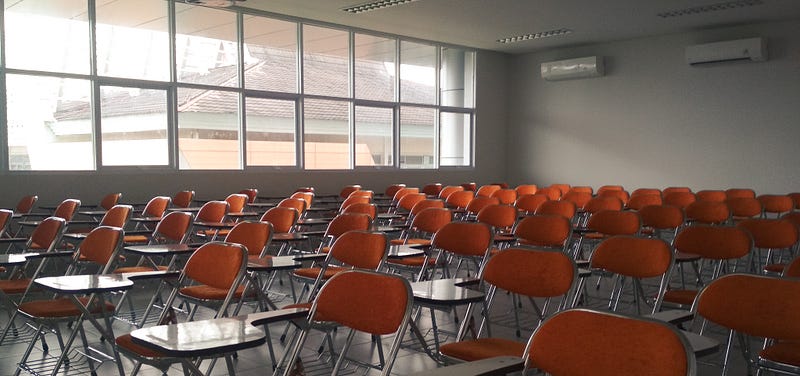
K-12 schools around the USA are struggling — to be, or not to be — open or closed — or somewhere in between. Reopening efforts have resulted in several hot spots of COVID-19 infections. Most K-12 schools are opting for distance learning or some sort of hybrid model.
The re-openings come with risks that cannot be ignored.
One of those risks is betting distance learning can substitute for in-classroom learning.
If you haven’t experienced modern distance learning (aka online classes, virtual learning, remote classroom, etc.) as a student or teacher, you might be surprised to learn it isn’t a blanket-solution for learning — or teaching.
If you have experienced modern distance learning, you’ve probably realized it isn’t a one-size-fits-all proposition, with no guarantees regarding success.
Many colleges and universities offer some online degree or certificate programs. These programs tend to work well, but they are designed for college-level students. For people that already have a job but want to enhance their career potential or meet continuing education requirements, this may be an attractive option. This option might also work for some disabled or geographically dispersed people since physically showing up on campus is minimally required. The costs might be (a little) easier to stomach.
Technology is broadly employed to enhance modern distance learning and fundamentally enables it.
Physical textbooks may be necessary, but the course materials (documents, images, lectures, and videos) are often accessed online as needed and downloaded to the student’s computer.
Students receive assignments through internet-based applications called Learning Management Systems, such as Google Classroom and Clever. Student work is submitted online for evaluation, grading, and feedback. Teaching staff can hold office hours via the internet. Email is a communications lifeline. Zoom, Meet, Skype, WebEx, etc. are used for real-time interactions such as class meetings, group exercises, and lectures.
Then Along Came the Coronavirus Pandemic
K-12 schools across the country closed down, and distance learning exploded onto the scene with schools and teachers all scrambling to put programs in place to complete the last couple of months of the 2019–2020 school year, meanwhile praying the 2020–2021 school year wouldn’t be affected.
That prayer (so far) is largely unanswered.
Distance learning is a challenge because teaching and learning are complex. We all sense this, but the devil is in the details.
In a K-12 system, the vast age-range of students and subject areas creates a complex web of needs. The cycle of teaching and learning is interactive and benefits from in-the-moment formative assessments that are difficult to achieve in distance learning. Differentiated instruction for students who are second language learners or have other supports in place in a brick and mortar building do not easily transfer to online platforms. Learning is collaborative — we want students to build language and social-emotional skills as they learn, and this looks extremely different and has different results in a virtual environment. The opportunity for collateral learning may be compromised. Effective distance learning is not impossible, but it is complicated.
“Perhaps the greatest of all pedagogical fallacies is the notion that a person learns only the particular thing he is studying at the time. Collateral learning in the way of formation of enduring attitudes, of likes and dislikes, may be and often is much more important than the spelling lesson or lesson in geography or history that is learned.” — John Dewey, Experience and Education
Abruptly disconnected from their school-life, about 50 million K-12 students face a gigantic rift in their social and academic lifestyles.
Around four million K-12 teachers face a teaching environment most had never experienced. Some had some training and experience in distance learning, but by and large, they were conventional classroom teachers.
Welcome to distance learning (and distance teaching). Let’s explore a bit.
While most colleges also closed down, impacting the educational opportunities of even more students, my focus here is K-12. Of quick note: there is a growing wave of college students demanding refunds owing to lack of access to on-campus instruction and other resources. As the pandemic has extended into the Fall-2020 school sessions, tuition discount demands are increasing.
I conducted some casual research. I spoke with K-12 administrators, teachers, students, and parents to get a sense of their perspective on distance learning. I asked them to articulate some pluses and minuses regarding distance learning. As you might imagine, the answers varied, sometimes humorous, at other times, quite serious.
Not being able to see your boyfriend in English class is not (quite) a disadvantage. Being able to play video games while listening to a lecture is not (entirely) an advantage. Not having reliable internet access is a disadvantage. Being allowed to work at your own pace could be an advantage. Not experiencing the social aspects of campus life is a significant disadvantage.
Not being able to go to work because you have to stay home and care for your kids and monitor their distance learning activities could be a disadvantage. Working from home could yield a big win-win. Being a stay-at-home MOM or DAD could be advantageous. Not having to drive your kids to school or pay for their bus service: advantage, maybe.
Not having much-needed access to the school lunch program is a disadvantage.
Not being able to see the confused look on a student’s face when they don’t understand something is a definite disadvantage. Having one-on-one contact with students, even if only through email, has its advantages. Not being able to observe the student as they complete an in-class assignment is a disadvantage. Having a lot of flexibility in your schedule is probably an advantage, but also perhaps a necessity.
Not having and not able to afford internet access and the requisite computer hardware is a major disadvantage.
Having to rapidly adopt, adapt, or develop a K-12 distance curriculum, train teachers and support staff in it, and then somehow make sure your schools fulfill their obligations to their students isn’t a disadvantage — it’s just a list of herculean tasks. Finding the funding for all of that is another challenge.
Those paragraphs are just the tip of the iceberg. There are myriad issues to be faced in distance learning. Some are technical. Some are just plain human.
Not all subject areas, or areas of subjects, lend themselves to distance learning.
So I shoveled all that information through my mental-grinder and arrived at a few conclusions. While not precisely scientific, I believe them valid and, of course, welcome any comments.
Please note that getting into a discussion about formative or summative assessments, or differentiation strategies in a distance learning environment, while assuredly important, is way beyond the present scope.
It All Depends
Let’s start with the students. After all, this is all about them and their education. Let’s assume (yeah, I know) the students want their education.
It all depends on the student’s age, maturity, grade level, learning ability, technical abilities, self-discipline, access to the internet, language proficiency (including at-grade reading ability), and their physical abilities. The subject area is a (huge!) consideration.
Should we even consider distance learning for younger students? Yes, absolutely, but in this case, many of the actual teaching functions transfer to the parent, with guidance from the teacher — more insight as we continue.
Speaking of the parent, let’s assume (there it is again) a parent is at home and available to assist their student in educational activities. Let’s also assume the parent is committed to their child getting an education. If you’ve ever wondered what it would be like to homeschool your child, here’s your big chance. The parent must take on the role of disciplinarian, and to a degree, the teacher. There are different perceptions, of course. There are more variables than readily perceived.
“Nearly Half of Men Say They Do Most of the Home Schooling. 3 Percent of Women Agree.” (Claire Cain Miller in The Upshot)
More mature and self-disciplined students can be very self-sufficient. Like traditional classroom settings, the parent is still obligated to monitor their student for attendance, assignments, work completion, grades, and periodically checking in with the student’s teachers to discuss assignments, achievements, grades, and opportunities for improvement.
If parental monitoring and communications are inadequate or neglected, negative consequences accrue. Distance learning increases the need for the quantity and quality of parent-teacher and parent-child communications.
It all depends on the parent’s availability, education level, commitment, technical abilities, language proficiency, and maybe even their physical abilities. Still prevalent are the child’s age, maturity, grade level, self-discipline, language skills, physical abilities, and access to the internet. The subject area remains a major consideration. If the parent is not knowledgeable in the subject area, they might have to become more proficient in order to help their child. Do you remember how to solve quadratic equations? Yeah, me neither.
Do all students require parental participation in the distance learning process? Yes. The younger the student, the more involvement required. It’s probably not possible to teach a 2nd-grader to read via the internet. Third-graders learn prepositional phrases. I (sort of) remember what they are. You? Those sorts of jobs will mainly fall to a parent. It isn’t much different than helping your kiddos with their homework. Kindergartners need pretty constant oversight as they navigate their activities. Regardless, the parent needs to establish a connection with their child and the child’s teacher(s).
It all depends on the teachers. Ideally, we wouldn’t assume anything about the teachers or their abilities. We wouldn’t assume, because we would know. We would know the teachers could successfully teach their subject areas via the internet as competently and effectively as they do in a classroom. That is, provided the subject can be taught remotely.
Today’s classrooms integrate various technologies to enhance educational processes. The technology tools available in the school have evolved over the years to become an integral part of the curricula. The teacher’s skills have kept pace with that technology, incorporating it into their teaching strategies and knowing how to use the technology as a result of their training and experience. Technology has enhanced the quality of education.
Guess what? All of that highly-evolved and integrated classroom technology is likely not available in the home of the teacher or student. Distance learning dictates a different set of technology tools, mostly very basic, but very necessary.
Again, it all depends on the parent’s availability, education level, physical abilities, technical abilities, commitment, language proficiency, as well as the student’s age, maturity, grade level, self-discipline, language proficiencies, physical abilities, technical abilities, access to the internet, and the subject area. The education of their children is at stake.
It has always rested on the students and their parents. You can lead a student to school, but you can’t make them learn.
The distance learning teacher becomes more of a process facilitator, a schedule juggler, a counselor, a mentor, and an administrator. And less of a babysitter. They still get to teach, but wow, what a difference a pandemic makes.
Whoops-damn! There’s an elephant in the room, right there. Let’s be nakedly realistic here: Some parents, certainly not all, send their kids to school so the parents can go to work and earn a living. That’s great — I get it. The parents expect the school will take care of their child during school hours. Schools and teachers do a fantastic job, day in & day out, throughout the school year. Let’s not forget the bus drivers and mechanics, crossing guards, custodians, counselors, librarians, nurses, food service staff, secretaries, coaches, teacher assistants, special education staff, technical support staff, security, and school administrators (and a few I’ve probably forgotten to list). It truly takes a village.
It all amounts to a vast, under-staffed, expensive, fairly well-oiled, tightly regulated, reliable, and centralized babysitting machine.
Coincidentally, the child gets to learn something in the process. Indeed, this varies from student to student and from parent to parent.
I don’t want to take anything away from teachers or the teaching profession. My limited experience as a teacher taught me that teaching is a beautiful calling. It relies on face-to-face encounters for effectiveness and quality. My experience has been that any learning or teaching environment that does not provide for real-time, bi-directional, face-to-face communications between teacher and student will compromise the quality and effectiveness of the educational processes. Meeting software like Zoom, Skype, WebEx, and Google Meet can effect an improvement but still leave the process wanting.
So What?
Much boils down to a big IF.
IF schools are permitted to reopen with students receiving the usual amount of interactive education, then possibly, maybe, perhaps, No Harm — No Foul. We would enter a “new normal” accommodating all of the restrictions this pandemic forces upon us: masks, distancing, uber-cleanings, daily health checks, and contact tracing. Sadly, it is possible some school programs would be suspended. Sports, band, drama, and dance all require close, constant, and intense physical interactions among students. Any after-school programs that regularly transport large groups of students to venues not controlled by the school might be unlikely to occur. Mandatory vaccination against the coronavirus, above a certain age, may be required for the student to attend school (when the vaccine is available).
Whoops-damn! There’s another elephant in the room. Given the first-hand, up-close-and-personal experience we’ve all had with this pandemic, I wonder how tolerant society will be of a parent’s right NOT to have their children vaccinated against a disease with proven fatality rates? This issue has been talked around for years. One way or the other, perhaps it’s time to put it to rest.
IF schools are not permitted to reopen or if they’re allowed only partially to reopen, then we enter a “new normal” with some glaring realities. A possible scenario would be students physically attending school only a few days a week, with the balance of school hours completed via distance learning. I haven’t quite been able to wrap my head around the impact this would have on the various support staff — it could be dire.
IF teachers lack appropriate training in distance teaching methods, technology, and curricula, they will be hamstrung from the get-go. Newer teachers may have slight advantages owing to their more recent techno-centric education experiences. A distance learning teacher training program would be needed, and support staff added for that program.
IF students, and by extension, their parents are technologically naive, those students may be at a distinct disadvantage. If they aren’t familiar with the basics of using a web browser, it’s an uphill battle. It’s a good thing we have all of those computer labs in our schools. Most students are exposed to computers and the internet very early in school. Still, it is possible some students and parents haven’t had the opportunity to become thoroughly steeped in the technology most of us take for granted. A distance learning technology orientation program for parents and students might be needed.
The internet truly enables much of our world. Without it, we likely wouldn’t be having this conversation because we’d be even more screwed than we already are.
IF the course materials for a particular subject area have not evolved to accommodate and utilize the unique aspects of distance learning, then students and teachers will struggle to succeed in that subject. Not all subject areas, or areas of subjects, lend themselves to distance learning. The fundamentals of reading, writing, and arithmetic are certainly a challenge.
IF a vaccine becomes available, will the school permit an unvaccinated student to attend? See above.
IF there is a second (or third) wave of virus infections, will schools be closed again? If so, guess what— full-time distance learning for all.
IF enough teachers (are willing to) return to the classroom, there might be enough teachers to go around. Remember, smaller class sizes could mean more teachers needed. It’s unreasonable to expect existing teachers to conduct three hours of classroom instruction that used to take one hour. Being a teacher is hard work, and they deserve compensation for their time.
IF enough parents (are willing to) return their children to school, it might all work. If not, then we’d be looking at some sort of hybrid education models that might work, but with many caveats.
Final Thoughts
Distance learning can work, as long as we understand its limits.
Basics First
The most common requirements have to do with the enabling technology of distance learning. Without this technology, neither the teacher nor the student or parent will be equipped for distance learning.
First, reasonably fast, secure, and reliable internet service is a must. Thank the fates we aren’t still using dial-up modems from yesteryear! When I say reasonably fast, I suggest a minimum of 10 Mbps (megabits per second) or more. Most Cable TV internet services are well above this, but rural areas where Cable TV is not available may struggle. All the trappings that go along with an internet connection are also required: modem, router, cables, wi-fi setup, etc. Rural areas underserved by internet service providers (ISP) will be especially hard-hit. New internet service technologies on the near horizon will hopefully address this issue.
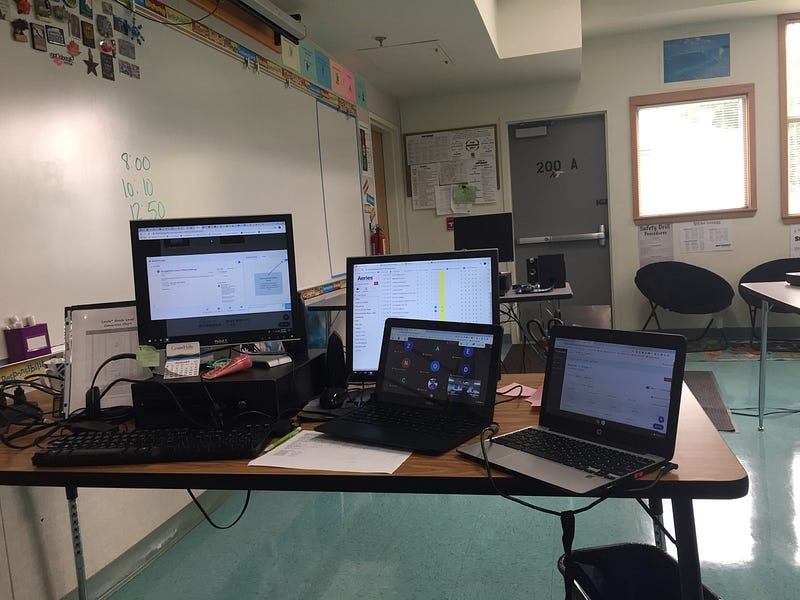
Second, the student and teacher need a decent computer. Some teachers may need multiple systems, like the above-pictured teacher work area. This teacher literally uses all four systems continuously throughout their distance teaching day.
My definition of “decent” in this context is a system manufactured after 2014. I know, I know, I know. Yes, that computer that your grandmother gave you in 1999 still works just fine. But not for the rigors of distance learning.
Get a modern Windows, Mac, or Chromebook system. It may be that your existing system just needs a little more memory or a newer monitor to optimize it for distance learning. Older systems will almost always create challenges, simply because they’re old or have limited capacity. Talk to your “computer guy” about it if necessary (everyone has a “computer guy,” right?). If you cannot afford a computer system or internet service, contact your school district. They may be able to assist you.
I generally recommend Chromebooks, primarily because of their lower cost, ease of maintenance, and web-centric focus.
Third, all the accessories that usually go along with a full-fledged computer setup. That would probably include a printer, a mouse (or trackpad), speakers, a webcam, a microphone, and an appropriate-sized desk/table to support it safely. Most laptop and Chromebook systems will have a trackpad, a webcam, speakers, and a microphone built-in, so you might simplify things by going that route. If multiple individuals are studying in the same area, earphones or earbuds, preferably with an integrated microphone, are a must. If you can afford them, I highly suggest noise-canceling models.
Fourth, a dedicated space for distance learning or teaching functions. For teachers, this might be their existing classroom. It’s not full of students, so why not use it? For students, this is a tough one. Ideally, it should be away from the areas where they normally experience entertainment, like movies or gaming. Eliminating distractions to their education is really important. This should include removing access to their phone during school time, except for breaks and lunch, of course (just like being on campus). If the student uses the same computer for entertainment, social networking, and school, those other non-school functions shouldn’t be running during school hours. I’ll leave it to the parents to enforce that rule (yeah, good luck).
Fifth, funding for all of it, and especially for the exceptions. Nothing is free, and a lot of families can’t even afford free. They are, to put it mildly, poor. If a student’s family cannot afford a computer, the school district should give them one. My local school district has issued hundreds of Chromebooks. The same goes for internet service for the student AND the teacher. Some of the local cable companies have made internet service available for free or very reduced pricing for students on the National School Lunch Program (NSLP). I feel school districts should pay for their teacher's internet access. Or at least, maybe a stipend of some sort (assuming the teacher is working from home). It’s also my hope that places like Starbucks with amazing Wi-Fi service would be willing to allow students to use that Wi-Fi for schooling (that’s what I call community service). Other businesses with Wi-Fi? You bet! It really does take a village.
Please, let’s not forget our special needs students. They and their families are deeply impacted by the pandemic — more so than many of us. School districts will need to address each student’s needs individually. Providing them with educational and support services is just as important today as ever, perhaps more so.
Sixth, support for it all. Other than dollars and cents, it takes a concerted effort to support distance learning programs and underlying technologies. That might mean beefing up the school district’s IT resources so they can take support/trouble calls from students and parents. Normally, a school district only supports (and has extensive control of) computer systems and networks operated and provided by the district. A teacher or other staff member usually initiates support/trouble calls. Now, instead of campuses populated with the equipment specified by the school district, we have entire communities populated with an unimaginable variety of hardware and networks. This diaspora of computer hardware and networks necessitated by distance learning will require support and a lot of it.
In Summary
I know I’ve probably barely touched on all the issues surrounding distance learning and distance teaching. My purpose here was to create an awareness of the challenges we’re facing in this endeavor. A lot of this is uncharted ground, and we’re learning as we progress — and probably making some mistakes along the way. But I believe it can work, given the right ingredients.
My heartfelt thanks (and sympathy) goes out to all the teachers, students, and parents that are essentially guinea pigs for much of this effort. Even more sympathy goes out to all the teachers and students that cannot perform on stage, dance, cheerlead, play in the band, engage in sports, or be around your campus family and friends.
Like so many other aspects of this pandemic, we will get through this and be better for it if we all work together.
What can you do?
First of all, trust the process. Contribute to it if you have resources that will help. It’ll have wrinkles, for sure, but it will evolve to the point where, maybe, we’ll wonder why we weren’t doing this all along.
Secondly, don’t be afraid to ask questions. Visit your school district’s website to learn about what is needed for their distance learning to work for you.
Thirdly, take a moment to thank the teachers and administrators that have busted their butts all summer to make it happen.


