
Distance
Space and Individuality
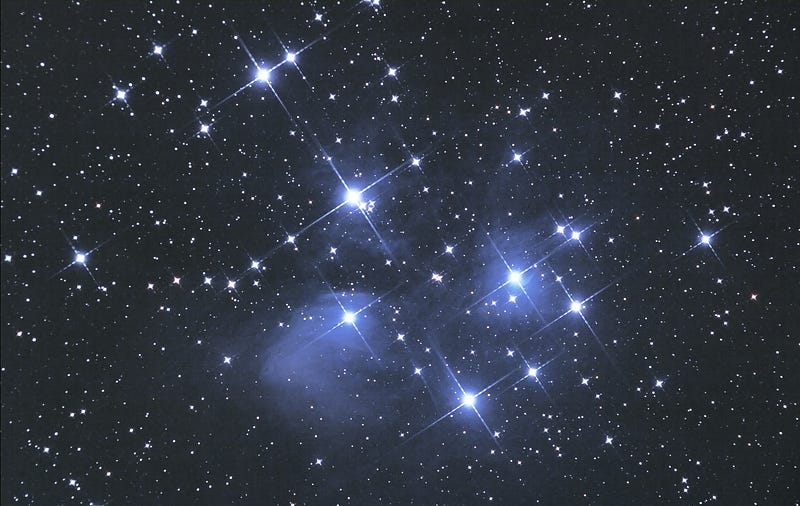
Space exists to introduce and interpose Distance
Were there no space, we’d all be in the same no-place.
And to be honest, I think that’s where we all began. Pre-dawn, that is; for I believe that the Chandogya Upanishad (at 6.2.1–3) hit it right on the nail when it sang:
“In the beginning, this world was just Being [i.e. Brahman] — one only, without a second. And it thought to itself ‘Let me become many; let me multiply myself.’”
And darn, if it didn’t, and very successfully at that. A decision that still stands (and walks, and runs, and thinks and holds water).
Yes, were there no space, we’d all be in the same no-place. And then, who could tell us apart? Or better still, would there be any apart to tell?
Although I know that the ultimate truth cannot be “thought” or conceived of analytically — for it transcends the thinking mind — when I go (and think) as far as mind allows me to go the Upanishads make perfect sense to me: Atman (the true “individual” Self) is Brahman (the “universal” Self) is Atman is Brahman is Atman is Brahman… I first encountered this thought-view in 1968 and it rang true then (I believe this, I thought: This is true) and it still rings true today.
Of course, when you read and reflect on what Gotama Buddha taught, the principle of Anatta (the teaching of “non-self”) — you get the feeling that he disagreed, strongly and specifically at that, with the Upanishads.
To quote Sue Hamilton from her excellent 1995 Paper “Anatta: A Different Approach”:
“Buddhism has often been said to complicate the attempts of scholars of religious traditions to find common defining characteristics of ‘religion’. One of the difficulties is that unlike all the other major religious traditions Buddhism is not concerned with the existence of a creator God.
“Furthermore, it is frequently pointed out that it does not accept the existence of an individual self or soul: it teaches a doctrine of anatta, usually translated as ‘no-self’.”
The first time I came across this teaching and concept I revolted — No, no, that can’t be true. I exist. I am an individual. I am eternal. We exist. We are individuals. We are eternal. What on earth is he (the Buddha) talking about?
Hamilton then goes on to ask (the very pertinent) question: “If there is no self, what is it that is saved?”
Well, the Buddha was never asked that specific question, but he was asked similar ones, all concerning the existence or fate of individual selves, all of which he refused to answer (thinking, I gather, that nothing he could say would improve upon the silence) — questions now known as the “classical unanswered questions”.
Hamilton then goes on to stress that Gotama Buddha’s focus was always purely practical (Buddha was an engineer, one could say): he focused solely on how things worked (not on how things are or were) and, based on that, what to do to get out of this mess.
I want to point out that the Buddha never said that there was no self, nor did he say that there was a self, he considered those questions and debates as distractions from what had to be done to reach liberation.
Or as Hamilton puts it: “We might tentatively conclude at this stage, then, that the most important thing to understand in order to attain liberation is how things operate.”
Again, I envision Gotama Buddha as the practical engineer who doesn’t have time for speculation, the practical engineer who, through his own enlightenment, had discovered how things worked — whether you were a self or not had no bearing on that equation.
Later on in the same paper, Hamilton says that, “the Buddha never answered any ontological questions because they were not conducive to attaining liberating insight.” Yes, the ever-practical engineer.
She then goes on to stress: “The doctrine of anatta [non-self] simply states that the manner in which human beings exist is not as independent selves.” [my emphasis].
Of course, the Buddha was also human; he wanted to engineer human freedom, and he did. He divined and designed the path to Nirvana, which, incidentally, as Hamilton puts it, “is stated to be unconditioned because it is the cessation of thinking in terms of self.”
In other words, the cessation of being so uniquely and intensely human.
Still, I hold with the Upanishads that ultimately there are no individuals, that we, at the very core are (or is, more correctly) not individual atmans, but simply Atman — just another word for Brahman.
And I hold that, as Robin Williamson puts it so simply in his wonderful song Job’s Tears: “All will be one.”
Amen to that.
As an interesting aside, even L. Ron Hubbard, the Scientology founder who vehemently disagreed with both the Buddha and the Upanishads and always maintained that we all are individual (and very eternal) spirits — always have been and always will be — states in his 25th Axiom that: “Affinity is a scale of attitudes which falls away from the co-existence of static [i.e., spirit], through the interpositions of distance and energy, to create identity, down to close proximity but mystery. [My emphasis].
What he (inadvertently, perhaps — a slip of the ego-tongue) concludes in this axiom is that identity (i.e., individuality) did not exist prior to the very introduction of distance, which is to say, before the birth of the Universe and its introduction of space.
Again, amen to that.
© Wolfstuff


