
Dislike Counts Are Finally Gone From YouTube: A Very Good Decision
But I ask one more change from YouTube.
No wonder if you’re also disappointed with YouTube’s recent decision of removing dislike counts from the videos. After all, it has been our go-to weapon to show our criticism towards bad videos.
On the internet, I’ve seen almost everyone talking about it is just criticizing this step. Even a very popular content creator on the platform — Marques Brownlee aka “MKBHD” has also made a video expressing his disagreement with this decision.
Users are complaining that this change limits their freedom of expression, it censors their opinions and disagreements with some videos on the platform.
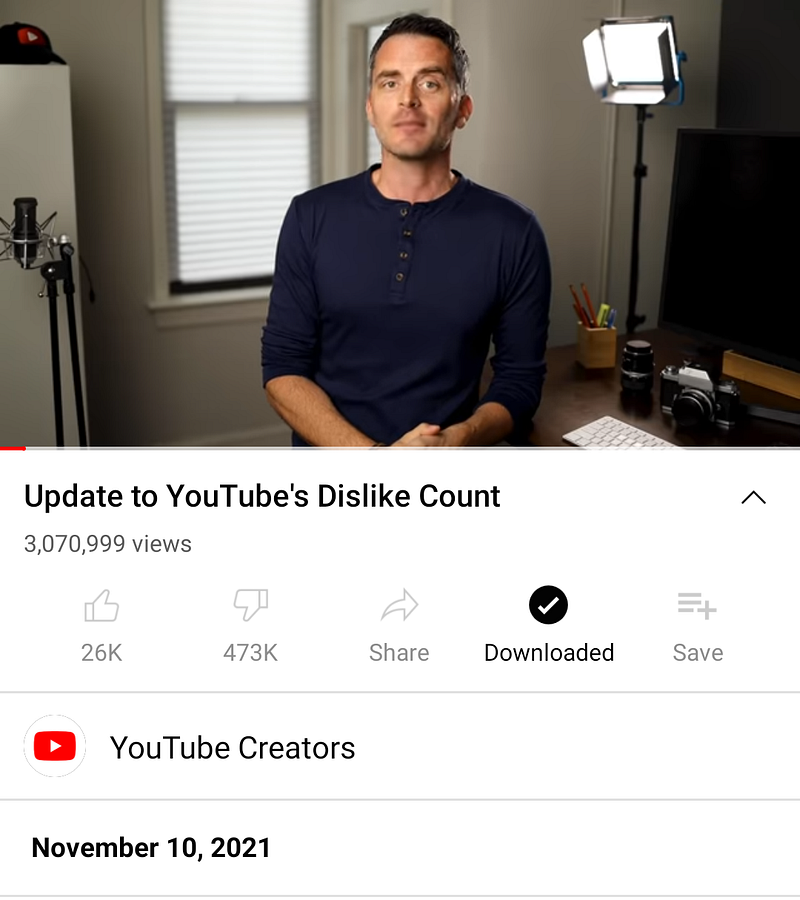
Even the video announcing this update on an official channel of YouTube Creators started getting mass dislikes from the viewers. Currently, this video has 473K dislike in comparison to only 26K likes.
YouTube’s co-founder Jawed Karim also condemned this decision by changing the description of his very old and popular video, “Me at the zoo.”
In favor of the dislike button, he said, “The ability to easily and quickly identify bad content is an essential feature of a user-generated content platform. Why? Because not all user-generated content is good.”
Then he warned YouTube “The process works, and there’s a name for it: the wisdom of the crowds. The process breaks when the platform interferes with it. Then, the platform invariably declines.”
And at the end, he wrote one line which is not something that only YouTube should consider, but also other businesses can learn from it— “In business, there’s only one thing more important than “Make it better”. And that’s “Don’t fu*k it up.”
While everyone seems against this change, I’ve some mixed thoughts about it.
YouTube is going Apple’s way.
YouTube is a commercial platform. Every video is a product. And every single user is a consumer.
So here you can definitely ask — shouldn’t YouTube ask its users before making this type of change?
Then here comes the unofficial philosophy of Apple, “users don’t always know”.
Many times, not everyone can see and think in a way that some individual people can do. Otherwise, every single decision would be taken by creating a poll and voting system.
Most people think in an ordinary and simple way. Only visionary people can see things from different angles. Hence, many times it’s just a better idea to not ask everyone.
Sounds stupid and manipulative? Let's look more into it.
The dislike button already was a failure.
The like and dislike buttons were introduced in 2010.
Before that YouTube had a star-based rating from 1 to 5. But as most people were using only 1 star and 5 stars, they finally switched to the like/dislike buttons.
But even this mechanism wasn’t helping much in stopping click baits and crap content. The dislike button was doing much more harm than good.
If you’re not getting BS videos on your YouTube wall, then you must have a very good test in watching.
Otherwise, if you just try searching for some nonsense content or watching enough of that crap, you’ll see the real garbage hiding behind and easily getting away with millions of views and making thousands of dollars.
There are countless videos on the platform, especially in the entertainment category which are very low in quality, problematic, and misleading. Even though, those videos don’t have any significant number of dislikes on them.
Why? Because mostly it is being watched by the audience who either likes that type of content or is a fan of that creator.
On the other hand, small creators who are just starting out were getting targeted because of reasons like they don’t look confident enough, don’t have sophisticated equipment to shoot videos, and lack enough experience.
While most people who produce rubbish videos anyways don’t care much about likes and dislikes on their videos.
Also, many times people were mass disliking just because they hate something without any proper reason.
In a fan war that took place between YouTube fans and TikTok fans in India in 2020, fans from the YouTube side started mass disliking the recently uploaded video of one of the popular TikTok creators on his newly created YouTube channel.
Eventually, that video ended up becoming one of the most disliked videos in the country. Although apart from his previous mistakes and controversies, that video specifically didn’t have anything wrong in it.
You might say, but they do have an option to turn off the like/dislike buttons, why don’t they just use it?
If they disable the like/dislike buttons, then the chances get even higher that they’ll be harassed even more thinking that they got scared. And they might also lose out on engagement and get punished by algorithms.
Also, if you check out Apple’s Official YouTube channel, then you’ll see their most videos have so many dislikes just because people hate the company and have a love for different OS or brands.
Also, I’ve seen many creators getting attacked by dislikes by their own crazy fans when they tried creating something different than usual.
These types of incidents suppress and discourage creators from experimenting with their content and style. And ultimately people-pleasing becomes a must-do thing to sustain on the platform.
Hence, I think, it might be a good idea to just remove it.
Not everyone thinks individually. Many people go by others’ opinions and what a crowd is saying about it.
Even there is a term for this behavior called “Herd Mentality”.
When someone sees a huge dislike count on any video, his/her interpretation automatically changes according to that.
Now, rather than understanding and analyzing the video on their own, they’ll start looking for the problems inside it.
This destroys the whole purpose of individual thinking and seeing something from multiple perspectives.
A person might not have reacted in the same way he did after seeing how others have reacted to it.
The situation becomes more pathetic when there is no space and tolerance for any other perspective.
So, I hope this change will encourage people to watch videos with individual thinking and help make enough space for different perspectives and experiments.
People will find a way.
The real place where the dislike count was helpful was in problem-solving videos, tutorials, and how-to videos.
I’m a programmer and whenever I get stuck in problems YouTube becomes the rescuer.
Not only for programming but whenever I’ve something to fix or need reviews of any product or service, I search on YouTube.
But in search results, not all videos are good and helpful.
Many of them are uploaded just for the sake of making money. Some are pure clickbait. While others are good but don’t actually solve my specific problem.
At this moment likes-to-dislikes ratio becomes a helping hand in filtering out those useless videos and saving our precious time.
But now, the dislike count is no longer available, so what is next?
Every time anything new happens in anything we mostly think about it using our older perspectives. And it always concerns us for its potential repercussions.
But with new changes, the psychology and other associated factors also get changed.
So, I think people will find a way around the new change to figure out if the video is worth watching or not.
One of the possible ways is obviously a comment section.
If someone doesn’t like anything about the video or finds anything wrong with it, then he/she will write a comment explaining a problem in detail. If the video really has such a problem in it, then the comment will get more support from viewers and eventually become a top comment helping forthcoming viewers.
I know it’ll take more effort and time than just simply having a dislike count in front of your eyes. But I think YouTube wants you to do it.
View count is also a big parameter people consider before watching videos. And with this change, I feel that the user interaction with the like button will increase, and the likes-to-views ratio will become a new deciding factor for viewers.
And in the case of finding some serious problematic stuff in any video, reporting it is a more effective option to use than the dislike button.
The dislike button is going to stay there.
After the news of dislike button removal, I was wondering that now how creators will get to know how their audience has reacted to their content. Because many times viewers’ reactions can also help creators make meaningful changes to their content.
But in the official blog of YouTube, they’ve mentioned that the button is going to stay there only the dislike counts won’t be available to the public. Although, the creators can still access the exact number of dislikes in their YouTube studio if they intentionally want to.
So now, if someone truly wants creators to improve their content, they can still press the dislike button.
But if someone wants to dislike it just to drive up the dislike count publicly and make a creator feel humiliated, then from now onwards this step will stop their evil fantasies from fulfilling.
What concerns me now?
Now what really concerns me as a viewer and consumer is that the increase in clickbait and irresponsible content on the platform.
Dislike button was working as a police officer on the platform. It was giving a mental reminder to creators of “what could go wrong” if they’ll upload any irresponsible and objectional stuff.
But now I don’t know if that reminder exists anymore or not.
What I’ll personally miss about the dislike button.
I don’t know how exactly the dislike counts have been helping me in improving my understanding, but I think generally every type of meaningful data helps us improve our intelligence.
If the dislike button doesn’t tell much about the video, it definitely helps us understand how people react to different types of things.
It also helps aspiring and existing creators make decisions about what type of content they should make, what mistakes they should avoid, and which ideas are good for their next experiments.
Although, the actual main reason might not be to protect creators.
YouTube officially has said that they’re making this change to protect creators, especially small creators from harassment and targeted dislike attacks from a specific group of people.
They also said they have heard directly from creators that how dislike counts are negatively impacting their wellbeing.
But if those are the actual reasons, then it doesn’t make much sense because the comments section is still there. And we all know that real harassment happens there.
From that, it seems that YouTube wants to protect its own platform more than to protect creators' wellbeing.
The dislike button has always been a troublesome thing for brands on the platform and for the platform itself.
There are not many popular platforms that have the dislike button or any similar type of mechanism except reporting. And now finally even YouTube is getting rid of it.
In past, we’ve seen many brands getting massive dislikes from users on their product’s launch videos, advertisement videos, or any other type of videos. Nintendo Switch’s recent Online Expansion Pack trailer video was the recent victim.
If the brands disable the like/dislike buttons, then people doubt them even more and it can negatively impact viewers' psychology. But if they keep them then they will get bombarded with dislikes.
These types of situations and incidents make brands lose a lot of sales and money.
Hence, other platforms like Facebook and Twitter become the more preferred options over YouTube for brand promotions and advertising products. This ultimately makes YouTube lose so much revenue.
So from now, even YouTube be like — Positive vibes only.
The real problem lies here.
As I said earlier, the comments section can really be helpful in deciding should you watch the video or not.
But here, one important thing remains hidden from the public.
YouTube provides a lot of options to creators to moderate comments on their videos and channel. But these options are something that also can be used to manipulate the comments section and public views.
YouTube provides an option to delete specific comments and even to completely stop every comment from specific users from public view. And here those users won’t ever get to know that their comments are being hidden from public view.
Also, there exist very advanced features like “Hold all comments for review” which gives creators the power to show only selected comments and manipulate the public view.
And the more stupid and problematic thing is — the viewers won’t ever be able to know that such modifications are happening with comment sections.
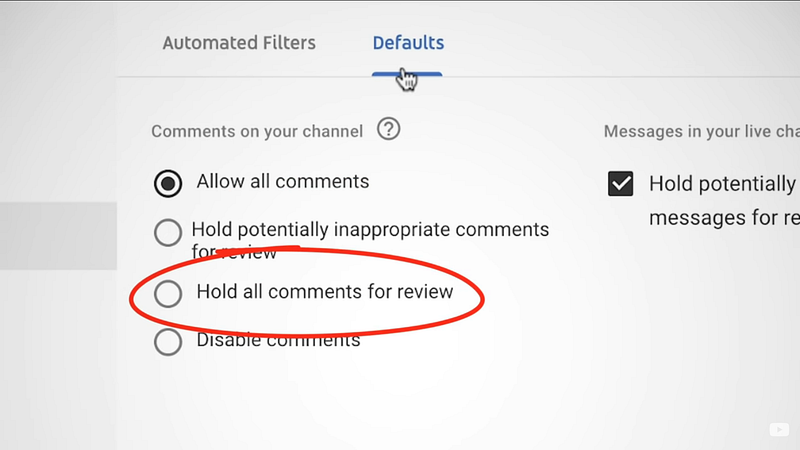
The solution: YouTube should either remove these types of features or at least add some sort of label that tells viewers that what types of moderations are being applied to the comments section and how many comments are hidden from public view.
And my final advice and request to YouTube.
Removing dislike counts might be a good idea, but it doesn’t solve all the problems. YouTube must think from the users' side as well.
YouTube must take strict actions towards stopping click baits and cleaning up the totally BS content from the platform. Just creating new policies and adding new rules every day won’t help.
There is a lot of objectionable and pathetic content floating around the platform getting away with millions of views and wasting brands’ money.
The real injustice and discouragement to meaningful creators happen when quality content gets suppressed by qualityless and effortless content.
Hiding something won’t help. If good creators won’t see any good results, then they’ll automatically move out of the platform. This will degrade YouTube’s brand value even further. And ultimately, there will be only spammers and crap creators left on the platform where no brand would like to invest their money.
I’m not saying this all because I hate YouTube. Instead, I love it so much among all the platforms and hence I don’t want it to turn into a landfill. So I hope this change will bring good results.
If you like reading these types of stories, then you can subscribe to Medium’s premium membership which costs only $5/month. And if you do it with my referral link below, I’ll get a small part of it.