
WORDS/WRITING
Disfluency, How We Infect Our Conversation & Writing with Verbal Viruses
Okay. Like, So, Umm, I wonder what you’re doing today?
Psychologist: “So, what is your biggest challenge in your marriage?”
Patient, scratching his bald spot: “Umm … well … like, you know …”
❤️(If you are not a Medium subscriber, use this link to read this article)❤️
Most people depend on fillers when they think about how to answer a difficult question. We rely on elaborate bullshit words that make low-IQ plebeians feel inferior.
Whenever, like, I hear people, like, dialogueing with bountiful verbal, like, fillers in a sentence, I start counting the number of filler words the person imparts rather than focusing on the actual message because it’s difficult to care what they have to say. Op-eds have overtaken our vocabulary. Like, you know? discourse markers, which is like, just crazy, you know?
Disfluent speakers can be perceived as nervous, unprepared, lacking confidence, or even deceitful. In short, these verbal viruses become credibility killers.
I’m not only talking about “Uhh or umm.” Those are the most used culprits. I am talking about filler words outside of these. “You know,” “I mean,” and “right,” to name a few, are tag words used to seek confirmation from the listener or persuade them.
I, too, have many words and phrases that sneak in, like thieves in the night, under the radar, in true cloak-and-dagger fashion.
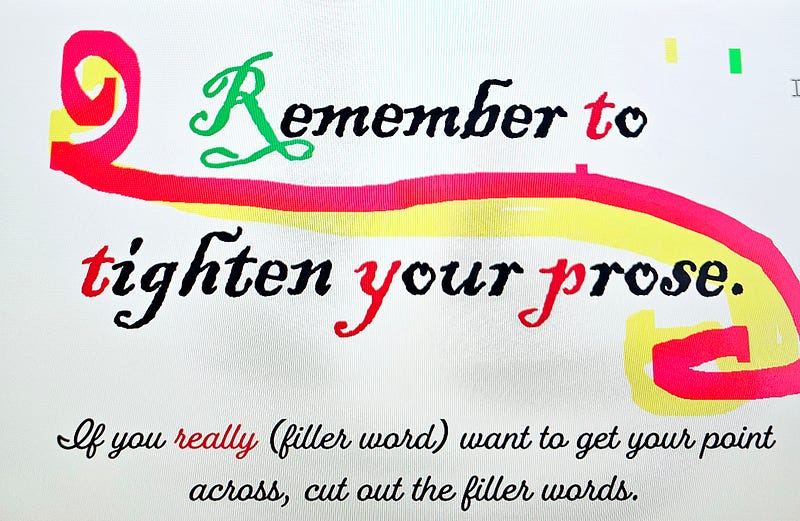
The “ums, likes, wells, and uhhhs” of vocabulary that even the most skillful writers and adept public speakers are not immune to the trap of filler words. These — not really — words might fall out of your mouth when you don’t know what to say, or you’re trying to remember something. But if you really (filler word) want to get your point across, cut out the filler words.
Many of our speeches or writings are weighed down by generally, basically, actually, kind of, really, virtually, totally, essentially, completely, practically, literally, and just.
We’re (literally) so used to (just) writing these words we may (actually) find that our writing sounds (totally) odd without them. But (generally) once you get in the habit of cutting these words, you (really) won’t miss them.
It’s simple: if one of these words is essential to the meaning of your sentence, keep it! But if not, let it go.
Too often, we balloon our writing with unnecessary filler words. Some of these paddings take the form of three or four words in the place of a single word — such as “took a step” instead of just “stepped.” But some are even trickier, and one is “that,” which seems to be a growing trend among bloggers and novelists.
“That” used as a conjunction can often be deleted.
For example, “I’m sorry I Laughed at you” is tighter than “I’m sorry that I laughed at you.”
The bottom line is if the sentence reads okay without “that,” it doesn’t need it. This is one of those obscured words our brains read right over. We’re proofreading along on the quest for those naughty interlopers, and yet we still skim right over them.
A few lucky people can speak fluently without pause. For the rest of us, however, words like “um,” “er,” and “I mean” are a standard part of our language. Every clutter word has its use. Occasionally, a little clutter may give us the casual tone or personality we want. But before you assume the sentence is perfect the way it is, try trimming a few words and reading the sentence without them.
Example:
1. There is (Omit)a rhino sitting on top of my vehicle.
2. This is actually (Omit) a difficult question.
3. To (Omit) apply the latest procedure to their entire system, perhaps they should run a local test.
3A. A tighter version: We should perform a local test before applying the new technique to our system.
Grammatically, these sentences are right, but they would be shorter if we eliminated some needless words.
Filler words, filled pauses, thinking sounds, hesitation markers, call them what you will: these little noises serve as added ingredients in our spoken word mish-mash. We all use them and observe and have opinions about them. So, what function do they serve?
A filler is a noise that allows time to think between words and sentences. They can also transmit hesitation, uncertainty, or another emotion subtly and indirectly. An interruption is a word that gives a sentence heightened intonation.
Sometimes, you might be searching your brain for the right words because you’re having a mind-blank or have been asked a particularly difficult or technical question. Equally, you might be making noises to signal you have something to say, and your brain hasn’t caught up yet.
Words ought to mean something. Unfortunately, it’s easy to get into the habit of writing common words and phrases that add no meaning.
Be aware of your writing habits to know whether you overuse words like rather, really, of course, and… and… and… My advice is to keep a list of them on your computer. And keep updating it every time you identify another word.
Congratulations. The fact that you’re reading this means you’ve taken one giant step closer to writing or speaking more fluently. And if you have habit-word tricks, please do share. We writers are always learning.
❤️Thank you!❤️
Now, go and seize the day! 🌅


