
Disease and Invasion Highlight Dictatorship’s Failures And Democracy’s Strengths
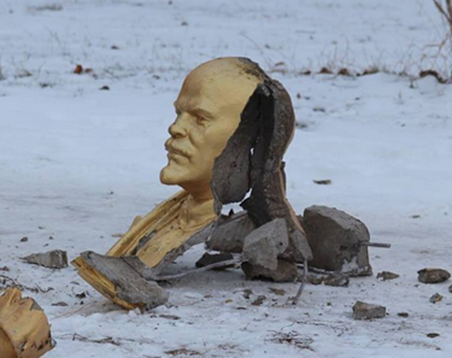
China is being drowned under a surge of Covid re-infection, with an expectation of 3.7 million new cases a day.
Russia has lost its ‘great power’ status in a needless war with its neighbour that is costing it as many lives as it lost in Afghanistan — which led to the overthrow of the USSR.
These are the last two major dictatorships in the world. When they are re-invented as democracies, we will have achieved a human first — a world at peace. Because no democracies have ever made war on one another.
But if you looked at this end-of-year outcome from the dawn of the decade, you would be forgiven for thinking it would turn out differently.
An article by senior CNN editor Nick Paton Walsh summarized how democracies have emerged into 2023 in “much ruder health” than the alternative:
“For nearly half a decade, you could be forgiven for thinking just about everything in Western democracy seemed a bit broken. The social-media yelling in 140 characters. The wild populism, and dog-whistle racism. The clumsy coronavirus lockdowns…the questioning and beleaguering of the electoral process. Some began to behave as if it were smoother on the other side of the fence, in autocracies where things are just ordered to happen, and criticism is swallowed whole. Yet [today] the fallacy that autocracies are a superior social contract is crumbling [and] the world is a place where consent matters, and debate might actually save your hide.”
We owe this new perspective to the obvious inability of two dictators to deal with their challenges. Isolated in their decision-making, unopposed in their actions, the dictators charged right into the jaws of defeat.
It was like watching a cancer test in a petri dish — future political scientists will envy us for the clarity of the lessons being revealed today.
In China, for example, Covid has opened the eyes of the people in that populous dictatorship that their path is wrong. They are seeing that the Party cannot protect them from a fearsome disease in their time of need. They are concluding that there is no purpose to their continuing obedience to the repression, rules and regulations.
China is above Russia in dictatorship mode, as being the best-resourced, most controlling and efficient of repressive regimes.
The pandemic led Beijing to resort to mass control on a whole new level. Its solution to the disease ravaging the planet was to be the harshest of all — in limiting movement. The authorities’ favored tool — used to its limits — was the one almost every other society realized would not work indefinitely.
Xi made spectacularly bad decisions about Covid. Shortly after a November front-page on Xi Jinping’s first decade as China’s leader praised him for controlling Covid, the floor dropped out. These sudden changes happen in dictatorships, when problems can no longer be kept quiet. Extraordinary protests were triggered by workforce riots that mutated into Covid fears and thus blew up like forest fires. After years of micromanaging the Covid situation, Xi stepped back in alarm and left officials scrambling to come up with new solutions.
Xi’s previous decisions lit the match. He refused to consider moving the country to Western vaccination technology, despite offers by Western governments and organizations. And he locked down infected people wholesale in crowded apartments. Officials reversed course many times, trying and abandoning and re-trying city-wide lock-downs.
“I tell you that in this world there’s only one sickness, and that’s poverty and having no freedom, and we’ve got plenty of that,” said a Chongqing man whose tirade went viral in China. “Give me liberty or give me death,” he exclaimed, using the American battle cry for democracy.
Speaking of democracy, America admittedly had its own Covid failures. One segment of the public refused to get vaccinated or to take precautions. That segment is dying out…literally. Science doesn’t care if Republicans don’t believe in vaccines. In a democracy, you can make that choice. The more important lesson from the American democracy is that in a time of enormous strain, the country held together.
China’s Covid situation is so bad the country has effectively stopped counting covid cases and deaths, abandoning mass testing and adopting new criteria for counting deaths that will exclude most fatalities from being reported.
Democracies tried to help. They offered the Western vaccine, which was much more effective than the one made in China. They also advised that the isolation of victims had no useful end-game — it was not a cure and new victims would emerge as soon as the citizens crowded into the streets again.
The second most glaring and unimaginably stark example of dictatorship failure is Russia.
President Vladimir Putin did as badly as Xi with the Covid challenge, blindly feeling his way through the pandemic with snap lockdowns, a poorly performing vaccine, and a general disregard for pandemic forecasting.
But it was his personal decision to invade Ukraine which has proved fatal to tens of thousands of people, and probably to his regime.
Growing up in his culture of secret police insolation from reality, he had few subordinates who could counter the expansionist ideologies of a ‘greater Russia’.
His military sources also fed his confident prediction that Russia’s invasion would be welcomed by Ukrainians and would be over in days.
And so started the largest land war in Europe for 75 years.
He invaded Ukraine with troops that were inferior in numbers and equipment to the defending forces.
He had to call up 300,000 new civilians to make up the gap. Then the draftees had to resort to “Go Fund Me” campaigns to get equipment.
He has lost about two-thirds of the area his soldiers originally captured.
He is losing the economic war, with his trump card — gas prices — falling to their lowest level in Europe now than since Russia invaded Ukraine 10 months ago. A million talented Russians have left the country. Factories are without high-tech parts. A thousand companies have exited the land, taking their expertise with them.
His enemies have been united against Russia, and his friends have fallen away. The countries on the fringes of his empire are deserting his cause and testing the waters for declaring their own freedom.
We can clearly see that the last two dictatorships are heading for oblivion.
What should be our stance?
We could, conceivably, bring both countries peacefully into a democratic form of government.
A previous article expanded on an idea from Canada’s Deputy Prime Minister Chrystia Freeland, urging the Democracies to adopt a future of “Friendshoring”.
Stop focussing on war as an inevitable course. Aim for “Peace and Reconciliation”. Vengeance will only lead to further war, which actually suits the dictatorships. If we try to judge nations by their war-crimes, we would be in dispute forever. With no satisfactory end-game or positive go-forward result.
The idea is that we will only do well if all the people with the same democratic principles trade only with one another. We do good if we trade with good people.
We will pay an economic penalty, says Freeland, if we do not adopt Friendshoring.
Our best approach is to adopt a “join me” club, whereby a nation has to have certain procedural requirements in order to join. People get a vote. Governments can be changed. There is no “one-party” state; elections have to be meaningful.
Think of what America has just gone through. Trump brought America closer to dictatorship than it has ever come before. Yet the country has rebounded. It would be exaggerating to say that it ‘bounced back’ but it is a stronger democracy than it was a few years ago.
Wars and conflicts will continue. Dictators will respect us more if we have strong values that are strongly defended.
We cannot doubt that we have a moral advantage.
Putin by contrast sought a world of strength, where democracies were despised.
Essentially, it is working within a world of democracies.
Democracies are the rising tide; the force of power.
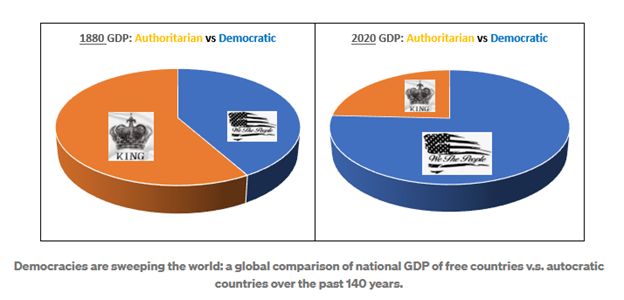
The correlation between literacy and democracy is important as a path ahead. It shows up again and again. One of our readers noted that we’re in a race between education and extinction.
War is insanity. Russia and China are the only remaining significant countries that have not yet been submerged in a democratic sea. And China is the only one that really counts in terms of economics, because Russia has an economy that is under-performing on the level of a developing nation.
It is sometimes hard for us to see the rising tide of democracies, but your grandparents would have noticed that tide, because they lived in a different world. 140 years ago, Authoritarian governments ruled the planet. It was the norm to see events shaped by Kings, Queens, Tsars and Kaisers.
In fact, that was true for almost all of human history — before the masses of people could read!
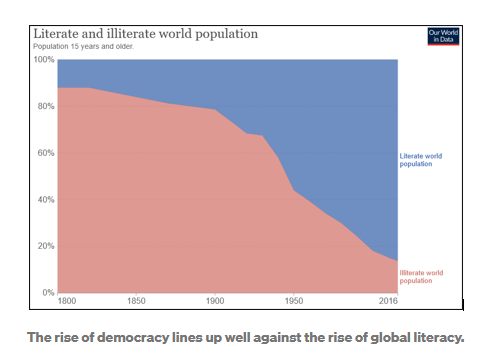
It is no accident that democracy started where the literacy rate was higher than anywhere else: America. This was a partly a heritage of the Puritans, who wanted to communicate and study new subjects.
Today most of the world’s GDP is produced with devices that rely on semiconductors. For a product that didn’t exist seventy-five years ago, this is an extraordinary ascent.
This ascent has “made in America” stamped all over it.
The chips are produced primarily by five companies: one Dutch, one Japanese, and three Californian. All Western, all started by people who were either directly in or connected with American firms.
In a test run of the Freeland Doctrine, the U.S. decided that it needed to retain a technological advantage over China, and singled out Huawei as the target. Concern over the Chinese company’s use of Western innovations, especially for use in network equipment, triggered the first practical demonstration of the Freeland Doctrine.
Today new Commerce Department rules stop the sale of U.S.-produced goods to Huawei and restrict any goods made with U.S.-produced technology from being sold to Huawei. In the sweep of a pen, Huawei was simply cut off from the world’s entire chipmaking infrastructure.
Beijing has conceded that it’s better to accept that Huawei will become a second-rate technology player than to hit back against the United States. The U.S., it turns out, has escalation dominance when it comes to severing supply chains. “Weaponized interdependence,” one former senior official mused after the strike on Huawei. “It’s a beautiful thing.
As a member of the Democracy Club, by contrast, Taiwan is building the most advanced chips in the world. It might not surprise you that in Taiwan, the GDP per person is $50,000; in China it is $18,000.
Thereafter, China gave up on its ambition to become the world’s largest economy.
If you don’t have silicon, nothing else matters.
China needs to play along with the Freeland Doctrine. If we can enforce this across the board, China will transform. While the Party bosses may dither, the country will inevitably drift to the Freeland camp. The Chinese are actually conservative decision-makers; the bosses do not risk their lives over military adventures, for example.
As I noted before, a disadvantage to Western countries from a free China, is that the level of their business competition will soar! In my years of travelling around the world, I noticed that Chinese businesspeople were often the most nimble and aggressive. The only thing saving Western companies at the moment is that the Chinese are ruled by a bureaucracy. Their flare is smothered. If you run a Western competitor, that is a good thing…but it won’t last forever. China will be free, and Freeland!
This is a level of mature decision-making that is absolutely missing in Russia.
Russia’s transformation may not be as peaceful, but it too will be remodelled as a free Western nation. There will be no options if it wants to join the world club.
There is no need to go to war with either of them.
There are still challenges, of course, that must be faced. Critical resources such as water are quickly running out; the climate crisis is a disaster waiting in the wings; and the uneven distribution of wealth needs to be resolved.
But we can do all of that much better once the last two autocracies cross the river and join us on Democracy’s shores.
We can do anything better, if we do it together.
And ultimately, it does not matter how these countries find their way to Democracy; no matter what your path up the mountain, the view is the same from the peak.