
Impressions of India
Discovering India’s Best Kept Secret
The eastern state of Odisha may not be as high profile as India’s other touristy hot spots, but has a lot to offer in terms of variety.
It was back in 2017 that I last made elaborate trips to South East Asia, back-to-back at that. In the first half of the year, I spent a little more than two weeks exploring virgin locations in Myanmar and Thailand. And in the second half, I had an unforgettable time hopping across the length and breadth of Bali, the very famous island paradise of Indonesia.
That was the last instance when I spent a considerable amount of time vacationing in Asia. It is not that I have not been to the continent at all in the six years that have followed. It is just that those visits were not long enough to qualify as travel narratives.
As such, it was time to plan another elaborate trip to the continent that boasts of a varied culture and delectable cuisine, even if it is a bit too crowded (and chaotic) for my comfort. It was after a long time that I was planning an elaborate trip out of Europe. I wanted to make sure that it was going to be anything but a touristy destination.
Predictable destinations ensure ennui
It did not come across as a surprise. Not at all. In fact, it would have been a surprise had the response been different from what I was expecting. When I mentioned to a family friend that I intended to travel to India next, he was certain as to where I was heading.
“Oh! The Taj Mahal,” he blurted. There was no way I could have blamed him for coming up with such a predictable response. Nine out of every 10 tourists heading to India have the marble monument in Agra on their priority list. It is not that I have not visited the Taj Mahal yet. That being said, it is also a fact that on each of the three occasions, I headed in that direction, it was because the person/s accompanying me were keen. To be honest, I find the Taj Mahal to be a hugely overhyped and ultimately underwhelming experience, like any touristy hotspot around the world.
India as a country offers a lot, to both tourists and travelers. For the former, there are options like New Delhi (the capital city), Mumbai, Goa and Rajasthan to name a few. While I have been to all these places, these days predictable destinations ensure ennui. As things stand, my favorite places in India happen to be the northern state of Himachal Pradesh and the eight states in the country’s northeast. I find these places unique and varied. Besides, the people are really nice.
However, on this occasion, the idea was to visit a virgin location. It is my interest in sport that not only helped me zero in on the place but also dig deep and find a German connection in it.
Designed by a German…
Die Mannschaft, or the German national team, is traditionally one of the powerhouses in global football. However, the recent performances have been forgettable. While it has been a disappointing few years in football, there has been good news coming in from elsewhere. Recently, the national team won the FIBA Basketball World Cup for the first time ever.
Then there is field hockey; I am not quite sure how many of you reading this will be aware that such a sport not only exists, but is also played in many countries. While it is nowhere as popular as the Beautiful Game, the German team has also won its World Cup on three occasions, the most recent having come earlier this year in India.
In fact, it is this success in field hockey that helped me to zero in on a different destination for my long-awaited return to India. The final of the FIH Hockey World Cup was held this January in Bhubaneswar, the city being the capital of the eastern Indian state of Odisha. What made it further interesting is to become aware of the fact that the German triumph was achieved in a city designed by a German.
Having decided to make a trip to Odisha, rather than to Bhubaneswar and the adjoining areas, it did not take long to make the necessary arrangements. I was soon airborne, and it was a matter of time before I reached my intended destination. It is imperative to mention here that being a state capital, Bhubaneswar is well-connected to all the major Indian cities like New Delhi and Mumbai.
… inspired by Edinburgh
The first noticeable thing about Bhubaneswar is the fact that it is one of the few cities in the world where the main airport is named after a real-life aviator. The Biju Patnaik International Airport owes its nomenclature to the state’s former chief minister, who also happened to be an eminent air force pilot — using his flying skills to play a stellar role in not only the Indian independence movement but also a significant part in the Indonesian freedom struggle. He went on to become an aviation magnate.
After a few days of exploring Bhubaneswar, I found out it is one of independent India’s first planned cities. While it is indeed designed by a German architect, the inspiration seems to have come from the Scottish capital. There is an old town area, that dates back to many centuries. Then there is the planned modern city, designed by Otto Königsberger, that came into existence in 1948 and has since served as the state’s capital.
The similarities with Edinburgh are striking. Besides having an Old Town, the new town of Bhubaneswar has three main streets, as is the case in the Scottish capital. So, there are thoroughfares like Janpath, Rajpath and Sachivalaya Marg on the lines of George Street, Queen Street and Princes Street in what seems a clear case of inspired urban planning. There are other major areas in the city, no doubt, but these three streets happen to be the hub of all the major activities.
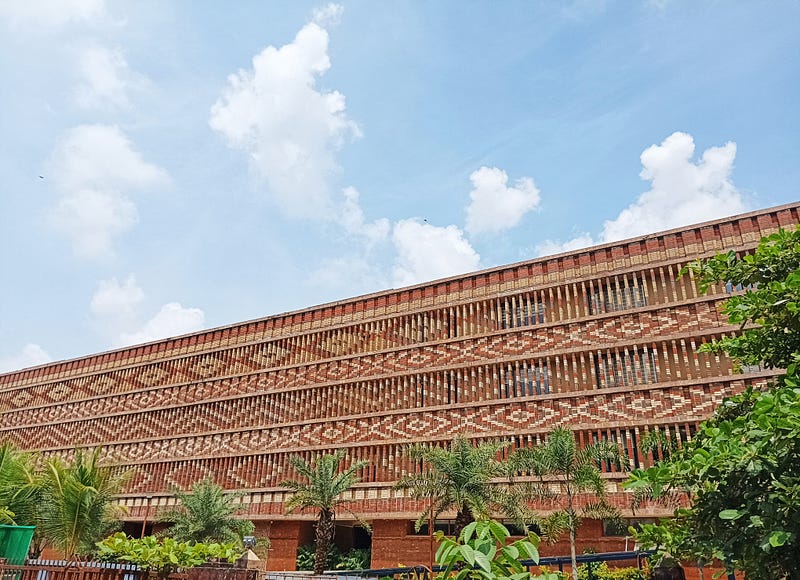
While the Old Town is characterized by a number of eminent temples, earning Bhubaneswar the Temple City moniker, the new town boasts of modern apartments and striking architecture, some of which — like the distinctly different Krushi Bhawan, have won multiple honors at various international forums.
Heading to the outskirts
Besides a plethora of museums, parks, places of religious importance and shopping alternatives within the city per se, what makes Bhubaneswar a distinctly different travel destination is the gamut of options surrounding the city proper.
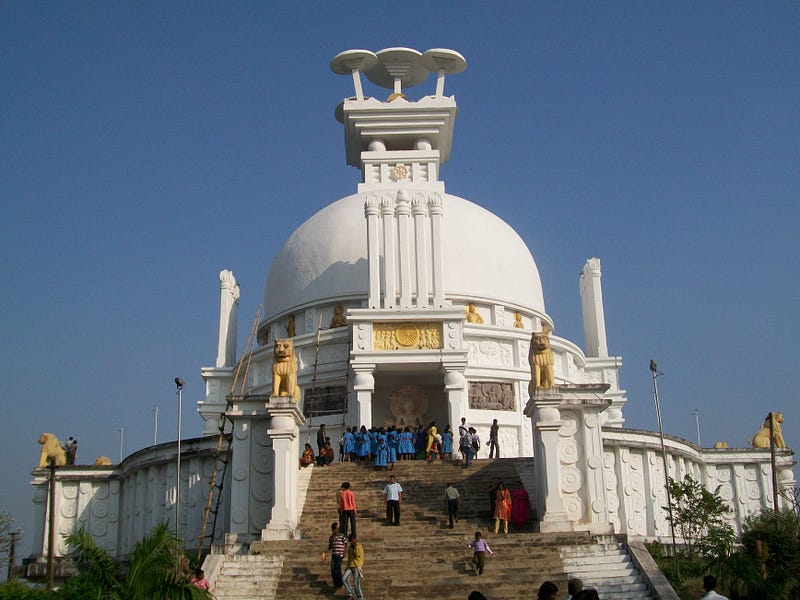
Less than 10 kilometers south of the city, on the banks of the river Daya, is a hill that is home to an iconic structure. The Dhauli Shanti Stupa or Peace Pagoda (pictured at the top), a monument of peace built in 1972, actually recounts the horror of war. The place is supposed to be the location where the Kalinga War, one of the bloodiest wars in history, was fought.
There are edicts, scriptures and programs that narrate the story of an emperor’s quest for power, its morbid aftermath and his subsequent renouncement of violence. The emperor (named Ashoka) embraced Buddhism and eventually propagated the teachings from the religion of peace to the world. As such, the Peace Pagoda in Dhauligiri is a popular landmark of the state’s Buddhist heritage.
Likewise, a few kilometers to the northeast of Bhubaneswar are the Udayagiri and Khandagiri Caves, of religious importance to the followers of Jainism. While I had a passing look at them, I wasn’t able to spend a lot of time, instead heading to another major landmark.
The largest marine ecosystem
Having traveled about 100 kilometes from Bhubaneswar, I finally reached Chilika Lake, the largest brackish water lake in Asia and the second-biggest lagoon in the world. The popular tourist attraction is home to a wide variety of flora and fauna. The expansive area is a hub of many recreational activities and also a paradise for seafood lovers. I have mentioned my seafood love before.
Between October and June, it is also a large wintering ground for migratory birds, that travel great distances and arrive in India from as far as the Caspian Sea and Lake Baikal in Central Asia. As such, Chilika Lake is a bird watcher’s heaven, with species ranging from flamingos to pelicans and cranes. The adjacent Nalabana Island is a bird sanctuary. The area is also home to some endangered species.
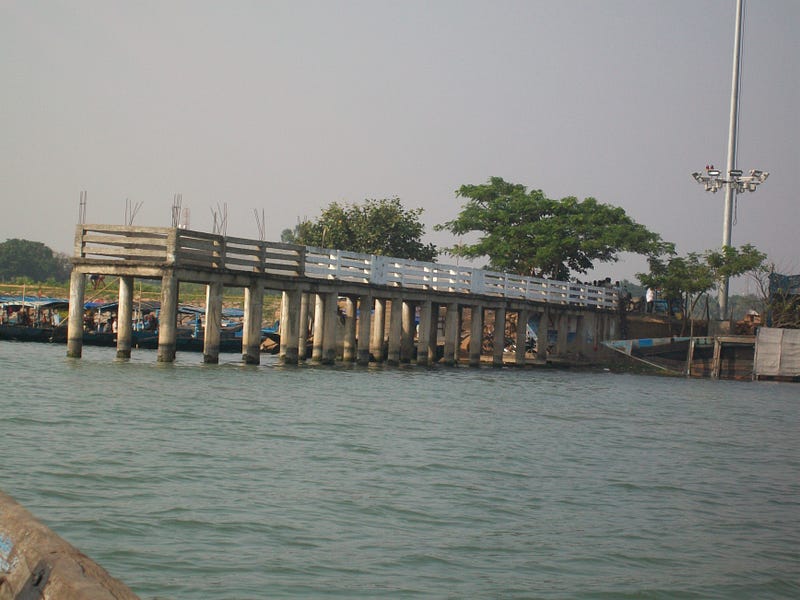
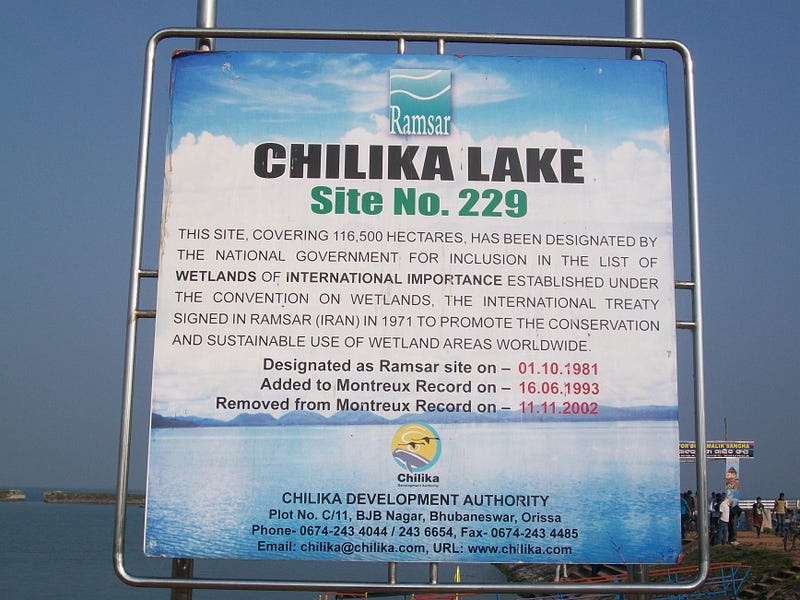
The vast expanse of water, and the surrounding greenery, ensure a serene ambiance. The entire area is best explored by boat, and I kept the privacy element in mind while hiring one. While the natural beauty of the region left me flabbergasted, my most memorable experiences palpably pertained to the variety of seafood I got to relish.
Considering its ecological significance, the Chilika Lake was designated the first Indian wetland of International importance under the Ramsar Convention in 1981. The region is also listed as a tentative UNESCO World Heritage Site.
There is more to come
Odisha’s beautiful capital city offers an entire gamut of options for a traveler eager to explore beyond the usual. My decision to devote ample time to explore Bhubaneswar and the surrounding areas proved to be a masterstroke, there are many things I missed out. It is a fact that one visit is not enough to do it all. That being said, I immensely enjoyed whatever I could manage to cover.
While I have made a small attempt to showcase the state capital, I will be attempting to venture beyond in my next post. However, having spent a few days in one of the least hyped destinations, I can say there is a lot to explore, and it is travel experiences like these that you tend to remember more than those usual touristy escapades.
In recent times, Odisha has advertised itself as India’s Best Kept Secret, more so in between hosting the two field hockey world championships back-to-back (in 2018 and 2023). Indeed, the state has a lot to offer, palpably to those who dare to think beyond the touristy options like the Taj Mahal.


