
Discovering Bhutan: The Land of Gross National Happiness
Approximately the size of Switzerland, Bhutan is a landlocked Buddhist nation located in the Eastern Himalayas. With an average elevation of 3,280 metres, it is the highest country in the world and has never been colonised in its entire history due to its harsh terrain.
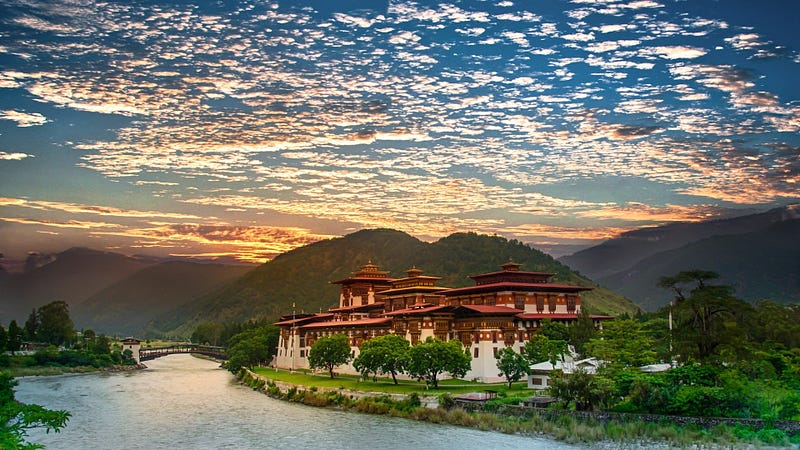
The Gross National Happiness concept, which is the foundation of the Bhutanese government, is viewed as a substitute for GDP in gauging the advancement and development of the country. This philosophy has four pillars: sustainable and equitable socio-economic development, preservation and promotion of culture, good governance and preservation of the environment. In order to uphold the last one, the government has allotted an astounding 43% of the nation to national parks, wildlife sanctuaries, and nature reserves, and an additional 9% for wildlife corridors.
In addition, 60% of Bhutan’s land area must be covered by forests, according to the country’s constitution. Currently, the percentage is approximately 71%. Bhutan produces roughly 1.5 million tonnes of carbon dioxide annually, but its enormous forests sequester about 6 million tonnes of the gas, making the country carbon negative due to its abundance of trees! The country is rich in biodiversity as a result of the government’s amazing conservation efforts.
With an estimated 103 tigers living there, Bhutan is one of the Bengal tiger’s most promising strongholds. The likelihood is that tigers will survive longer in Bhutan than nearly anywhere else if they do become extinct in the near future. They coexist with buffalo, clouded leopards, and sloth bears in the country’s warmer southern region. Red pandas, bears, sambar deer, and muntjacs can be found in the temperate forests on the Himalayan slopes. Moving even further north and up the mountains, the alpine regions are home to wolves, snow leopards, and the takin, the nation’s national animal — a muskox-like creature.
In addition, Bhutan is home to almost 800 different species of birds and a diverse range of primate species, including two macaques, three langurs, and the unusual and poisonous Bengal slow loris. Among these feathered companions are the critically endangered white-bellied heron, of which there are only 250 left in the world, and the endangered white-winged duck.
Bhutan is a prime example of a country that is steadfastly committed to protecting the environment. Bhutan has distinguished itself as a leader in environmentally sustainable practises on a global scale. It is clear from considering Bhutan’s incredible journey that balancing economic growth with environmental preservation is not only possible, but also necessary for a prosperous and balanced future. Bhutan’s resolute commitment to preserving the delicate equilibrium between development and environmental stewardship is a source of inspiration for nations across the globe, compelling us all to reconsider our conservation strategies and give equal weight to the welfare of people and the environment.


