
Discover toxic folk today: How to recognise (and escape) the deadly time-bomb people in your life.
Understanding why small children run at pigeons will help you avoid toxic people that throw your life into chaos.
Wherever human beings gather there is ‘drama’. There is a tendency for specific individuals to create and manufacture avoidable chaotic situations. These people lurch from crisis to crisis with little recognition of the havoc they cause. Life around them becomes a soap opera of their own making. You need to learn to spot them in advance before you’re cast in the latest episode.
Once you’re part of the drama it becomes difficult to extricate yourself. Life in the soap opera is hard. When your storyline finishes you will be spat out into the Green Room for recovery. Sometimes you may be asked to take a lesser role in someone else’s emerging storyline. If you’ve experienced this, take a deep breath and…
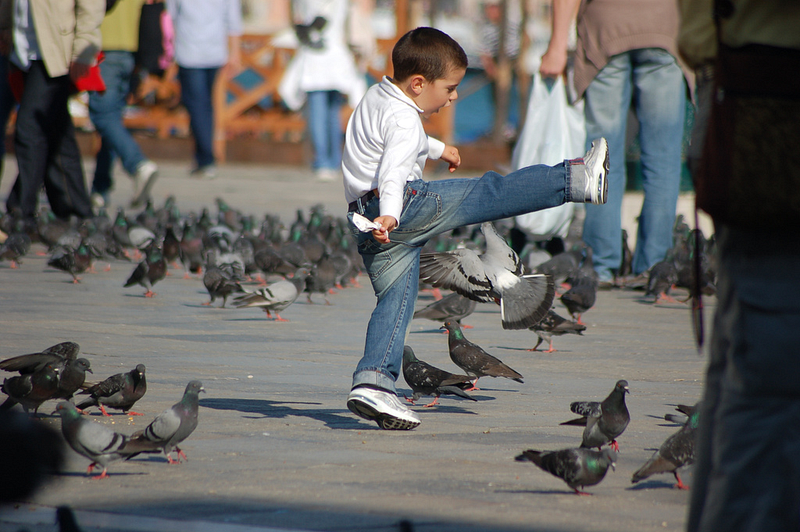
Imagine a toddler trying to kick a pigeon.
You can go to any public park and watch this happen. Toddlers will run at or aim a kick at a group of pigeons. The startled pigeons launch themselves into the air. The toddler is delighted. The disgruntled birds land nearby. The toddler lowers their head and lunges at the pigeons again. The pigeon takes off and this game continues ad infinitum.
A passer by will get a pigeon to the face in due course. The game will then abruptly stop. Often halted by a red-faced parent stammering an apology for their child’s inexplicable behaviour.
Remember the pigeons. They’re important. But let’s talk about you for a second. You may have kicked at pigeons when you were small. You probably don’t do it now. You’re an adult. So here’s a different example.
Imagine that you’re standing on a beach with a stone in your hand
It doesn’t have to be a beach. It can be any body of water. You’re going to throw the stone in. A stone that has worked for years to get itself out of the water. You’re going to throw it back in. From an evolutionary point of view this is a pointless behaviour. But millions of humans will do this every day.
Most have no idea why.
If you’re being honest with yourself then you’ll realise a few things are happening.
- Without the splash you’d get bored. You’re a splash junkie.
- The bigger the splash, the better you feel.
- If the splash becomes boring (and it does) you’ll invent a new game. You might start skimming the stones or finding a bigger stone
- Now you’ve doubled the splash, or if you’re good enough…trebled it. You filthy splash-addict.
- You aren’t the only one who does this. Help is available.
The tendency of human beings to skim stones goes against the traditional understanding of what motivates us. Initially psychologists believed that we were motivated by hunger, thirst and getting our little mammalian rocks off. But skimming stones doesn’t help with any of that.
We are getting our rocks off, just not the way psychologists expected.
Competence Effectance Theories
Your brain gets a positive feedback loop when you show competence. All human beings (big and small) like to see the effect they’re having on the world. When there is evidence that they have caused a change and received feedback from the universe they understandably feel good.
Why do you think children’s toys have big colourful buttons and make loud noises? It might be the bane of your life as a parent but it’s very addictive to the brain of your offspring. As we get older we get similar positive feedback when we learn new things. Musical instruments, complicated games, even writing an article and watching your stats go up.
This positive feedback loop forms an integral part of our motivational system. It’s necessary for learning and it’s necessary for life.
Understanding the psychological implications of competence-effectance theories of motivation and play should give you pause for reflection. About yourself and about those around you. If you understand the psychology underlying human behaviour you are better placed to spot potential fecal storms before they hit your kinesthetic air circulator.
What does this have to do with Toxic people?
You’re the average of the five people you spend most time with. (Jim Rohn)
If you surround yourself with people who are happy, fulfilled people who have ambition and purpose. You will likely have it too. If your social circle is constantly lurching from drama to drama then someone in the circle is toxic. Check the other five. If they’re all fine, it might be you.
There are some people who never stop kicking pigeons. Metaphorically speaking. They enjoy the feedback loop that comes from seeing others react to their actions. If they have low social skills they will do it online and we call them ‘trolls’. They’re best ignored or (if you have the energy) handled with compassion a la Sarah Silverman
Online is one thing, but what if toxic people have already found their way into your life?
Their own deep-rooted unhappiness will only manifest itself in manipulation and chaos. They will play people off against each other. They will marinate in the unhappiness of others. They will leave chaos in their wake. You’re all pigeons and they enjoy watching you ruffle your feathers and making you take off in a panic. Once you settle down, they’ll aim another kick in your direction.
This is how they manufacture self importance when other things are out of their control.
These people aren’t bad people. I don’t believe in ‘good’ or ‘bad’ people. These are people who don’t feel happy with life. People who feel that they have nothing to control or contribute and are disenfranchised. They might be unhappy with work. With their home life. With their children. At their core these are miserable people (or sociopaths).
I have met a handful of toxic people in my time, they’re usually very charming and fun people. These are the warning signs I’d advise you to look for:
- They have a constantly shifting circle of friends.
- You’re instantly their best friend/closest friend and being lavished with attention and or gifts.
- Previous partners/friends don’t want to know them.
- There are plenty of stories of how people have wronged them, but very few about how they have wronged other people.
If you can spot these tell tale signs in the early stages of a friendship you can sometimes get out. Sometimes the best option is to cut and run. I have almost always ghosted a toxic person without explanation. They desperately try and get back into your life for a while, then they find a new person to kick at.
If you’re related to a toxic person ghosting might not be an option. In that instance you have to limit your involvement and refuse to join the mind-games.
If you’re unlucky they’ll cast you as the villain in their next narrative. It’ll be a familiar story. ‘Them vs The World. And you’ll be part of that story. You’ll be spoken about at parties and become one of the people who wronged them.
Some of these people realise that they are the common denominator in all their life drama. Many of them don’t. What begins as toddlers kicking pigeons can turn into a toxic uphill battle with the universe.
They remain the central players in their own 1980’s zero-to-hero film, starring themselves.
If you understand the brain and how it motivates us. If you understand yourself and other people better than the average person. You can make more informed choices about who you interact with and get the best from your relationships.
The most important thing to remember when you’re dealing with toxic people is… NEVER be the pigeon.

📝 Read this story later in Journal.
🍎 Wake up every Sunday morning to the week’s most noteworthy stories in Wellness waiting in your inbox. Read the Noteworthy in Wellness newsletter.