
Disaster or Triumph? You Won’t Know Until It’s Over
What looks bad now can turn out to be a blessing later
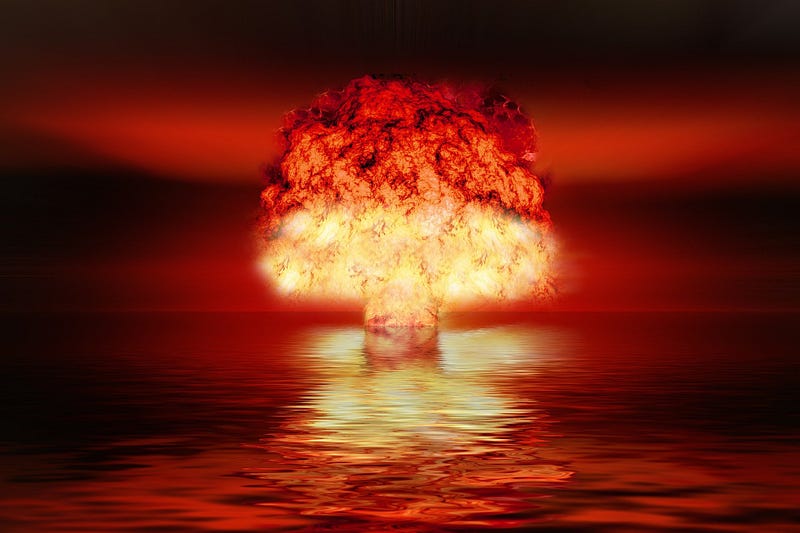
Disaster is everywhere. You can’t avoid it. All you need to do is turn on the TV or pick up your phone to hear the content Cassandras at it again. It’s the storm of the century. It’s the most important election of your life. By next Tuesday, you’ll be fighting packs of feral dogs for scraps of rancid meat in the ruined halls of government.
Telling ourselves the world has never been worse — when in reality it’s never been better — does more than mildly irritate a rhino-skinned campaigner like me. More sensitive souls are driven to despair. When you believe the world is against you, it will be. The doomscroll bends into ironclad prophecy. Like cells in a single body, when we turn against each other, all is lost.
It’s easy to blame the media. But aren’t we all part of the media now? Even your obscure blog posts and the tweets you write sitting on the toilet all add to the tsunami of garbage that’s becoming the hallmark of our current culture.
Everybody has a voice. Nobody’s listening. And yet we all keep cawing at each other, arguing over trivia while the storm invisibly gathers.
If it bleeds, it leads. Fear-based news makes money. As attention becomes the only commodity that matters, hysterical headlines are the weapon of choice for anyone that wants to be noticed. The sudden panic that hijacks your limbic system, hardwiring your monkey brain by zipping right past reasoned reaction into the teeming mass of emotion.
It’s as simple as that. Not that your media of choice doesn’t have its ideological agendas, too. It definitely does. But nothing survives for long that doesn’t turn a profit. And fear works. It moves units like nothing else.
That’s not the media’s fault. It’s ours. Our chambered hearts are waiting for a catastrophe like a revolver’s cylinder waiting for a bullet. Catastrophe is what we are made for, what our whispering shadows long for. It’s our destiny. If it hasn’t found you yet, it’s coming. Calamity is one of the few things we can count on.
But what looks like disaster isn’t always.
Even the very wise cannot see all ends. The story isn’t over until it’s over, and until it is, we are in no position to say what was a disaster and what was not.
Often, what looks like a setback can turn out to be a necessary step in some greater achievement. The second act twist only makes the third more satisfying. We don’t know. We can’t know. And understanding that — that your problems and difficulties may turn out to be the best things that ever happened to you — can help you bear with any hardship.
In 2009, I Bought a House
Okay, an apartment. Almost the cheapest apartment in Vancouver, one of the world’s hottest real estate markets both then and now. You know what they say about buying the worst house in the best neighborhood.
I was twenty-six. And I thought I was being really cute, too. Buying right after the 2008 financial crash, taking advantage of prices, I wouldn’t see again in my lifetime.
I didn’t come from money. I clawed my way to a down payment by living well below the means provided by an unglamorous job. When I bought, rent cost almost as much as a mortgage. At the time, it made sense.
And that was true until 2012 when I had the opportunity to start my own business. The problem was, I needed to move away from Vancouver to do it. And when I put my grotesquely overpriced apartment up for sale, there were no buyers.
I hadn’t owned the place long enough to build up any equity. Effectively, all I did was pay interest. Plus condo fees and maintenance I wouldn’t have had to pay if I had rented. Mortgaged up to the eyeballs, I couldn’t afford to sell. Even a small drop in the asking price would ruin me.
So I rented the place out and moved. The rent didn’t cover the mortgage. Every month, I took a loss. And my infant company wasn’t in a position to pay me. It was only my wife’s willingness to keep toiling away at a corporate job she hated that kept us from being ruined.
At the time, it was a disaster.
I remember sitting at the dining room table with a crudely handwritten account in front of me, listing our income and expenditures. We had no savings. Only debt.
Over and over again, I cursed the day I bought that place and signed up for this anchor that looked like it was going to drag me down into the poverty I had spent years trying to escape from.
Somehow, we managed it. We cut our budget down to nearly nothing. After a year, the new business started to pay me. Not much, but something.
And steadily, by some mysterious magic, Vancouver’s already obscene rental rates kept climbing, narrowing the gap between what was coming in and what I had to shell out.
I ended up keeping the apartment until 2019. By then, Vancouver’s voodoo real estate had added over a hundred thousand dollars to the value of the place.
The apartment I tried and failed to get rid of, that I would’ve been happy to give away for no more than what I owed on it, ended up making me a small fortune.
The Virus Is Still Raging
People are still dying and will continue to for another year or more. There’s corruption in high places, and even though that’s always been true, it used to be less visible.
The more comfortable people become, the more they complain about their lot in life, but this year has been difficult for everyone I know.
It’s still 2020. And we don’t know how this will all end. Maybe the much-lauded coronavirus vaccines will not only solve the current pandemic but provide the framework to solve the next and the one after that. Pandemics that might have been far more deadly than the one we’re currently living through.
Maybe the institutions that protect democracy will become more robust through being challenged. Maybe a brush with tyranny will help people to realize the constant risk living in a free society inevitably entails.
We don’t know. That’s the point. What looks like calamity often turns in the end to be a blessing. The eucatastrophe that turns all the trauma and suffering into something radiant and hopeful.
Maybe that sounds naïve. But I have more than my own examples to draw on. The story of history is not one of linear progress from barbarism to prosperity. But it’s hard to deny that things have gotten better.
If you don’t believe that, ask yourself what period of history you’d rather live in than this one. In almost any other period, you’d have fewer rights, more diseases, worse medical care, a shorter life expectancy, and a greater chance of experiencing violence.
The Triangle Shirtwaist Factory fire gave us fire safety regulations that have saved thousands of lives. The inventor of the airbag came up with his idea after crashing his own car. Just about every safety regulation today is written in the blood of unfortunate others.
And, of course, the wars of the 20th century were so destructive that no powerful countries have dared to directly confront one another since.
We Love Tragedy
Not just when it happens to others. Secretly, we long for tragedies of our own. Like Auden’s children, waiting for a “so-called traumatic experience” so that “life may become a serious matter.”
We want our lives to matter. We want them to mean something. And suffering can give the impression of having meant something even when it doesn’t.
Tragedies and dramas win Oscars and Pulitzers; comedies don’t. Serious art and serious lives must be grim and dark, we seem to think. The light and the joy seem somehow ephemeral.
Guard against that instinct.
Keep a close watch on the parts of yourself that quietly long for tragedy. The parts that feast hungrily on every shrieking headline and mean-spirited comment, forever seeking confirmation that your life is a Serious Matter in a dark and gloomy world.
While outside, in the sun or the snow, the birds are still singing. And remember that even when tragedy strikes, it isn’t the end of things.
The same mechanisms of time that turn mountains into sand can turn disaster into triumph. You just need to hang in there long enough to see it happen for yourself.
Thank you for reading.
© Ryan Frawley 2020.
All proceeds from this article will be donated to Doctors Without Borders/Medecins Sans Frontiers.