
Dirty Money: The Sackler Family and the Ethics of Art Philanthropy
How can museums rehabilitate their reputations with a tarnished name above the door?
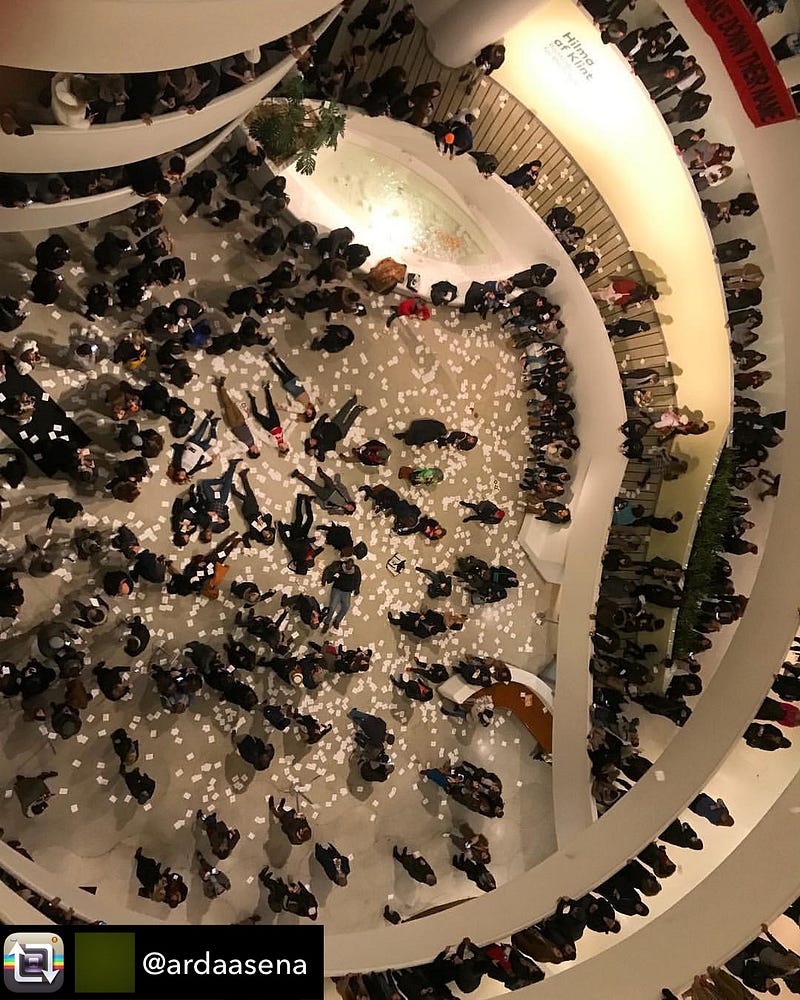
The rotunda of the Guggenheim Museum, designed by Frank Lloyd Wright, is crowned with a domed skylight that draws the gaze heavenward. Its spirals encourage people to move. In its whitewashed descent, visitors trickle through exhibitions in their own time before eventually ending their visit at ground-level. It’s rare to see the people circumventing the spirals go still, and rarer still to find them looking away from the artwork surrounding them. But in February of this year, crowds filled the winding pathways and watched as paper fell like snow through the central rotunda. Though one would have been forgiven for mistaking the showmanship for a performance art piece, the fluttering papers were instead intended to resemble prescriptions for OxyContin. It wasn’t a performance after all. It was a protest. The Guggenheim was one of many museums that have recently come under fire from protestors for its connection to the Sackler family. The Sacklers created their vast fortune through Purdue Pharma, the pharmaceutical company that created and then fraudulently marketed OxyContin, and their name has a place of honor at the Guggenheim, at the helm of The Sackler Center for Arts Education. The protest was designed to mimic one of the Sackler’s words. At the launch of OxyContin, Richard Sackler said that the drug would be “followed by a blizzard of prescriptions that will bury the competition.” His words were chillingly prescient.
According to the Centers for Disease Control, there are 192 drug overdoses deaths every single day in the United States. In 2017, there were 70,237 drug overdose deaths. In 2017, physicians wrote 191 million prescriptions for opioid pain medication, and prescription opioids would result in move than 35% of drug overdose deaths that year. While drug overdose deaths fell in 2018, the first time this has occurred since the 1990s, the increasing rise of fentanyl could manifest as a third wave of the opioid epidemic — following prescription drugs and later heroin. The opioid epidemic has been called a uniquely American problem, with drug overdose the primary cause of death now for people under the age of 50 and Americans consuming 80 percent of the global opioid market. Moreover, the United States offers a dangerous combination of a cultural aversion to enduring pain — to numbing what hurts, rather than allowing a wound sufficient time to heal — coupled with insurers that are more willing to cover opioids. Opioids have been less regulated in the United States than other nations. The healthcare system is privatized, managed inconsistently by states, and beholden to competitive markets. All of which is to say that the use of opioids skyrocketed due to a perfect storm of aggressive marketing and a healthcare system that was perfectly poised for exploitation. It wasn’t just the doctors’ pads, but the prescriptions were certainly one of the catalysts that led to this new dark age of addiction. OxyContin — pink and concentrated and frighteningly euphoric — will forever be linked to an epidemic that brought a nation to its knees. But that isn’t the only name we will remember.
The Sackler name is now inextricably linked to the tiny pink pill and everything attached to it: its immeasurable devastation and its sordid riches. The name also adorns the walls of some of the most revered museums in the world. The Metropolitan Museum of Art. The American Museum of Natural History. The Victoria and Albert Museum. The Dia Arts Foundation. The Tate Modern. The Sackler Gallery. And though the opioid epidemic has hit hardest in the United States, it has ravaged people the world over. Accordingly, protests demanding that the Sackler name be stripped have a global tenor. For their part, museums have responded differently. Following a protest in its fountain, brandishing a banner of “Take Down The Sackler Name” in front of its iconic pyramid, the Louvre decided to redact the name from its Sackler Wing. Engraved plaques have been taped over; the website now makes no mention of the name. The Tate Group of British Art Galleries was the first to announce that it would no longer accept funding from the Sacklers. The National Portrait Gallery, The Metropolitan Museum of Art, and the Guggenheim followed suit. In essence, the rest have committed to severing a lucrative relationship, but have said they will keep the Sackler name.
Some have argued that donations made prior to the introduction of OxyContin to the market (in 1995) should be free of association with the drug. Arthur Sackler, the driving force behind Purdue Pharma, died in 1987 after all. However, there is ample evidence that it was Arthur who pioneered the aggressive marketing techniques that worked so effectively for OxyContin. In a sense, there is some karmic retribution that Arthur may masterminded the blueprint of his company’s downfall. The Sackler name is bound up inextricably with OxyContin and parsing out dates — delving into which descendent had sufficient knowledge and culpability — is semantics at best. Certainly, we cannot require museums to so thoroughly investigate their donors. States and individuals have brought suits, individually naming the Sacklers, and a global settlement has been offered. But still. Just as we question the ethics of admiring amazing art created by geniuses who were terrible people, we also have to look at the integrity of those who float the money.
It’s an uphill battle. Some contractual agreements create a relationship that exists in perpetuity. Others stipulate naming rights that lapse after a specific period of time. Cutting off one donor could serve as a deterrent for another, because who can control how his or her descendants might stain the family name? Because the true appeal of naming rights for a wealthy philanthropist is the promise of immortality, for those who would give and for their lineage, too. Museums, sometimes a little too empty and a little too quiet, require the benevolence of deep-pocketed donors to remain competitive. However, there’s a disconnect here that smacks of elitism. While museums were the beneficiaries of stunning donations, rural, impoverished segments of America were hit hard by the opioid crisis. It is difficult to fathom a contrast as stark as a museum with the wherewithal to add another wing, and the gritty reality of death by a drug overdose. T.S. Eliot put this sort of blissful unawareness best in The Love Song of J. Alfred Prufrock: In the room the women come and go/Talking of Michelangelo.
The Sacklers aren’t the only philanthropists of questionable integrity to have donated to art museums. Nevertheless, the uproar surrounding the genesis of their wealth offers an important lens into arts funding. It also begs the question as to how museums can best make amends in the event of a scandal. Museums play a significant role in public life, connecting us to our shared history and reminding us of the best impulses of human nature: to create for creation’s sake. They should belong to us all, rather than simply the chosen few who can afford naming rights. So while their instinct to rise above impropriety is laudable, even necessary, we must ask whether a museum can rise above a scandal while still scarred with a tarnished name.
Purdue Pharma went hunting for OxyContin. Following the end of a period of patent exclusivity for one of its best performing drugs, MS Contin, the company needed to launch a drug that could command a sizable market share. MS Contin is a morphine-based painkiller. Because MS Contin was the first controlled-release tablet on the market , the medical community’s consensus was to narrow its use to managing acute pain. As with all opioids, MS Contin presented the risk for tolerance and abuse. It should be noted that federal prosecutors have now highlighted emails and reports sent to various members of the Sackler family indicating that MS Contin was being abused as well. In any case, the company moved forward with their investments in opioids, determined to dominate the market.
OxyContin is a form of oxycodone that had been reformulated into a long acting form. Up until this point however, all opioids had been prescribed sparingly — primarily for cancer patients and for people managing pain at the end of their lives. Doctors were (rightfully) reticent to prescribe opioids, out of an abundance of caution for their potential for abuse. But the medical community’s hesitation could have cut into Purdue Pharma’s profits. A patent approval wouldn’t be enough to make OxyContin profitable if physicians wouldn’t prescribe it, if insurers wouldn’t cover it. Purdue Pharma was ready to manufacture a powerful, highly-addictive painkiller, and Arthur Sackler’s past efforts had primed the corporate culture for what was needed next to make OxyContin viable: a marketing campaign.
From the beginning, OxyContin was marketed with the intention of overcoming the cancer hurdle. An aggressive campaign was launched in tandem with the rollout of the drug. Significantly, sales reps extolled OxyContin as a salve to not just short-term pain, but long-term pain from less serious ailments, too — with limited risk of addiction. Purdue Pharma, along the same lines, never corrected doctors who believed that oxycodone was less powerful than morphine. It is actually twice as strong as morphine. Further, the study referenced in the drug’s FDA insight wasn’t actually a study at all; it was a short letter to the editor that was published in the New England Journal of Medicine in 1980. Though sales reps were actively trained in assuaging physician’s concerns with misleading information, the company line was that OxyContin was an important, necessary drug being misused by addicts. Purdue Pharma never acknowledged its role in creating addicts. They buried a study that suggested that OxyContin didn’t consistently work for a 12-hour period — the linchpin of its marketing strategy — and that patients were accordingly took more than directed for pain relief. When physicians complained to sales reps that the drug didn’t work, they were instructed to raise the dosage. Purdue Pharma manufactured a highly-addictive drug that often required more than the recommended dosage to be effective. In essence, the company didn’t fill a hole in the market with its drug. Rather, its drug unleashed a need, a hunger, a void that could never be filled.
2007 brought about the first public reckoning for Purdue Pharma. In federal court, Purdue Pharma’s affiliate, Purdue Company, Inc., and three of its top executives pleaded guilty to criminal charges. They admitted that they had deceived doctors and patients about OxyContin’s abuse potential. Though no jail time was required of the individuals, the court ordered them to pay $634 million in fines. Purdue Pharma also entered into a Corporate Integrity Agreement with the United States Government and, in the ensuing years, violated it. Purdue Pharma continued aggressively marketing OxyContin and setting high targets for its sales. In an action initiated by the state of Massachusetts against the company, the state enumerated these corporate violations and also demonstrated the individual involvement by Sackler family members in orchestrating such non-compliance.
Currently, state actors have ratcheted up the battle against the opioid epidemic. 48 states and the District of Columbia have now sued Purdue Pharma. Rather than merely focusing on Purdue Pharma’s wrongdoings, they have also individually named members of the Sackler family personally liable for the crisis. These complaints point to the family members direct involvement in Purdue Pharma, as board members and in other leadership roles, throughout its corporate existence. Following a surge of almost 2,000 lawsuits nationwide, the first settlement of its kind saw Purdue Pharma and the Sackler family agree to a $270 million payout to Oklahoma. At this time, the Sackler family has offered to relinquish ownership of Purdue Pharma and to personally pay $3 billion in a settlement proposal. The family now seeks to thwart future lawsuits. Purdue Pharma isn’t being singled out — it’s one of almost two dozen drug manufacturers that are currently dealing with the fallout from their role in the opioid epidemic. Time will tell as to whether the proposed “global settlement,” which would resolve further claims against Purdue Pharma, will bring closure to victims while simultaneously bringing an end to this “unprecedented” mass of litigation.
Even if, as expected, Purdue Pharma descends into bankruptcy and the Sackler family pays out-of-pocket to resolve the claims against them, there is still the matter of their name. Many of the world’s most prestigious museums and galleries have opted to keep the Sackler name incised into their walls. Naming rights in perpetuity have bound these institutions to a kind of purgatory, forced to trumpet a toxic relationship that threatens their own good reputations. There are ways, however, to diminish the power of a name — even one permanently locked into a plaque above your door.
It is an ancient urge: to carve your name into the pillars of a prestigious institution that will outlive you. And just as some philanthropists will pay for a public acknowledgement of their benevolence, museums depend on their charity — particularly in an era when funding for the arts is the first to go. In order to make capital improvements, and to meet budgetary and operational requirements, most venerated institutions still offer enticements to donate. While there are many ways to recognize a prominent donor, the ability to leave a name behind is the ultimate (and most expensive) carrot.
Historically, charitable gift agreements that offered naming rights in perpetuity were more common. The Smithsonian’s relationship with Arthur Sackler exemplifies this. Though Arthur Sackler died in 1987, his name lives on in the Arthur M. Sackler Gallery, a art museum under the Smithsonian’s umbrella that exhibits Asian artwork. According to the Smithsonian’s webpage, Arthur Sackler donated “one thousand masterworks of Asian art and funds” that would ultimately construct the building. Recently, Oregon Senator Jeff Merkley demanded that the Smithsonian remove Arthur Sackler’s name in light of the opioid criss. In response, Lonnie Bunch, secretary of the Smithsonian Institution, said that the institution was legally required to keep the Sackler name. He donated Asian artwork valued at $50 million in conjunction with an additional $4 million for building costs. In exchange for Sackler’s donation, Bunch explained that the legal agreement “obligated the Smithsonian to designate the facility as the Arthur M. Sackler gallery in perpetuity.” This stalemate illustrates the problem with naming rights in perpetuity: they leave the institution no flexibility in responding to crises and in securing additional donations.
A better option is to offer naming rights for a specific duration. When David Koch donated $100 million to the theater at the Lincoln Center, it was the biggest single donation in the institution’s history. It is now known as the David Koch Theater. Significantly, the contractual agreement stipulates that Koch’s naming rights will expire after 50 years. His heirs, however, have a right of first refusal to match Koch’s original gift. An expiration date to naming rights coupled with a right of first refusal are legal maneuvers that together preserve an institution’s freedom, while also salvaging a potentially beneficial relationship. It’s an elegant solution, allowing a museum continue to honor prominent donors while also meeting present-day challenges. Koch himself put it best: “a naming opportunity should be a defined length of time, to allow the institute to regenerate itself with another round of major fundraising . . . Fundraising is pretty difficult if there is no place for a new donor to be recognized.” In time, perhaps these donors will come to be seen as the more virtuous, more giving, as they have placed the institution’s needs to maintain its vitality above their own yearning for recognition.
To avoid a scandal of the Sackler’s epic proportions, museums can also carve an escape hatch into their agreement. Though it might require an indelicate conversation, inserting termination rights into the contract can ensure that all parties enter into an agreement with the same expectations. They will know that the relationship is conditional one; it only lasts so long as it is mutually beneficial. More specifically, in order to preserve an institution’s good reputation, parties could insert a warranty to that effect at the outset of negotiations. This would protect the institution from any unforeseen events that could harm its reputation. Serious problems would serve to breach the warranty, recognizing that a promise was broken to tread carefully with reputations now so publicly intertwined. Alternatively, some institutions have used morality clauses. However, requiring a donorto be moral and to exercise good judgment requires some specifics and a near-philosophical discussion. What’s enough to tarnish a good name? A criminal conviction? An ethics scandal? A divorce? One person’s public shaming can be easily shrugged off and explained away by another. Because virtue can be an ambiguous concept, it’s important to have an open discussion as to what it means to demonstrate good character — and then to get it in a writing.
Sometimes, as with an ironclad charitable gift agreement in perpetuity, there is no legal maneuvering to be done. At a certain point, accepting the name incised in stone overhead becomes a bit like tolerating that relative at the Thanksgiving table. You know the one. Any close, lasting relationship can too easily turn turn toxic, becoming a thing to be endured. When tensions reach a fever-pitch, sometimes it’s best to just eat the pie and contain your side-eye and talk to someone else. Museums can improvise this way, too. They can dilute the power of a big name by peppering their walls with the names of many, many others. A big donor might donate anywhere between 25 and 65% of a building’s cost to attain naming rights. While institutions rightfully covet these relationships, a more egalitarian approach would be to let individuals contribute according to their own ability. “Mosaics” of brick and stone, where pathways and walls and rooms acknowledge myriad donors, can be a spirited way to give ordinary individuals a sense of ownership in the institution. If museums are meant to belong to the people, maybe we should know more of their names.
Emmanuel N. Ariana’s, former President of the Commonwealth Association of Museums, stated that museums: “hold the cultural wealth of the nation in trust for all generations and by its function and unique position, have become the cultural conscience of the nations.” Museums collect our life’s work and preserve the passions of those who have long since disappeared. They are the good stewards of what remains. In their contemporary offerings, they show us who we are now. They remind us that our pain, our love, our failings, and the fine essence of our individual lives are special and, yet, not. People have felt this way before. In their clumsy search for meaning, people have dared to transcend their fleeting lives with beautiful, magnetic creations. Perhaps the true appeal of naming rights in perpetuity is less about public recognition, than it is the notion that you could be forever latched to another’s genius. Either way, the names outside and the creations inside all contain within them the same itch for immortality.
Yet, beyond simply honoring the past, museums also show us who we are now — particularly in their contemporary offerings. So if countless individuals are suffering, if museums benefitted from the largesse associated with that suffering, then it isn’t enough to simply scrap a name. Museums need to step up and utilize the unique platform that society accords them. Through the art they exhibit, museums and galleries can examine the opioid crisis prismatically. They can open their hallowed rooms to artists with something to say on the matter. They can open their doors to a grieving public, hungry for meaning and expression and the kind of retribution that no court judgment can provide.
The Tate Modern is leading the way in a public reckoning. After deciding that its museum could go further than severing its relationship with the Sacklers, the Tate Modern is displaying work by Nan Goldin through October. The exhibit includes a slideshow of her portrait photographs and a soundtrack entitled, “The Ballad of Sexual Dependency.” Goldin herself struggled with an addition to opioids. Following her hard-fought rehabilitation, she has been the unflappable engine behind the protest movement urging museums to cut ties with the Sacklers. Goldin was prescribed OxyContin for tendinitis and ultimately overdosed on Fentanyl. As someone who came so perilously close to dying, Goldin opined gravely and succinctly on Purdue Pharma and the Sackler family: “I don’t know how they live with themselves.
Unfortunately, Goldin is in good company with many other artists who have struggled with addiction. Vincent Van Gogh relied on absinthe and digitalis to soothe his inner demons, while Henri Toulouse-Lautrec also favored absinthe in his addiction to alcohol. Jackson Pollock too self-medicated with alcoholism, as did Jean-Michel Basquiat with heroin. Contemporary artists have also used their art to flesh out the contours of their dependence. Bryan Lewis Saunders famously created self-portraits of himself while high on various substances, examining the varied ways that addiction can affect art. The exercise gave him mild brain damage. A few years ago, Richie Culver’s exhibited entitled, Things That Never Worked Really Worked Out — Most Things, referenced his years of drug addiction in Berlin and his subsequent recovery. Perhaps most haunting of all, Zefrey Throwell’s project, Panic in the Chalk Cave, used crystal meth and his father’s ashes — silk-screened over photographs on canvas — to create art in a provocative meditation on drug addiction. His father died from a drug overdose; Throwell too dealt with drug addiction and constructed the works with eight years of sobriety behind him.
Many have surmised that artists could be particularly vulnerable to drug addiction, as many artists throughout history have suffered with mental illness and with the inherent stress of market instability. However, while artists might be predisposed to substance abuse, they can also rely on their talent as a tool to work through it. For instance, Van Gogh’s famous Sunflowers are a likely byproduct of the digitalis prescribed for his epilepsy, as one of its side-effects can tint vision yellow. Creative impulse is not so easily parsed from an artist’s addiction. That doesn’t matter much, however. Better that Van Gogh had the opportunity to process his pain through the riotous brushstrokes of his “yellow period,” than for him to have suffered silently without a brush in hand. Art therapy is now known as an effective tool in support rehabilitation from drug addiction. Accordingly, an artist’s passion can also be a salve to the soul.
Importantly, it’s not necessary to make the creative work in order to heal. Exposure to an artistic medium can offer visitors similar benefits to the artist who created it. In this way, museums too have an opportunity to support the community’s efforts to heal. Following the synagogue shooting Pittsburgh at the Tree of Life Synagogue, the Children’s Museum of Pittsburgh opened its doors and offered free admission to a grieving populace. In a statement, the museum said: “We invite families to the museum to spend quality time together at a safe location, express their feelings and be creative. One of the values of play for families is that it can be very healing, for children and parents alike.”
Recent reports indicate that a potential settlement has been reached with Purdue Pharma and the Sackler family. Reportedly, Purdue Pharma will file for Chapter 11 bankruptcy and the company will be dissolved. The Sackler family will personally contribute $3 billion. The timing of the deal is strategically significant, as it comes down only a few weeks before Purdue is a defendant at a trial in Cleveland. If the deal is good, the nature of global settlement could resolve all future claims against the parties.
The settlement does not contain any admission of wrongdoing. This subtle assertion of innocence is no great surprise, and keeps with the company line that it is not at fault. Internal records indicated that no matter the circumstances — whether one has a predisposition for addiction or whether one never knew addiction before OxyContin — the company maintained that addicts were criminals who wrecked access to the painkiller for everyone else. That has been Purdue Pharma’s drumbeat and its primary focus: their consumers’ criminality, rather than their humanity.
In further testament to the Sackler family’s character, the New York attorney general’s office has traced the Sackler’s funds and found $1 billion in wire transfers. These transfers allegedly indicate an effort to protect assets before settlement negotiations and further litigation. Fittingly, protests have erupted following news of a tentative agreement, as protesters demand a day in court. Nan Goldin asserted that, “[w]e have to continue to show up . . . including showing up in the streets and screaming; including continuing to put pressure on museums to take down their name.”
Frank Lloyd Wright, whose curved Guggenheim stands apart in a city of such sharp edges, also dealt personally with addiction. His daughter, Iovanna, spent her life addicted to alcohol, sleeping pills, and amphetamines. His wife, Miriam, was addicted to morphine. In dealing with these difficulties and other tragedies, Wright coped by throwing himself into his work. Though he didn’t live to see the Guggenheim’s completion, he was detailed in his intention to “make the building and the painting an uninterrupted, beautiful symphony.” Wright recognized that the museum itself can enhance the experience of seeing art in person. He didn’t care much for New York City, and so he endeavored to create a sanctuary, away from the bustle of the city streets. In a 1944 letter, Wright wrote that “[a] museum be . . . expansive, a great calm pervading the whole place. The whole thing will either throw you off your guard entirely or be just about what you’ve been dreaming about.” Solomon Guggenheim, whose avant-garde collection was certainly enhanced by Wright’s modernist design, called their museum “the only way to peace.” And though the Sackler name might still be inscribed like a regretful tattoo, as you round the ramps of an inimitable building shaped like a nautilus shell, there might be no better place for those who are suffering to heal.