
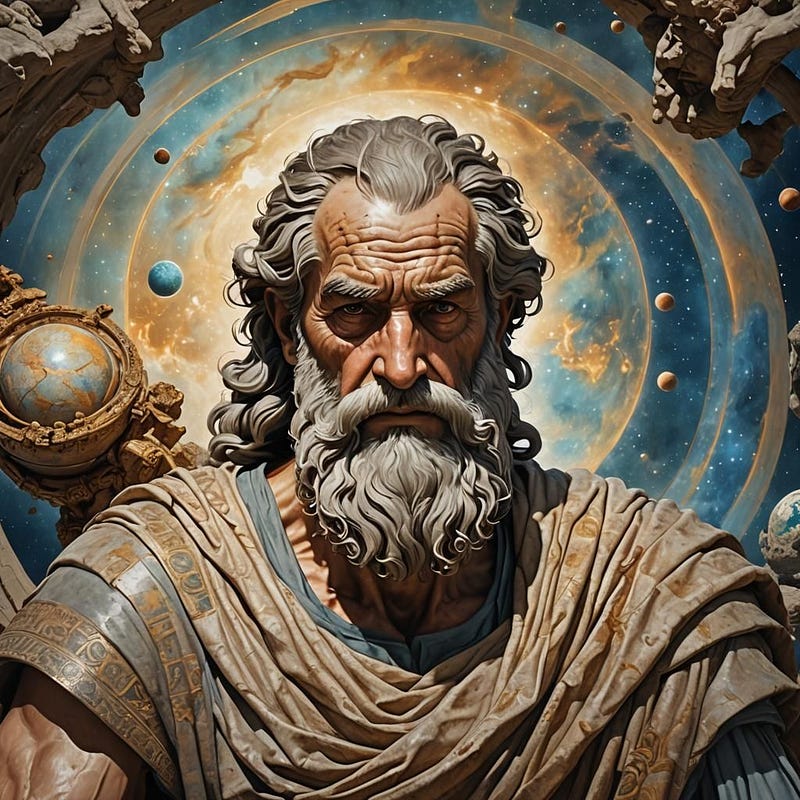
Diogenes of Apollonia: Air as the Source of Life and Intelligence
Seeking to explain the nature and origin of the universe through his own observations and theories.
Diogenes of Apollonia, an ancient Greek thinker, was a prominent cosmologist who lived during the 5th century BCE.
He was known for his unique perspective on the nature and origin of the universe, which he believed was made up of air.
His ideas were a departure from conventional wisdom of the time, and he was a critical thinker who sought to explain the world through his own observations and theories.
The Theory of Air
Diogenes of Apollonia believed that air was the source of life and intelligence, and that everything in the universe was made up of this essential element.
He argued that air was the driving force behind all natural phenomena, and that it was responsible for the existence and sustenance of all living things.
This idea was a radical departure from the prevailing beliefs of the time, which held that fire, water, or earth were the fundamental elements of the universe.
Diogenes’ theory of air was based on his observation that all living things require air to survive.
He believed that air was the life-giving force that sustained all forms of life, and that it was the source of intelligence and consciousness.
He argued that air was not just a passive element, but an active force that interacted with other elements to create the diverse phenomena we observe in the world.
The Qualities of Air
Diogenes believed that air had different qualities, such as hot, cold, wet, and dry.
He argued that these qualities accounted for the diverse range of things in the world, from the smallest microorganisms to the largest celestial bodies.
He believed that these qualities were not fixed, but could change over time, and that they were responsible for the dynamic nature of the universe.
Diogenes’ theory of the qualities of air was based on his observation that different substances had different properties.
He believed that these properties were determined by the qualities of the air that interacted with them, and that these qualities were responsible for the unique characteristics of each substance.
The hot quality of air was responsible for the warmth of the sun, while the cold quality was responsible for the chill of the night.
The Role of Air in Cosmology
Diogenes believed that air played a crucial role in the creation and maintenance of the universe.
He argued that the universe was created from a single, homogeneous mass of air, which gradually differentiated into the diverse phenomena we observe today.
He believed that the qualities of air were responsible for the formation of the stars, planets, and other celestial bodies, and that air was the driving force behind the movement and evolution of the universe.
Diogenes also believed that air was responsible for the development of life on Earth.
He argued that air was the source of life, and that it was responsible for the emergence of all living things.
He believed that air was the driving force behind the evolution of species, and that it was responsible for the development of intelligence and consciousness.
Diogenes’ Legacy
Diogenes of Apollonia’s ideas were influential in ancient Greece, and his theories had a lasting impact on Western philosophy. His emphasis on the role of air in the creation and maintenance of the universe was an important contribution to cosmology, and his ideas were later developed by other thinkers, such as Aristotle and Plato.
Diogenes’ legacy also extends beyond the realm of philosophy. His ideas about the qualities of air and the role of air in the universe have been explored by modern scientists, who have found that air does indeed play a crucial role in the creation and maintenance of the universe.
His theories about the qualities of air have also been explored by chemists and physicists, who have found that air is composed of a variety of different substances, each with its own unique properties.
Diogenes of Apollonia was a pioneering thinker who sought to explain the nature and origin of the universe through his own observations and theories. His belief that everything in the universe was made up of air was a radical departure from conventional wisdom, and his ideas about the qualities of air and the role of air in the universe have had a lasting impact on Western philosophy.
Today, his ideas continue to inspire scientists and philosophers who seek to understand the mysteries of the universe, and his legacy continues to be a testament to the power of critical thinking and independent thought.