
Dimash, the Kazakh Prodigy
Six-octave voice, seven instruments, and as many languages
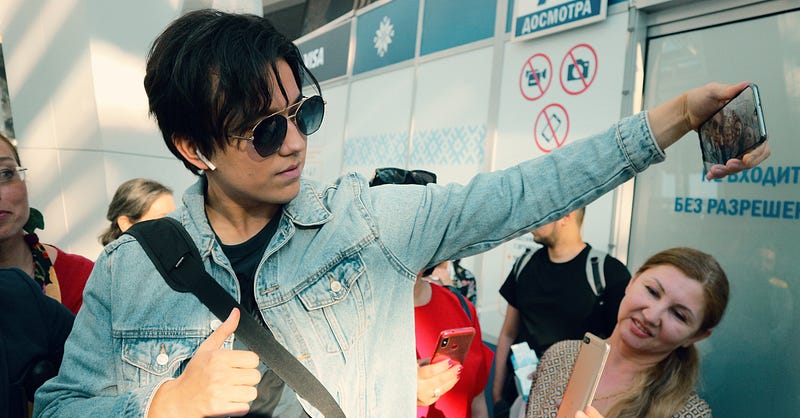
Have you heard his name?
Those among you who have been following me for awhile know that I’m a very young old lady. But this time I’ve surprised even myself: At 65 I have developed a genuine teenage crush on a music idol. Yes, I have become a Dimash Dear (as his fans are called) and I don’t care who knows it.
In fact, I am dying to share my admiration for Dimash Kudaibergen with the world. Without much further ado, this is what I am talking about:
In case the embed is not working, hurry over to YouTube NOW and copy-paste this: Dimash Kudaibergen S.O.S Slavic Bazaar 2018. Listen to it before reading the rest!
How I discovered Dimash
One day I opened YouTube to seek some distraction from the depressing COVID-19 lockdown. Anything would do: laughing parrots, baby sloths being bathed, a few tracks by Playing For Change, or some great dabke dancers.
Instead, YouTube suggested a bunch of “reaction videos.” At the time, I did not even know what those were. The thumbnails showed various music experts, from voice coaches to rappers, responding to a new phenomenon in music. The expressions on their faces upon hearing Dimash sing “S.O.S. d’un terrien en détresse” ranged from tears to shock, and prompted me to click on the first one.
The rest is history. Before I could count to three, I was, as the French say, emballée: mad about the voice (and the guy).
Dimash (short for Dinmuhammed Kudaıbergen) has a vocal range that currently covers 6 octaves (I suspect he’s still trying to stretch it). He sings every genre from opera to freestyle rap and everything in between. The son of two highly accomplished classical musicians from Kazakhstan, he was the proverbial Wunderkind, trained from childhood in every aspect of music, first at home (winning a national piano contest at age 6), then at several specialized schools, through university. He holds a Master’s degree in music and is going for a PhD. He turned down a position at the Astana opera, choosing the freedom to sing anything and everything.
At twenty-six, he looks like the ultimate teenage heartthrob (or a Korean drama actor!), and reportedly he’s also a down-to-earth, all-around nice guy with a long list of benefit shows and other humanitarian actions to his name. What’s not to like?
What on earth is he doing?
Well, in the first video I watched (based off his performance in the 2017 Chinese reality show “Singer”), being the insufferable language nerd that I am, I flinched at his French pronunciation in the first two lines. Apparently, nobody had told him that the final “s” in “je vis” and “je ris” is supposed to be silent, and so he was actually singing “Pourquoi je vise?” and “Pourquoi je rise?” Minus one point. Nevertheless… within seconds I no longer cared. That voice! That range! That incredible virtuosity!
But, what exactly was this guy doing? Showing off, that’s what! One moment he’s whispering, the next he’s belting. He holds high notes for an improbable time. Starts out in a bass and segues to a head voice, a falsetto, then a “whistle.” Seriously, my son thought I had Maria Carey on.
And I don’t normally condone that kind of immature behavior. Minus another point. The melody, however, was haunting and so were the lyrics. I wanted to find out more about the song. I looked it up and compared it to the original version, written by Michel Berger for Daniel Balavoine, a French singer who also had an amazing tessiture, and who tragically died, much too young, in a 1986 helicopter accident.
Convert to the Dimash cult
Of course, to Balavoine, a very sensitive soul and a native French speaker, it would have come much easier to put the proper emphases and emotions into Luc Plamondon’s lyrics, expressing the distress of an “earthling” questioning the meaning of life. And I don’t blame my sister in Brussels if she still prefers the original version. But I have been converted to the cult of Dimash. Because it is his version that is stuck in my head, and that I never tire of. The song that gives me goosebumps every time.
After conquering Kazakhstan and neighboring countries, his unbridled talent took him to China, Russia, and beyond. In 2018 he returned to the Slavic Bazaar Arts Festival in Belarus, which had launched his international career with a “Grand Prix,” only three years earlier. This time, he performed as a celebrity guest, not a contestant. By now he had perfected his signature song and, lucky for nitpicking me, also his French pronunciation (which, it must be said, was already remarkable for someone brought up in Kazakh and Russian). It remains my favorite among all his many songs.

Controversy in the USA
When Dimash appeared on the CBS talent show, “The World’s Best” early in 2019, he soon emerged as the frontrunner. On learning that his competitors in the semi-final were a 13-year-old Indian pianist and a 12-year-old singer from his own country, he was shocked and decided to withdraw. His surprise public announcement on the live show stunned the judges, and you can imagine the producers weren’t too amused, either. Dimash explained that he did not want to compete against these young people who needed the opportunity much more that he did. Eventually, the talented young pianist, Lydian Nadhaswaram, walked away with the title of World’s Best and a cool million dollars in prize money.
My boy Dimash is far from a one-hit wonder. Aside from many popular covers, he has, in collaboration with Russian composer Igor Krutoy, built a repertoire of original compositions. Despite the World’s Best debacle, he had his first solo concert in New York in December of 2019, with 19,000 fans from 63 countries gathered in a sold-out Barclays Center. Some wore sparkly tiaras spelling DEAR.
A 2020 European Tour started in February but was canceled in March, due to the COVID-19 related measures taken internationally.
Did I mention that he also composes, writes lyrics, and can play seven instruments? Or that, bilingual in Kazakh and Russian, he’s getting more fluent by the day in English, French, and Mandarin, while singing in numerous other languages…?
All this gushing is making me tired. If you want to hear or know more, I will now refer you back to YouTube, which is brimming with oodles of Dimash performances, Dimash trivia and assorted tell-alls. Viva la Dimashmania!
Rasheed Hooda Salam Khan Desiree Driesenaar Dennett Dr Mehmet Yildiz Gurpreet Dhariwal Charlotte Zobeir Ali Holly Jahangiri ICO Anuradha Amy Marley Roz Warren Jojo Anjali Puri Niru Priyanka Srivastava James Finn Sana Rose Mziqbalk Kevin Buddaeus Eric Griggs Rehanshah Shirin Khan Christine Van den Hove Hadjira Hussain Khan Shelley Schanfield Shringi Kumari
Post Scriptum:
Another story related to Dimash and one of his most famous songs, Daididau:
Enjoy!


