
Digital Strategy as Experimental Science
The “set it and forget it” approach is dead

A good strategy should be rather straightforward — describing where an organization is going and how to get there. But the complexity arises when a beautiful plan going down execution highway trips and faceplants on the concrete of reality.
We all know things change. Uncontrollable external forces unfold and unleash havoc. So no matter how much a leader may finetune, roadshow, or polish their precious strategy, the plan is inherently limited…often in big ways.
This especially applies to organizations going through digital transformations. Whether you’re completely modernizing or just optimizing technology — or completely reinventing your business model — digital strategies will face serious roadblocks.
The problem is two-fold:
- “Transformation” is a misnomer. Many leaders craft digital strategy as though it’s a one-time occurrence (“We transform from A [analog] to B [digital] and then we’ll be good.”). Going digital is not a transitional period, but a new and sophisticated operating state altogether. It’s a shift in mindset and capabilities.
- Digital capabilities must stay ahead of a chaotic, fast-paced world. Competition is now extreme and truly global, with much of the power swinging to buyers. In this world of niches, customers have choices, so we must adapt quickly if we want to serve them.
A strategy is hard enough. Digital strategy — while all the rage — is even harder.
The unique challenges with digital strategy
“The righter we do the wrong thing, the wronger we become.”
— Russ Ackoff
Tuning a digital strategy to fit organizational needs is a continuous process that needs to address external drivers. Customer engagement platforms must be refreshed to meet evolving user experience (UX) requirements. Backend IT infrastructure might need newly-available cloud services. Or maybe your internet-connected hardware products require a new suite of software services.
Then there are actual external threats. Competitors forming alliances, making acquisitions, or blindsiding you with new digital features. New domestic and international regulations coming down on an increasingly “connected” society. Or cyber threats actors running rampant, taking advantage of the digital attack surface you’ve now made available to them.

Getting digital business “right” is like trying to hit a moving target. What you know quickly becomes outdated.
The more we attempt to ground digital strategy in well-planned logic, the more we rely on existing (inherently outdated) information, which drives us toward mediocrity.
The point is: digital strategy requires constant attention. Setting a static strategy — especially in digital business — can be a recipe for disaster. Instead, the opportunity lies in a dynamic, science-based approach.
Betting on scientific experimentation
“The game of science is, in principle, without end. He who decides one day that scientific statements do not call for any further test, and that they can be regarded as finally verified, retires from the game.” ― Karl Popper
Boiled down, a strategy is just a guess. If we knew for certain that a given action would deliver a certain outcome, we’d just plug away like robots. But life is interesting — it doesn’t work that way. The world doesn’t stand still and neither can your strategy.
More than simply setting a course, strategy is equally about discovery.
Remember, winners know things that (ahem) losers don’t. We need to experiment, and we can look to an approach ignited by Aristotle and formalized by the likes of Bacon, Descartes, and Newton: the scientific method.
In the scientific method, we first bring focus by framing the issue with key questions: What customer problems are we solving for? How do digital capabilities enable that? What few bets might generate outsized returns (think 80/20)?
Second, develop your hypothesis. You’ve got some understanding of what your strategy should be and why, so put it on paper and get a core group of people excited about its essence. No need to overbake the details or start printing posters; just establish clarity at the high level.
Third, jumpstart strategy execution with small actions. Think tiny movements. What single major initiative can we most easily design and launch? What three pieces of low-hanging fruit can we tear off and claim as quick wins? Rather than be obstructed by a long-winded, overly-polished strategy, simply get moving — gain momentum.
Finally, the most important phase: the learning engine. It’s all about discovery and strategy refinement. Complete the loop by turning on all relevant “sensors” in your organization (human, machine, and otherwise) to start listening and analyzing. Are we making progress? What just failed? Where are we getting uptake? Find the signal in the noise, and then bring those insights back to the center.
The learning engine should be lightweight and customized for the given organization. At the core, it should include (a) a small set of capabilities designed to consume several key “learning” variables from the operating environment and (b) a simple organizational structure and process for dissecting the information and deriving new insights that’ll help you update the digital strategy.
By employing this experimentation approach, you’re aiming to:
- Gain clarity on what you know and don’t know
- Make flexibility a core tenet (e.g., goal and tactic modification)
- Value speed over accuracy
- Seek out and devour context as a habit
The more you learn, you’ll notice your strategy starts bending and taking some hits. It might feel disconcerting at first, but that’s alright; you’re learning what’s working and what’s not, and that’s what matters. Digital strategy is a living thing — when you’re open to this idea, a better strategy continually emerges.
Adopting an emergent strategy mentality
“[Strategy is] a never-ending process of successive steps in which continual nibbling is a substitute for a good bite.”
— Charles Lindblom (The Science of “Muddling Through”)
When looking at companies’ strategies, Professor Henry Mintzberg would often get upset with how obnoxiously verbose they were. He often asked, “Why is there so much BS?” His view: BS levels grow as the desire for peering into the future outpaces the availability of reliable information. So he got to solving for this, championing the idea of emergent strategy.
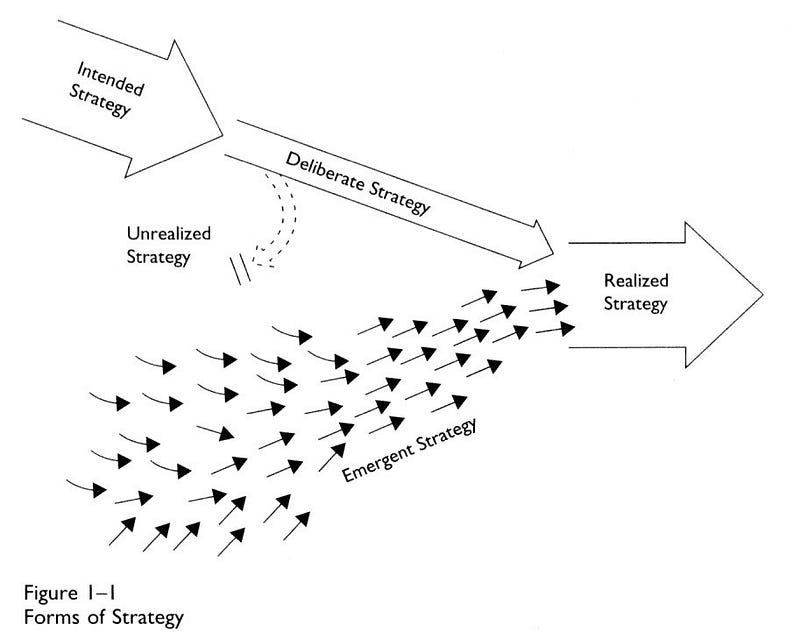
He argued that static plans mislead, especially in a world of constantly-changing external variables. So why put in all the effort? Instead, the emergent strategy focuses on:
- Shaping the environment for experimentation (the scientific method gives organizations a framework for doing this)
- Creating a testbed that generates a continual flow of insights
- Finding ways to make sense of the environment within a quarter or two (as opposed to a year or two)
- Continually asking, “are we on the right track?”
- Determining the signals (e.g., customer feedback, KPIs) that really illustrate if the strategy is working or not
When using an emergent strategy approach, it’s vital to keep your head up and on a swivel. If you’re heads down (working IN the business), you’ll likely miss important signals. Instead, leaders need to spend more time working ON the business — finding ways to continually transform based on learnings.
Let’s say a small customer analytics unit was just stood up, and you’ve licensed them a high-powered predictive analysis technology platform (oh, they’re excited!). This maneuver is an experiment, and it requires leaders to work ON it — providing that group top-level expectations while also clearing roadblocks that will aid their success.
A good digital leader recognizes their own fallibility without losing confidence that they can uncover valuable new insights over time. Yes, they should always be testing a rational hypothesis, but the key is to cultivate an unbiased mind. The Stoics championed this as having an indifferent view.
Would you rather work with the leader unflinchingly trying to prove their strategy right? Or the one who’s open-minded, willing to change direction based on emerging information?
Conclusion
A digital strategy is nearly impossible to “lock-in”. Instead, a good strategy responds creatively and intelligently to externalities beyond our control. Given the importance, let’s get comfortable with shaping an appropriate mindset and the capabilities that allow for this emergent way of crafting, executing, and refreshing digital strategy.
Want to stay in touch? Follow me on matthewdoan.com, Medium, LinkedIn, and Twitter.