
ANTARCTICA
Digging Into Antarctica: A Recent RAND Corp Document On The Reality Of Antarctica
Geostrategic Manoeuvring and the Future of the Antarctic Treaty System
The 88 page document published by the RAND Corp in 2023 has 10 authors and states in the intro, “Antarctica has long been conceived of as a continent of peace and calmness, bereft of all but limited human activity. In reality, however, it is a resource-rich continent historically contested by multiple powers seeking to gain both symbolic and material gain. Although the territorial claims of seven states — Argentina, Australia, Chile, France, New Zealand, Norway, and the United Kingdom (UK) — were frozen as part of the 1959 Antarctic Treaty (AT), tensions remain over what it means to possess territory in Antarctica, what activities are permitted, and what Antarctic sovereignty actually means. These issues are exacerbated by the AT’s broad language, which is intended to provide countries with the flexibility to pursue peaceful exploration and scientific research.”
I added the bolded language for emphasis. I will continue sharing parts of this document I find most important. You can access the document yourself here.
Also, if you want more source material on the background of Antarctica you can read my previous article A Sober Exploration of Antarctica and UFOs where I dig into Operation High Jump and the International Geophysical Year (IGY) using the US Navy’s own documentary and documents as primary sources. There’s little evidence of actual UFOs, but a clear history of modern aerospace being birthed in Antarctica leading up to the Antarctic Treaty.
“…as international dynamics have shifted, the [Antarctic Treaty System] ATS has become increasingly exploitable. The ATS does not resolve outstanding territorial claims, nor does it force countries to inspect the activities of others to ensure compliance; it merely suggests that they do so. Therefore, it is difficult to determine the true activities of civilian and military personnel stationed in Antarctica. Moreover, although the ATS nominally prevents development and mineral extraction, Russia and China, in particular, have identified the Antarctic as a source of rare earth elements and might pursue these activities more readily after 2048, when the Environmental (Madrid) Protocol is potentially up for review.”
“Although some aspects of the ATS — specifically, the Environmental (Madrid) Protocol — are potentially up for review in 2048, the future of the continent is likely to be decided in the intervening years by strategic-minded parties seeking to exploit susceptibilities in the lean mechanisms of the ATS.
Indeed, given some of the public statements by various national entities (which we will discuss later in the report), it is anticipated that, in the coming decades, there will be efforts by some actors to either recalibrate (bend) the ATS to their benefit or potentially render unworkable (break) the ATS and seek a new international instrument to govern Antarctic affairs.
To explore these dynamics, we focus on three questions:
• How might growing strategic competition among actors with interests in the Antarctic manifest in the lead-up to the potential review of elements of the ATS?
• What might this mean for the broader treaty system, particularly as it pertains to sovereignty and ungoverned spaces?
- How might these trends in the Antarctic affect great-power competition globally?”
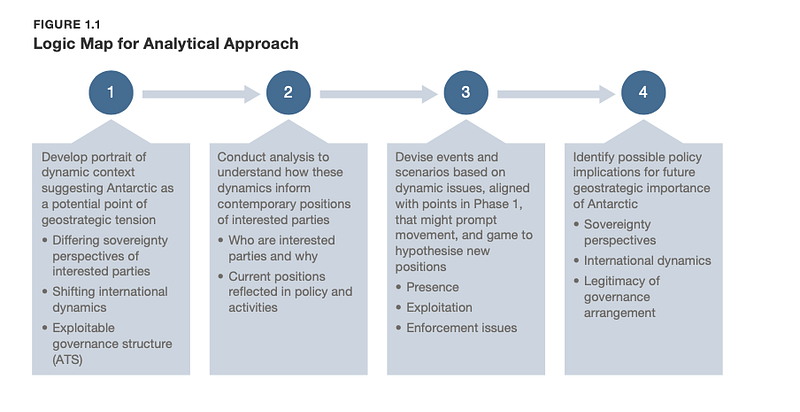
“Therefore, we hope this report will deepen discussion, not just on the Antarctic but also on ungoverned and alternatively governed spaces that are emerging as potentially contested spaces, including the polar regions, outer space and the electromagnetic spectrum.”
History
“The years 1898–1899 marked the beginning of what would later become known as the ‘“Heroic Age” of Antarctic exploration...States began to make formal claims to Antarctic territory in this period and continued to do so up to World War II. Argentina established the Orcadas station in the South Orkney Islands in 1904 and declared the surrounding region as under its control. The British laid claim to vast parts of Antarctica in 1908. Portions of their original claim were apportioned to New Zealand and Australia in 1923 and 1933, respectively. Norway made a formal claim in 1939, partially to protect the area where its explorers had traversed to prevent an arriving Nazi German expedition from laying its own claim and partially to protect its fishing industry.
South American states made their own formal claims as well, in part because of their geographical proximity to Antarctica. Chile announced its formal claim over the Antarctic Peninsula and its environs in 1940 (partially overlapping the British claim) and was soon followed by Argentina declaring a claim over much of the same region in 1942. In 1948, the two South American countries signed an agreement not to contest each other’s claims. In 1955, Chile and Argentina formally rebuffed efforts by the UK to settle the three countries’ overlapping claims in the ICJ. This dispute, alongside growing Cold War competition, constituted one of the primary motivations for the International Geophysical Year (IGY) and the AT.”
“Inspections simply might not be sufficient to effect compliance. Moreover, we have seen the effect that unforeseen challenges, such as the coronavirus disease 2019 (COVID-19) pandemic, have had on governance in Antarctica. For the first two years of the pandemic, ATCMs and CCAMLR meetings were delayed or cancelled, and inspections largely ceased, which has increased concerns and decreased quality of governance of the whole system.”
“An increased emphasis on transparency and encouraged compliance does not necessarily equate to their existence in practice, however. The ‘Antarctic Treaty provides no specific criteria by which to measure States’ compliance, nor any monitoring programs to determine the recommendations’ effectiveness’. On the ground, there have been, and continue to be, ongoing tensions ‘between maintaining peace between States, which govern through consensus, and ensuring compliance with the provisions of the Treaty and the Protocol’.”
“As of February 2022, the Australian government has also announced increased investment in the Antarctic, pledging an additional AUD$804 million over ten years to ‘strengthen our strategic and scientific capabilities in the region’. A large proportion of funding has been allocated to increase Australia’s aerial and inland capability, in particular inland traverse capability, helicopters, drone fleets and other autonomous vehicles. Other focuses for investment include environmental management and research in marine science and climate change impacts, which will improve Australia’s ‘ability to support Pacific partners to monitor information about climate and oceans’. Additionally, AUD$3.4 million has been allocated to ‘enhance Australia’s international engagement to support the rules and norms of the Antarctic Treaty system and promote Australia’s leadership in Antarctic affairs’.”
“Argentina’s claim overlaps with those of the UK and Chile; the AT froze these overlapping claims in 1961.
Argentina has a long and complex history with Antarctica, quite apart from its 1982 war with the UK over the nearby Falkland Islands and South Georgia Island. Argentina has held a continuous presence in Antarctica since it established the Orcadas station on the South Orkney Islands in 1904 and declared that at least part of Antarctica was part of Patagonia. In 1942, it made a formal claim to Antarctica between 25° and 68°34’ west longitude and south of 60° south latitude. In 1947, both Argentina and Chile rejected a British suggestion to resolve overlapping claims at the ICJ. Instead, Argentina and Chile ‘agreed to cooperate in defending their respective rights’. In an effort to stop what one scholar described as a ‘scramble for Antarctica’, the AT froze overlapping Argentine, Chilean and UK claims, amongst others.”
However, Argentina has also discovered how preexisting tensions with several states on Antarctic issues are becoming ripe for manipulation from within the ATS. Early in 2022, and amid tensions with the West over Ukraine, Russia provoked a quarrel among Argentina, the UK and the United States at CCAMLR over Patagonian toothfish. The feud ‘sparked fears it could threaten wider international cooperation over the fishery and risks reviving Britain’s tensions with Argentina’ and illustrates how external issues and national trajectories are affecting the ATS by changing governance dynamics in the region…In 2020, the Argentine government used a 2016 United Nations Committee on Limits of the Continental Shelf decision extending mainland Argentina’s continental shelf beyond the 200–nautical mile limit to justify the declaration of a 200–nautical mile EEZ around Antártida Argentina despite competing claims from Chile and the UK. In 2020, the Argentine government published a new map showing its expansive EEZ claim. Argentina intends to maximise its rights associated with its claimed Antarctic EEZ, including
• a 12–nautical mile territorial sea •‘sovereignty rights for exploration, exploitation, conservation and management of natural resources, both living and non-living’ • control over the EEZ, which it claims is ‘part of the Argentine Republic’…Argentina’s government has voiced concerns that China and Russia might seek to exploit natural resources on the Antarctic continent over the next 30 years.”
“in 1984, Brazil established a permanent base in the Antarctic, Comandante Ferraz Antarctic Station, on an island just north of the Antarctic Peninsula (in territory claimed by Argentina, Britain and Chile). The base burned down in 2012 but was re-established in 2020.”
“Chinese General Secretary Xi Jinping reportedly announced China’s intentions of becoming a ‘polar great power’ during a speech in Australia in 2014. Chinese military sources have also considered the polar regions as one of China’s new ‘strategic frontiers’, with the government’s 2020 Science of Military Strategy arguing that ‘[t]he polar regions have become an important direction for our country’s interests to expand overseas and far frontiers, and it has also proposed new issues and tasks for the use of our country’s military power’…The Wilson Center’s Anne-Marie Brady has also found that the 2013 and 2014 ‘annual reports on China’s polar policy both emphasized that access to the considerable natural resources at the two poles was essential for the continued growth of the Chinese economy’…The consistent development of China’s Antarctic scientific infrastructure and resources also indicates the country’s growing interest in Antarctic affairs. Notable developments include the expected opening of China’s fifth Antarctic research centre in 2024 near the Ross Sea, the development of two icebreakers to support Antarctic scientific research, and 38 Antarctic research expeditions. However, Chinese sources seem to view scientific activities in Antarctica as a tool to gain a ‘right to speak’ in regional affairs, allowing China to have greater influence in the region. Brady has noted that an ‘[e]xpanding presence in Antarctica is understood by the Chinese government as a means to establish necessary physical foundations for Antarctic resource rights, Antarctic governance rights, and the future opening up of resources’.”
“For protection of the environment, in particular, France has been a strong supporter of strict environmental regulations in Antarctica, creating frustration, in particular, on the part of China, which interprets France’s (and others’) efforts to protect the environment as an attempt to limit other parties’ ability to establish a larger presence in Antarctica. France — along with Australia, New Zealand, the UK and the United States — has been advocating since 2012 for the creation of three MPAs, which China and Russia have been opposing. As of 2021, the French Ministry for Europe and Foreign Affairs still described France as ‘very engaged in the elaboration and defense of this project’, and then–French Foreign Minister Jean-Yves Le Drian expressed his hope that ‘the two large countries that we still have to convince will soon see its soundness’.”
“France’s relations with China in the Antarctic have been tense since 2008 because of France’s criticism of Chinese policies towards Tibet; the relations have not recovered, essentially resulting in a lack of scientific cooperation in Antarctica between the two countries.”
“In 1983, Malaysia, alongside Antigua and Barbuda, raised the Question of Antarctica at the United Nations General Assembly. Malaysia’s concerns centred around
- the exclusivity as well as dominance of the ATCP within the Treaty System;
- the decision making system that lacks accountability, transparency, and democratic practices;
- the need to preserve the fragile environment on the continent at all times;
- the banning of resource exploitation on the continent under the pretext of research; and
- that the United Nations should be more involved in the administration of the continent.
- These concerns formed the basis for proposals from Malaysia, including for the ‘administration of “uninhabited lands” such as Antarctica by the UN’ under an international agreement that would ‘ensure the interests of all nations were served’, possibly under a model similar to the UNCLOS, which was open for signature at the time. These criticisms and proposals were supported by various members of the Organisation of the Islamic Conference (OIC), the Association of Southeast Asian Nations (ASEAN), and the Non-Aligned Movement. Through the Question of Antarctica, Malaysia became a leading voice against the ATS. Ultimately, however, Malaysia’s proposals were not successful, although the UN Security Council considered and debated the country’s concerns.
- Malaysia’s policy towards Antarctica gradually shifted from critique to engagement and cooperation with ATCPs, largely in the period of 1996 to 2004. Malaysia was invited to ATS consultative meetings as a non-acceding observer country in 2002, and an invitation from New Zealand to conduct research at its Scott Base led to the first scientific expeditions by Malaysian scientists in 1999. The Question of Antarctica was removed from the UN General Assembly’s active agenda in 2005, by which time Malaysia had indicated its intention to accede to the ATS. Over time, Malaysia’s focus has progressively changed from the relationship of the ATS and the ATCPs with the UN to environmental protection and concerns over issues including ‘tourism, IUU fishing, bioprospecting, and liability for environmental damage’.”
“In its 2021 budget, the New Zealand government committed NZD$344 million to rebuild Scott Base to accommodate up to 100 people.”
“It is noteworthy that the protection of Southern Ocean resources and support for a permanent presence in Antarctica feature prominently in the most recent New Zealand Defence White Paper, in which the New Zealand Defence Force has an explicit role in supporting New Zealand’s civilian presence in the Ross Dependency. This is a recognition by the New Zealand government that maintaining its interests in Antarctica will be challenged by the new strategic environment. The white paper notes that the increasing number of countries with a presence (e.g. bases) in the region is a signal of ‘the value that other countries place on having a presence in the region, [and that] while scientific research is a key focus for most countries, the motivations of others may be less clear’. Indeed, some have asserted that ‘China’s interests and activities in Antarctica appear to breach the terms of the Antarctic Treaty and have the potential to undermine New Zealand’s stated interests there’. That being said, New Zealand works closely with several other countries in Antarctica, including the United States, Italy and South Korea.”
“Norway is the only state in the world that governs territory in both polar regions. The northern tip of the Norwegian mainland, the Svalbard archipelago and Jan Mayen are all north of the Arctic Circle, making Norway one of eight recognised Arctic states within the Arctic Council. At the same time, Norway is also claimant to the 2.7 million square kilometres of Queen Maud Land in Antarctica and to Peter I Island. The uninhabited Bouvet Island lies in the sub-Antarctic region but is not part of the ATS.
Norway was one of the first states to officially claim Antarctic land (Norwegian whalers began map- ping Antarctica in 1892). Fishing remains one of Norway’s key interests in the Antarctic; the Norwegian whaling industry previously dominated the Antarctic oceans from the turn of the 20th century to the 1960s. In 1991, the Norwegian explorer Roald Amundsen became the first explorer to reach the South Pole, and Norway’s first claim to Antarctic territory was made in 1939 to protect the whaling industry from other states’ competing claims to Antarctica and its surrounding waters, as well as to prevent Nazi Germany from staking a claim.
Beyond fishing, Norway’s interests in the Antarctic region centre around peaceful scientific research and environmental protection. Norway works to promote Norwegian sovereignty over its claimed Antarctic territories and peaceful governance up to and beyond the mandate of the ATS. Following the heightened geopolitical tensions in Europe in the 2010s — notably, Russia’s invasion of Crimea — Norway formally annexed the previously ungoverned space between Queen Maud Land and the South Pole in 2015 to signal its increased strategic interest in the polar regions. The same year, the Norwegian Parliament issued a white paper mapping out key strategic interests and policies for Antarctica. Norway’s strategic interests in the region are founded on the stability of shared Antarctic governance and the management of heightened Russian and Chinese Antarctic activities. Antarctic operations cost Norway between 30 and 40 million kroner (roughly US$4 million) per year. However, Norway has pushed for further private-sector investments in Antarctica and has leveraged its commercial fishing, tourism and space industries to increase its profits.
Norway established its first permanent research station, Troll, at Fimbulheimen Mountain, 235 kilo- metres inland from the ice shelf. In addition, the marine research icebreaker Kronprins Haakon has been operational since 2018 and constitutes one of Norway’s primary investments in international research collaboration. Furthermore, Norway is party to multiple sub-treaties of the ATS that concern environmental protection. Preserving the unique geology of the Antarctic is a cornerstone of Norway’s research efforts in the region, and the country previously chaired the Protocol on Environmental Protection to the Antarctic Treaty negotiations. Norway also maintains its historical role as an advocate for sustainable and highly regulated resource extraction in the region and strongly opposes efforts by actors such as Russia and China to relax the existing regulations.”
“In addition to being an Arctic state, Russia signalled its strong interest in Antarctica in 2020 by dubbing it the ‘Year of Antarctica’ in honour of the 200th anniversary of the Antarctic continent’s discovery by Russian naval officers Fabian Gottlieb von Bellingshausen and Mikhail Lazarev. Russia’s physical presence consists of six research stations (four permanent and two seasonal). An additional four Soviet-era stations have been closed, the last one in 1991. Russia has not built a new research station in Antarctica since the last stations were opened in the 1980s. However, the months preceding the Year of Antarctica saw the announcement of numerous projects to modernise and revitalise these stations, including USD$113 million to reequip Russia’s Vostok facility.
The Soviet Union was among the signatories of the AT in 1959, which stated that the Soviet Union — and, by extension, its modern successor state, the Russian Federation — was one of two countries in the world, along with the United States, that maintained a ‘basis of claim’ at the time of signing. This means that Russia is legally eligible to formulate a territorial claim on the continent; however, it has not done so, nor has the United States. Still, Russian President Vladimir Putin has stressed Russia’s historical links with Antarctica, arguing that Antarctica is well known by its Russian geographical names.
Russia has stated that it believes it has been marginalised in the region compared with its Western counterparts, particularly in recent years. It has critiqued the Antarctic Ocean Commission for making decisions that Russia feels to be discriminatory. Russia has, therefore, shown significant signs of seeking to increase its presence in the Antarctic and to become a major player in the region. To this end, in addition to its efforts to revitalise its physical infrastructure, Russia has sent several scientific expeditions to Antarctica, including assessments of fish stocks. Russia also has conducted surveys of underground resources despite the prohibition of any drilling activities on the continent.
Arguably, Russia’s renewed interest in the region is based on economic interests, including a desire to pursue exploitation of natural resources in the Antarctic. These resources include oil, natural gas and minerals; Antarctica is known to have significant deposits of gold, coal, iron ore, copper, zinc, nickel, lead and hydrocarbons. Russia also wishes to reinvigorate its fishing activities (including large-scale fishing of krill), which reached their peak prior to the collapse of the Soviet Union; Russia recently announced plans to invest millions of dollars in a krill fishery. Fishing activity is also restricted by the ATS.
Russia and China have worked together on several fronts to achieve mutual goals in the Antarctic continent. Both countries have expressed an interest in relaxing the Madrid Protocol to permit further resource extraction. Similarly, Russia has repeatedly vetoed the establishment of new MPAs at annual meetings of the CCAMLR. Critics allege that Russia has opposed such measures, which sought to protect wildlife, primarily out of a desire to prevent reduction of permitted fishing areas. Russia and China similarly have cooperated in the field of scientific research, signing a memorandum of cooperation between their research institutions in 2017.”
“While South Africa has acknowledged the increased interest of some states to take advantage of Antarctica’s mineral deposits, potentially to the detriment of the environment, it is likely that South Africa will seek to preserve the status quo if the Environmental (Madrid) Protocol is renegotiated in 2048.”
“The UK has a strong historical connection to the Antarctic, dating back to the Royal Navy expedition of Captain James Clark Ross in 1839–1843. Serious UK government interest in the region began in the late 19th century, when the British Empire sponsored further exploration of the Antarctic, including the Discovery Expedition led by British explorers Robert Falcon Scott and Ernest Shackleton.
The UK first claimed sovereignty over parts of the Antarctic in 1908: specifically, South Georgia Island, the Sandwich Islands, the South Shetland Islands, the South Orkney Islands and Graham Land. The UK also claimed sovereignty over Victoria Land and Enderby Land but transferred control of these areas to Australia in 1933. The UK’s British Antarctic Territory Strategy states that the UK’s claim to Antarctica is the oldest legal claim. At the time of claimancy, the uninhabited area claimed by the UK was referred to as a dependency of the Falkland Islands.
The first permanent British presence in the region was established during World War II by the British Admiralty and Colonial Office, with bases at Deception Island and Port Lockroy. These bases were manned by members of the Falkland Islands Dependencies Survey, which conducted scientific research and maintained British presence in the region from 1945 onward…The 2021 Integrated Review of Security, Defence, Development and Foreign Policy stated that the UK would ‘continue to uphold and strengthen the ATS and maintain our leadership in the study of the global implications of climate change in Antarctica’. However, the UK is also committed to maintaining its territorial claim, the ‘oldest formal territorial claim’ in the Antarctic, and it explicitly stated in the 2021 Defence Command Paper that it was ready to fight for its overseas territory in the Antarctic.”
“The United States is an original signatory state to the AT. Unlike the seven signatory states, the United States makes no formal claim to any Antarctic territory. However, like the Russian Federation, the United States ‘maintains a basis to claim territory in Antarctica’ if it so chooses. The United States was a major negotiator in the ATS process. As with other states, the United States conducts inspections of other countries’ stations to ensure that they are compliant with the AT protocols…U.S. interests in the Antarctic began in earnest in the years leading up to World War II. In 1928 and 1933, Admiral Richard Byrd undertook two privately funded expeditions to the region. In 1939, the Navy funded the U.S. Antarctic Service Expedition, also led by Byrd, to develop bases at Marguerite Bay and the Bay of Whales.
The United States is a strong proponent of the existing ATS and does not recognise any other signatory state’s territorial claim. Instead, it recognises other signatories’ responsibilities to the AT and expects them to recognise the U.S. position in turn. The U.S. Department of State notifies signatories when an NGO expedition ‘organized in or proceeding from the United States’ occurs…Notably, the strategy highlights the IceCube Neutrino Observatory, ‘a cubic-kilometer array of 5160 optical sensors [that have] been emplaced deep in the 9,000-foot (2,745-meter) thick ice sheet near the South Pole’. The observatory’s purpose is to identify and better understand neutrinos and dark matter in the universe. The National Science Foundation manages scientific research and associated logistics in Antarctica and aboard ships in the surrounding oceans…Some American observers have echoed their Australian and British counterparts in voicing concerns that China and Russia are expanding their goals in Antarctica to potentially include mining and dual-use infrastructure. In particular, China has been identified as seeking to develop a formal claim through its growing number of scientific research stations.”
Table Top Exercise
“a. The first point was that the terms science and peaceful purposes, which are fundamental to the integrity of the ATS, might be interpreted in novel ways by both claimants and non- claimants as Antarctica becomes embedded in a technologically mediated environment. This environment might result in new activities and actors, and it might be particularly difficult to navigate in the context of dual-use and autonomous technologies.
b. The second point was that enforcement responsibilities are largely addressed by participant nations’ domestic legislation, but there is a tension between exercising legislative jurisdiction and upholding the ATS. If a claimant’s law is not enforced within the claimant’s territory, a claim could be questioned. However, enforcement on a territorial basis might undermine good relations and influence in the ATS.
c. The final point was that there are significant ambiguities in Antarctic governance caused by misalignment of the ATS with other international agreements. For example, there is ambiguity as to the status of coastal states’ claims to rights over the extended continental shelf, which some claimants consider to legitimately extend from their Antarctic territories. Recognition of these rights might be considered enlargement of existing claims, which is not allowed under the AT.”
Game 1: Bend
“Environmental concerns and climate change were not an obvious priority for many countries, perhaps reflecting a move from the altruistic nature of the ATS at its establishment. Indeed, we were struck that there was not a single mention of the penguins. Where we did see mention of environmental issues, it tended to be tied to other strategic ends, especially in the context of potential resource exploitation. In some cases, those who wished to counter resource exploitation were driven by their own self-interest (e.g. domestic reserves).”
“We found that, across the breadth of the responses, there was an inclination towards realpolitik and an assumption that states would use the Antarctic to prosecute other strategic ends. Most countries were relatively open to exploitation of the ATS and the Antarctic continent, although it was unclear whether anyone was willing to move first.”
“Although there were not any significant shifts in position for the updated response round, across the breadth of responses, we found intensification of the sentiment that the ATS was becoming unworkable and clear concern that Antarctica was at risk of being carved up like Africa during the late 19th century, split among rival powers jealously guarding their own interests and threatening everything from the Drake Passage to the maritime environment.”
Game 2: Break
“We saw an obvious tension between states that viewed the commencement of astronaut training and titanium mining as a precedent for a ‘race to the bottom’ in terms of exploitative, polluting and militaristic behaviours and states that saw these activities as signifying advancements in scientific research with broad-based benefit.”
“We saw continued concerns over ‘who owns what’ and over attempts to control parts of the Antarctic to inhibit the movement of others. In some cases, we saw this turn into openness to more-explicit assertions of sovereignty.”
“For the United States, a reformed ATS would need to address at least two broad issues: (1) what constitutes scientific research and (2) resource exploitation. Scientific research includes space research, but it must be conducted by civilians or military personnel in an open, transparent manner. A reformed ATS would need to decide whether limited mineral resource mining can occur, and the treaty’s language would need to be strengthened to close loopholes and clarify the ATS’s relationship with UN-related laws. The reformed ATS would also need to address emerging interests of private companies, ranging from tourism to space exploration, and it would require teeth (i.e. the real weight) to be effective, which might include a sanctions regime and suspension from voting rights within the ATS general meetings.”
What Does It All Mean?
“We found that ambiguity in such international arrangements as the ATS, particularly those that were developed for another age (e.g. analogue as opposed to digital, Cold War as opposed to multipolar), will likely be exploited in favour of narrow national interests. States will seek to capitalise on what is increasingly perceived as a weak and unconventional governance mechanism, even more so as the lines for legitimate conduct are blurring. Extended or contested definitions of scientific, research and peaceful purposes and increased use of dual-use technologies on the ground might increasingly be used as cover for realising a benefit or an end, as is the case in the Arctic and the South China Sea. Emerging technologies, particularly automated systems, create new ways in which entities can interact and operate. The ATS will need to be adjusted to accommodate this reality. Moreover, the lack of enforceability in the ATS has shown the limitations of countries seeking to exploit loopholes. Under these circumstances, grey zone tactics to test stated red lines might become common practice.”
What These Results Mean for the Antarctic Treaty System
The lines for legitimate conduct in Antarctica are blurring, and both claimant and non-claimant states are taking advantage of this situation, which, in turn, causes further distortion of the ATS. The provisions of the AT reflect the 1950s context in which they were written. However, since that time, the strategic climate has shifted so markedly that the treaty and associated instruments no longer reflect the primary concerns of many interested parties. Under these circumstances, actors will be more inclined to push on what they perceive as weak points in the ATS.
The worst-case scenario — which this research has shown is within the capacities of our current comprehension — is that perceived weakness in the ATS’s governance and enforcement mechanisms will result in a race to the bottom in terms of exploitative, environmentally damaging and militaristic behaviours. Once an interested party takes a course of action that challenges significant elements of the ATS, other parties might sense that dissolution is inevitable and pursue a similar course to ensure that they are not excluded from accessing the same benefits. This fundamentally destabilises the ATS: Countries are more willing to prioritise national interests over the global good, at high cost to, and possibly even the dissolution of, the ATS.
These courses could take multiple forms, but our research has highlighted several areas with a high propensity for exploitation. The growth of dual-use technologies — i.e. those technologies that can be used for both peaceful and military aims — opens a Pandora’s box, whereby exploitation of the Antarctic becomes inevitable and the decline of the ATS becomes irreversible, particularly if a country decides that it needs to protect itself. Moreover, dual-use technologies might expand the definitional contours of the terms scientific, research and peaceful purposes. These terms constitute and reflect the fundamentally altruistic underpinnings of the AT and the broader ATS, and, therefore, their exploitation could mean the effective dissolution of the binding spirit of Antarctic governance as we know it.
Our TTX revealed heightened concern over such activities as mineral exploitation, particularly by countries such as Russia and China. However, once one country violates the Madrid Protocol, the flood- gates for similar activity could open, especially because there are no means to enforce the Madrid Protocol in real terms. Therefore, if the moratorium on mining and drilling is ignored, and mineral exploitation becomes inevitable, a compromise to maintain the ATS that is acceptable to all parties would likely be a push for mineral exploitation to be closely monitored by international observers.”
Implications for Competition Globally
“With the new space race gaining momentum, Antarctica might also be seen as a feasible location for developing space-related infrastructure and for conducting critical testing for space travel. For example, China views outer space as a domain for future competition and the polar regions as the ‘strategic commanding heights’. Therefore, it is not a stretch to imagine that China might not only build infrastructure in Antarctica but also send scientists and members of its military to support the efforts. Once one country starts using Antarctica for these purposes, others involved in the space race will follow.”
“Our analysis suggests that the altruism that underpinned the ATS is unlikely to survive; contemporary interests in the Antarctic are driven by, whatever the rhetoric, realist priorities.”
“Commercial interests in Antarctica are likely to increase, as is the presence of NGOs. This might be symptomatic of a potentially increasingly anarchic system that will benefit some countries but disadvantage others. It might also be the catalyst for growing global competition among interested parties over resources found in the region, for which there is no scope for management under the ATS.”
IF YOU ENJOY MY WORK PLEASE FOLLOW ME ON MEDIUM
You don’t have to join Medium to read my work, but if you do use the link below.


