
This framework changed my perception on conflicts with my partner
I struggled with a rule that my boyfriend had: no surprises, no presents. As someone who prides herself on her surprise party-throwing skills and hilarious joke gifts, venturing outside of this was confusing.
At first (yes, this is dumb), it shook my world because I didn’t even know there were other ways to show love and appreciation. But we’ll circle back at this in the end, if you’d like to hear that story.
Part 1: Finding commonality
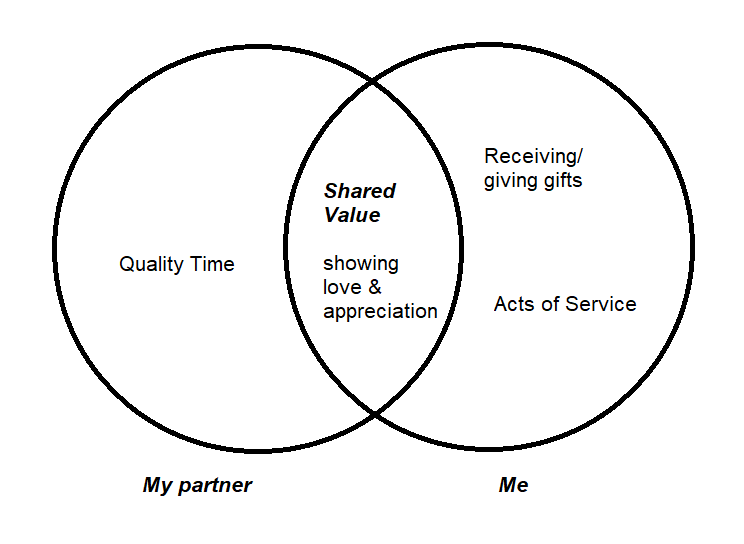
Mark Manson talks about having values (things that you care about) and metrics (how you measure whether the things you care about are being done). This framework helped me find commonality in values but understand that my partner and I may have had different metrics.
We shared the value in wanting to show love and appreciation.
However, we both naturally assumed that the other wanted to receive love the same way we wanted to receive love. In this case, the other party might feel neglected because their needs aren’t fulfilled but you feel like you’ve given all the love you can to them and feel frustrated and unheard about this accusation.
Part 2: Understanding the differences

This is where Gary Chapman’s Five Love Languages was a helpful tool to help us communicate how we were each measuring this shared value of appreciation.
The five love languages are ways that people like to receive or show affection in relationships, including:
- Words of Affirmation
- Physical Touch
- Receiving gifts
- Quality Time
- Acts of Service
The way that I was showing affection was by giving gifts and throwing surprise parties or random acts of kindness (acts of service), because in turn, I personally value those experiences. The thought that goes into tailoring a gift choice or event planning just scratches that itch. (Yes, I am basically Leslie Knope from Parks and Rec).
My boyfriend felt really burdened about it, and I can see that perspective too. (Spoilers: Thank you to the Parks and Rec episode where Leslie’s best friend and partner staged an intervention for her gift-giving so that there would only be ONE gift-giving day per year)
On the other hand, after we did the quiz together, I realized he valued Quality Time spent together above all else. All this time he just much preferred to just low-key chill together, while I was freaking out, thinking: “I’m not doing anything. I’m not giving anything. It’s just time. ”
The short of it is that by working through this together I learned that the best gift, most tailored, thoughtful gift I can give him is dedicated, uninterrupted time. It was honestly that easy.
And he learned that in our time together, I’m more adventurous and always want to try new things whereas he likes routine. We found an activity that incorporates both: cooking new recipes. For me, I’m trying new food, new cooking techniques; for him: we’re following a recipe. Rules. Good.
The summary
- In conflicts, I like to think about what values we share in common, and then figure out how we might be measuring that value differently.
- When it comes to romantic relationships, the five love languages framework was helpful in explaining metrics for expressing affection, because often, we aren’t aware of our own blind spots
(epilogue) The backstory I mentioned earlier
Over time I started wondering why certain people favour certain types of showing affection over another.
For me: I internalized my immigrant parents’ way of showing love. They never apologized, they never praised, but if you were on good behaviour maybe you’ll get an extra chicken wing at dinner. I associated gift-giving as a way to show appreciation when words seemed empty. (Unfortunately, I also associated food as a coping strategy for any kind of negative emotion, but that’s another story, for another day).
For my boyfriend: he experienced the same kind of parental love but reacted differently, and it became guilting and burdensome.
Even in the same context, we reacted differently based on our personalities. And that’s something I’m always so curious about exploring further.
It was really cool to draw connections over two books like that (Mark Manson’s The Subtle Art of Not Giving a F*ck and Gary Chapman’s The Five Love Languages).
I also recently (finally) caught up on Marie Kondo’s books!


