
THE RARE BOOK SECTION
Diet or Die — The Story of Dolly Dimples, the “World’s Prettiest Fat Girl”
An exceedingly rare book that will knock you back around $600 if you can even find a copy for sale
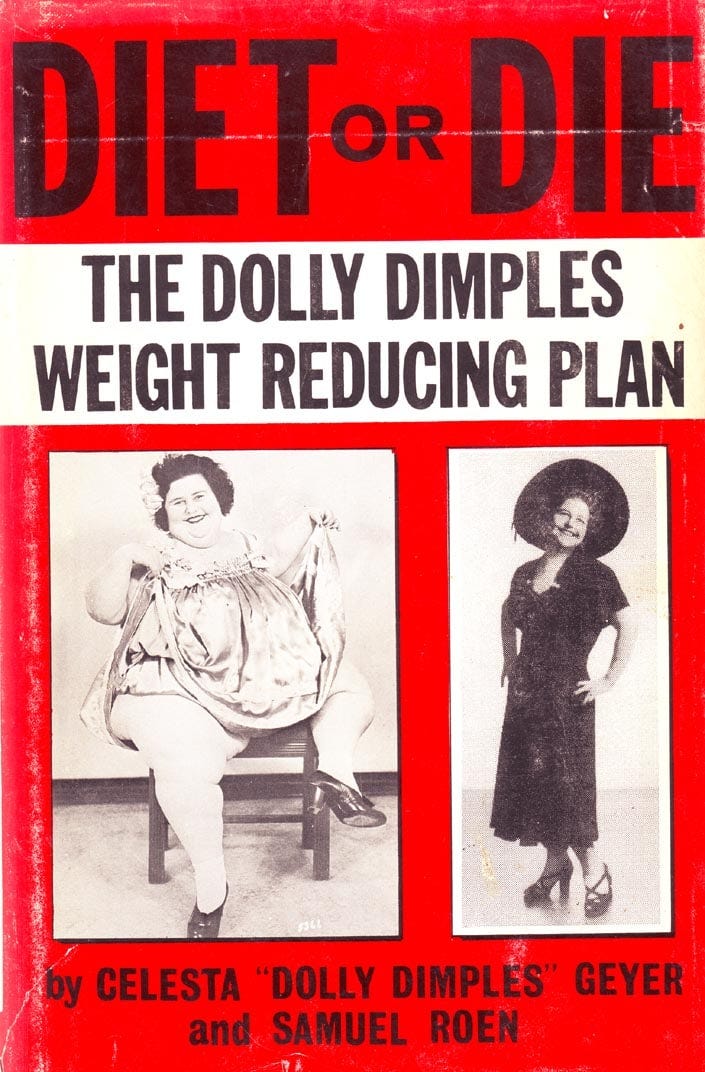
Trigger warning. This is not a piece about fat-shaming, but it is about a woman’s journey, losing hundreds of pounds after her doctor bluntly told her she must lose weight or face certain death.
I read this book, Diet or Die: The Dolly Dimples Weight Reducing Plan, sitting inside a study carrel at the University of Calgary’s library. I was a student at the time and was supposed to be writing an archaeology term paper on the ancient town-site of Meroe.
When I saw the book on the shelf I was intrigued by the cover. It showed the smiling face of Dolly Dimples — a woman who’d lost 440 pounds after working as a “Fat Lady” in a carnival side show from 1927 to 1950.
She had been recently recognized by Guinness Book of World Records as having lost the greatest amount of weight in the shortest period of time.
I remember the book was a page-turner. Her life was fascinating, her weight loss was an amazing feat — all of it shed in just fourteen months.
But it was her attitude and positive spirit that was so inspiring.
One of the most amazing parts of the book was her richly detailed descriptions of her mother’s traditional German cooking and what her daily meals consisted of before she began her famous weight loss journey.
At the time I had a friend at the university who weighed well over 300 pounds and I was curious how this Dolly woman was able to lose her weight.
Earlier this year something reminded me of the book and just for fun I googled the title.
I was shocked to learn it’s become a rare, collectible item. So rare it can’t even be found online for less than $325 a copy.
Multiple book sellers state it’s “unavailable” and most say they have a list of people waiting for more copies to be unearthed. Amazon had a single copy going for $648.99.
On Thriftbook’s website it reads: “Temporarily unavailable; 42 people are interested in this title; we receive fewer than one copy every six months.”
Even Powell’s Books, the world’s largest independent new and used bookstore, didn’t have a single copy. However, the art, antiques, and collectibles auction site, Worthpoint, does currently own a copy of Diet or Die and they’re taking bids.
An eye-grabbing title
No one can deny its title, Diet or Die, meets the standard for click-bait.
But the contents don’t disappoint if you can find a copy. The 1968 autobiographical book by Celesta Geyer (aka Dolly Dimples) takes the reader through her transformation from a self-described “555 pound freak” to a 112-pound “Champion Dieter.”
It’s an inspiring read, and I was planning on writing a review about it on Medium.
Alas, I was unable to find a copy in our city library and was unwilling to pay hundreds of dollars to obtain one. But while sorting through some old files — in my current attempt at Swedish Death cleaning — I found an article on Dolly and short excepts from her book which I had photocopied years ago from the website dimensionsmagazine.com.
Dolly’s early days
Dolly was born as Celesta Herrmann in Cincinnati in 1901. She weighed a normal seven pounds, eight ounces. Her father was a German immigrant and ran a tavern with her mother, who was also born into a German family in the U.S.
Dolly claims her first words as a baby were “Meat! Meat!”
By the fifth grade she weighed 150 pounds. A victim of constant bullying she dropped out of high school — where she had put on an additional 150 pounds.
To sooth her hurt feelings her mother provided even more “comfort food” in addition to the six meals the family sat down daily to consume.
From an excerpt of Diet or Die, Dolly recounted what she ate on a typical day.
Breakfast 4 to 8 eggs, any style 1/2 pound of bacon or a pound of ham 1 can of peaches mixed with a pint of cream and “lots of sugar” 1 or more loaves of bread, sliced, with butter and jelly Cafe au lait made with cream and sugar
Lunch 3 to 4 pork chops — “if they were breaded, I’d have 5, with gravy” A platter of fried potatoes “including all the grease” Vegetables served in a sauce of cream, sugar, salt and pepper 1 or more loaves of bread, sliced, with butter 4 pieces of peach pie with whipped cream 1/2 or more gallon of milk
Afternoon snacks 1 or more boxes of candy 6 or 7 bananas Cookies, apples, popcorn, etc.
Dinner Most of a large roast, or one or more whole chickens, with gravy 3 or more servings of mashed potatoes — “Sometimes I’d eat enough potatoes to feed a family of 10. I’d hollow out little holes, sink in the butter, and cover it all with gravy.” 2 avocados in season, or mixed green salad with grated cheese and mayonnaise dressing Hot biscuits with butter and honey 4 pieces of custard pie, half a cake, or 2 pounds of candy 1/2 gallon of milk
Evening snacks 4 or 5 sandwiches Ice cream, or in summer “the leavings of a frozen custard machine that belonged to a friend. Each night she’d give me a half gallon bucket filled with the extra rich creamy custard that settled at the bottom of the machine.”
Bedtime snack 2 pieces of pie A box of crackers in bed to “munch myself to sleep”
Dolly said these portions were admittedly modest compared to what she ate on special occasions — which in her family were frequent.
Dolly’s marriage and a new career
Dolly was a strikingly attractive woman and never lacked suitors. She worked in factories, sold cosmetics and served as a manicurist before marrying Frank Geyer, a trim jovial man of normal weight.
By all accounts their 40-year marriage was a happy one.
At the end of the 1920s, as the U.S. was lurching toward the Great Depression, Geyer lost his job. In search of a new one the couple moved to Detroit. One day, on a whim, they visited the Happy Land Carnival.
When they checked out the Fat Lady exhibit featuring Jolly Pearl Stanley, Dolly — then still known as Celesta — noted her own weight was substantially greater than the lady in the tent.
After the woman’s performance, Dolly struck up a conversation with Stanley, who encouraged her to give show business a try. The money was good she said.
If people are going to laugh at you, she told Dolly, you might as well get paid for their insults.
When she met the sideshow’s manager he offered her a job on the spot. Her husband became her manager and road assistant. She took the stage name Dolly Dimples, named after the dimples on her elbows, each an inch deep.
Life on the sideshow circuit
Remarkably, Dolly was an admirable singer and could impersonate celebrities like Kate Smith. She was also a gifted comedian. Her stand-up routines were filled with humor that resonated with her audiences who were surprised by her wit and intelligence.
Her act soon became one of the biggest draws on the road and by the late 1930s she and her husband were hired by Ringling Brothers.
Dolly performed for Ringling Brothers throughout 1930s and 1940s. Not quite five feet tall she weighed 555 pounds at her heaviest. Her waist was 68 inches with 84 inch hips. Her bust was 74 inches, a little more than six feet. Dolly’s costumes required twelve yards of material.
At this time, Dolly was consuming around 10,000 calories daily, the intake of five average women.
By the time she was in her forties her weight peaked at 555 pounds. In 1950 she survived a near fatal heart attack.
It was then her doctor told her with no reservations she had to shed significant weight. His words were: “You must diet or you will certainly die.”
Dolly didn’t want to die.
She put herself on a strict 800 calories per day diet. In little more than a year she lost 440 pounds and reduced her weight to 112 pounds which she maintained for the rest of her life.
Dolly reemerged as a new kind of celebrity
When Dolly regained her health she became an avid advocate of dieting and exercise. She wanted others to benefit from her experience.
She appeared on television, wrote a best-selling book and was guest speaker at numerous conferences and other events.
Her autobiographical book, Diet or Die: The Dolly Dimples Weight Loss Plan incorporated scenes from her childhood, along with narratives of marginality and bullying.
There was never a trace of self-pity or blame.
She offered practical advice on how to lose weight, how to stay focused and how to not give up. Hers may be one of the first motivational and self-improvement books written by a woman.
Diet or Die was followed by decades of books exploring the history of obesity as both a cultural phenomena and disease. It seemed to strike a note of “moral panic” as researchers and writers wrestled with the complexity of obesity.
A ground-breaking book, Fat: A Cultural History of Obesity by Sander Gilman attempted to connect the cultural implications attached to obesity over time and to explore those meanings within the context of our wider society.
Dolly herself suggested her weight was partially due to her mother’s “hearty German cooking” and their family’s cultural tradition which brought them together half a dozen times a day for meals.
She writes, “He [her paternal grandfather] learned early in life his fellow Germans loved well-seasoned, well-prepared, heavy food. The culinary arts he inherited, along with those my mother absorbed in her German family, were to be my undoing or, more accurately, my ondoing.” https://www.erudit.org/en/journals/jcha/2010-v21-n1-jcha1519262/1003044ar.pdf
She also stated her life-long obsession with food was due not to some psychological compulsion but rather the simple pleasure she attained from eating.
“It was my deepest joy, and was the defining passion of my life.”
The importance of Dolly Dimple’s story
These days, Dolly’s story may seem unremarkable given the proliferation of programs like Fat to Fit, The Biggest Loser, TLC’s Half Ton series and Oprah Winfrey’s tell-all interviews.
These shows — which can be uncomfortably voyeuristic — regularly showcase extremely overweight people attempting to shed pounds and then celebrating their weight loss when they do.
Too often they don’t.
As Dolly’s book impressed me years ago with its narrative authenticity, it remains a story of pride and resistance, bravery in the face of inevitable death and one woman’s determination to turn her life around or face the inevitable consequences.
No amount of slickly produced TV shows can parallel Dolly’s deeply personal account of transitioning from a bullied obese kid to a side-show “Fat Lady,” to a woman who regained her health and happiness, and then went on to share her experience with others.


