Did the Easter Island Have a Written Language?
New research discusses the origins of the Rongorongo script
Rapa Nui, also known as Easter Island, is located in the Pacific Ocean, around 3800 km off the coast of Chile. It was one of the last landmasses humans settled around 1150 and 1280. Initially, it was a lush and forested island thriving with animals and life. However, the arrival of humans led to gradual deforestation. By the time the first Europeans arrived some 440± years later, in 1722, the island was almost entirely devoid of trees.
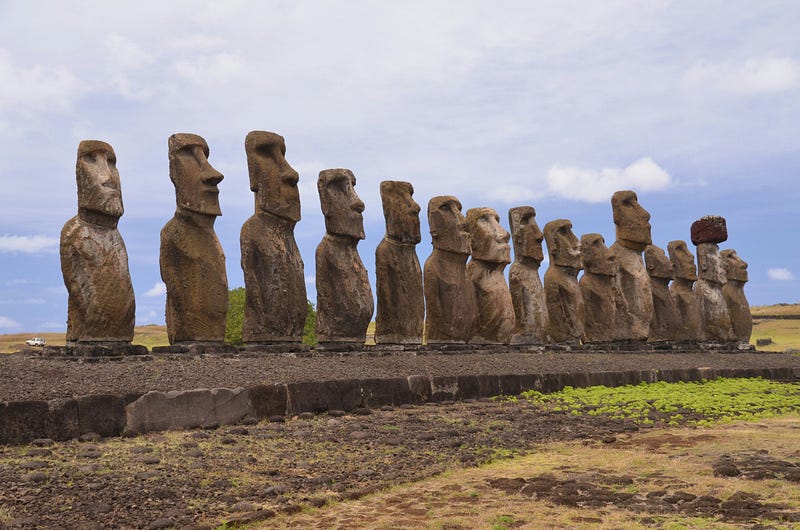
I’ve always been interested in Easter Island because it’s a running joke in our family that it’s ‘our’ island since we are the Osters (Easters). Despite this little joke, I never knew much about the island besides its famous giant moai statues. So, while perusing the archaeological world for recent discoveries, I was immediately drawn to a paper about the Rongorongo script of Rapa Nui. Wanting to learn more, I began reading the relevant papers, and here’s what I learned.
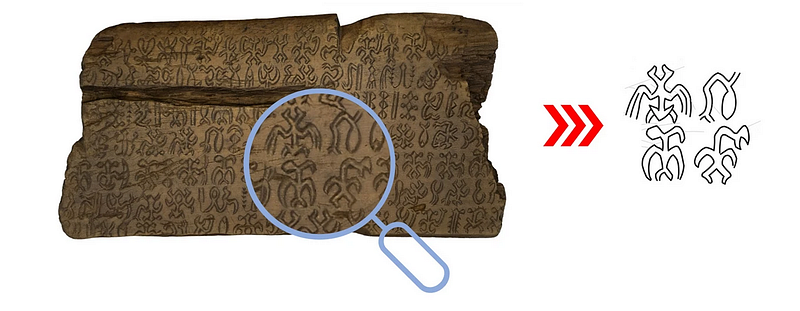
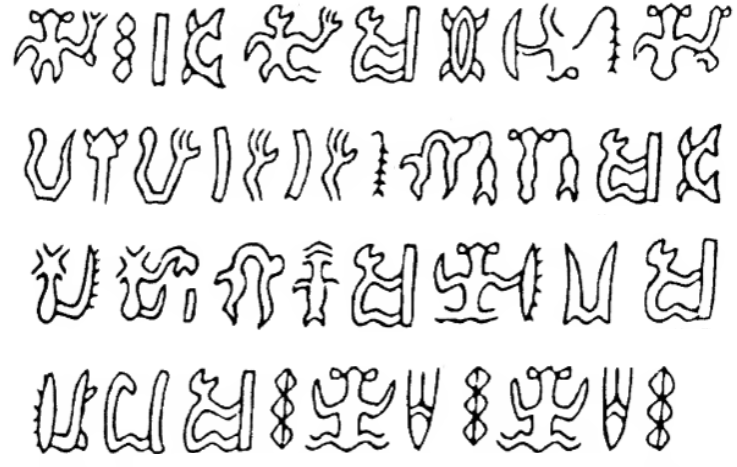
Rapa Nui was once home to several inscribed wooden tablets. These tablets preserve an enigmatic script called Rongorongo that was first documented by outsiders in 1864. Still, it could be much older as visitors to the island recorded how the native Rapa Nui people practiced writing with a quill in 1770, though whether they practiced Rongorongo or Latin script was not mentioned. Not that the two would’ve easily been confused since the Rongorongo script is made up of long lines or rows of pictorial signs called ‘glyphs,’ which usually depict motifs such as plants, body parts, animals, human postures, tools, and celestial bodies.
Origin and Purpose of the Rongorongo Script
Sadly, the script's origin, purpose, and meaning are unknown. It is possible that the inhabitants were inspired to create their written language after witnessing European writing. The Rapa Nui could’ve independently created a written language before the arrival of the Europeans.
No oral tradition on the script’s creation exists since after the arrival of Europeans, epidemics, kidnappings, and Peruvian slave raids decimated the population and their culture. For example, in 1862, a single Peruvian slave raid resulted in the abduction of over 1400 Rapa Nuians. After these devastating blows to their population and culture, the writing of Rongorongo could barely survive and altogether ceased by the late 1860s.
Sadly, the script remains undeciphered because the means to read and write the language was lost early. Only around 30 tablets still exist; most were taken out of Rapa Nui by missionaries and are now housed in museums and institutes worldwide.
While the meaning and purpose of the tablets may be lost to time, without an equivalent Rosetta stone to guide in their translation, the tablets can still provide insights into when and how the written language may have originated. It is essential to determine if the script pre or post-dates the arrival of Europeans.
If the script predated European arrival, it would represent only a handful of times in human history when people independently invented writing—the only other known times writing was invented independently occurred in Mesopotamia (the oldest currently known and proven instance), Egypt, China, and Mesoamerica. If Rongorongo were an independent invention, it would be the last known instance where the script was invented independently.
Determining when the script was first invented is easier said than done. One way this can be achieved is by directly dating the tablets.
Two tablets, Tablet O, housed in the Ethnological Museum Dahlem in Berlin, and Tablet Q, housed in the Museum of Anthropology and Ethnology in St. Petersburg, were dated in 2003. The former yielded a calibrated date between 1811 and 1838, while the latter produced three. The latter's results were recalibrated, and a single date of around 1812 to 1836 was determined.
Both these dates are after the arrival of Europeans.
The Tablets
Ferrara et al. (2024) believe determining the origin of Rongorongo will further our understanding of the invention of writing in human history. They dated the four tablets housed at the Congregazione dei Sacri Cuori di Gesù e di Maria, a religious order in Rome, Italy.
The tablets were obtained by European missionaries who sent them to the Bishop of Tahiti, Tepano Janssen, in 1869. This was done because the bishop was working with Metoro Taouaouré, a Rapa Nuian living in Tahiti, to create a list of characters according to subject matter (food, clothes, religion, etc.) with French and Rapanui translations. The goal had been to create a dictionary of sorts whereby a translation of a word existed in both languages. However, by then, knowledge of reading and writing the script had already been lost, and no real headway could be made in translating the script. The tablets were sent to Europe at the end of the nineteenth century and eventually ended up in the care of the religious order.
The tablets A, B, C, and D, Tahua, Aruku Kurenga, Mamari, and Échancrée, were scanned, analyzed, and radiocarbon-dated. 3D models of each tablet were made to preserve the pre-extraction status of the tablets before sampling them digitally. This is because to obtain a radiocarbon date, a small sample, between 40 and 74 mg of wood powder, must be extracted from the tablet, thus ‘destroying’ a part of the original artifact.
The 3D models preserve the original look of the tablets and provide such a detailed digital replica that researchers could assess precisely where to extract the samples from, causing the least damage. Analysis of the wood type further allowed researchers to determine the species of tree that the tablet was made from.
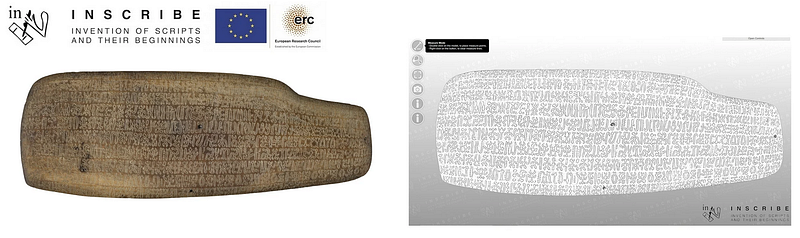
Tablet A was determined to have been made out of common ash (Fraxinus excelsior), which is a tree native to Europe and never grew on the island. Meanwhile, the tablet was produced at various ages, but the most probable date was around 1862–1887, which predates the raids on Rapa Nui but post-dates the arrival of the Europeans. Tablet B was carved on both sides with a dozen lines of text. It was made from Pacific rosewood (Thespesia populnea), once native to the island. The tablet was dated to around 1832–1857AD, meaning it falls within the same context as Tablet A. Tablet C, also made from Pacific rosewood, was also dated after the arrival of Europeans.
Surprisingly, Tablet D resulted in dates that pre-date European arrival, 1439 to 1509. The tablet was made from yellowwood (Podocarpus latifolia). This tree is not native to the island but comes from southeast Africa.
Interestingly, other Tablets like the Large St. Petersburg, Large Washington, and Small Vienna tablets were also made from the African yellowwood species.
The Choice of Wood

Before any conclusions can be made, we need some context.
Firstly, the Pacific rosewood has historically been a powerful symbol in eastern Polynesian culture. These trees may have been brought to Rapa Nui with its first inhabitants, thus also carrying with them the beliefs and symbolism surrounding the tree. The cultural importance of Pacific rosewood trees is evident in the few songs and oral traditions that survive the Rapa Nui. So revered were these trees that they surrounded the platforms on which the famous moai statues once stood. Thus, carving the tablets out of this wood may also have had a symbolic significance.
The origins of the yellowwood and standard ash tablets are more enigmatic. Since the trees did not naturally occur on the island, the question of where they were sourced needed to be answered.
One hypothesis is that these tablets were created from driftwood that had washed up on shore; this would mean a yellowwood or common ash fell into the ocean and was carried by the currents as far as Rapa Nui. The other hypothesis is that the wood was salvaged from ships since all three tree species were preferred materials in shipbuilding for hundreds of years. Considering how few trees seem to have been present on the island by the time of European arrival, it makes sense that the Rapa Nui islanders would salvage driftwood and ship wood to make their tablets since the lack of trees on the island naturally fostered a practice of reuse. This is also evident in that Tablet D featured notches along the sides of the tablet, facilitating its use as a winding spool for the cord.
The second line of evidence pointing to the reuse of tablets is that either side of Tablet D looks to have been written by different scribes, as seen in the difference in handwriting, one smooth and elaborate, the other rougher and less elaborate.
Lastly, four tablets are known to have been made from yellowwood; it is unlikely that yellowwood would have washed up on the shores of Rapa Nui on four different occasions. Instead, it is suggested that one large piece of yellowwood may have washed up on the island, salvaged and preserved long enough to create various tablets.
The dates obtained from the tablets do not indicate their creation; they only show when the tree they were made from was cut. This means, in theory, a tree could have been felled but not been made into a tablet until many years after its death. Thus, the data obtained will tell researchers when the tree died, not when it was inscribed. The wood sourced, preserved, and revered may predate Europeans. The inscribed text could be after their arrival.
Local Origin
Does this mean there is no possibility of a local origin for the Rongorongo script?
No.
There’s evidence that may point to a local origin. Namely, written scripts derived from other scripts usually share some similarities; think Chinese, Japanese, and Korean writing systems originated from the same writing system and thus use characters following similar sentence structure and writing style. Similarly, Latin script and Greek script, while different, share similarities that researchers can use to trace back the origins of symbols, letters, words, and meaning. Rongorongo, on the other hand, resembles no known writing system. Instead, motifs found in Rongorongo closely resemble ancient carved rock art on the island. This suggests a local origin for the Rongorongo script.
It is also possible that upon seeing written text for the first time, the Rapa Nui were inspired to create their script. Instead of using the Latin script of their European visitors, they turned to the familiar and culturally significant motifs of their rock art. This explains why many tablets appeared when the Europeans came, yet they didn’t resemble known written languages. This means that while not an independent invention, Rongorongo does have a unique Rapa Nuian origin. Of course, it is also possible that the script existed before European arrival, but the practice of inscribing on wood was more recent.
Rongorongo was a script used on Rapa Nui, but its origins remain a mystery. Since Europeans first saw it, attempts have been made to decipher the script from the 19th century onwards. But these attempts were in vain. Another question that researchers have tried to answer unsuccessfully is whether the Rongorongo script was an independent invention.
Ferrara and her colleagues have potentially provided some evidence, but everything is plausible. More research needs to be done to understand whether these Rongorongo tablets and their script were independent inventions. One of the other surviving tablets may contain answers to these questions. If the Rapa Nui did independently invent their writing system, this would rewrite the known history of written language and enrich our knowledge about the mostly lost Rapa Nuian culture.
For all your support I am immensely grateful, if you’d like to support me some more, why not Buy Me A Coffee?

References
- Ferrara, S., Tassoni, L., Kromer, B., Wacker, L., Friedrich, M., Tonini, F., Lastilla, L., Ravanelli, R. and Talamo, S., 2024. The invention of writing on Rapa Nui (Easter Island). New radiocarbon dates on the Rongorongo script. Scientific Reports, 14(1), p.2794.
- Macri, M.J., 1996. Rongorongo of Easter Island. The world’s writing systems, pp.183–8.