
Did Scientists Just Uncover the First Interstellar Samples?
A paper just published in “The Research Notes of the AAS” found spherules of extraordinary composition. The possibilities of what they could be are astounding, not only for astronomers, but for all of humanity.
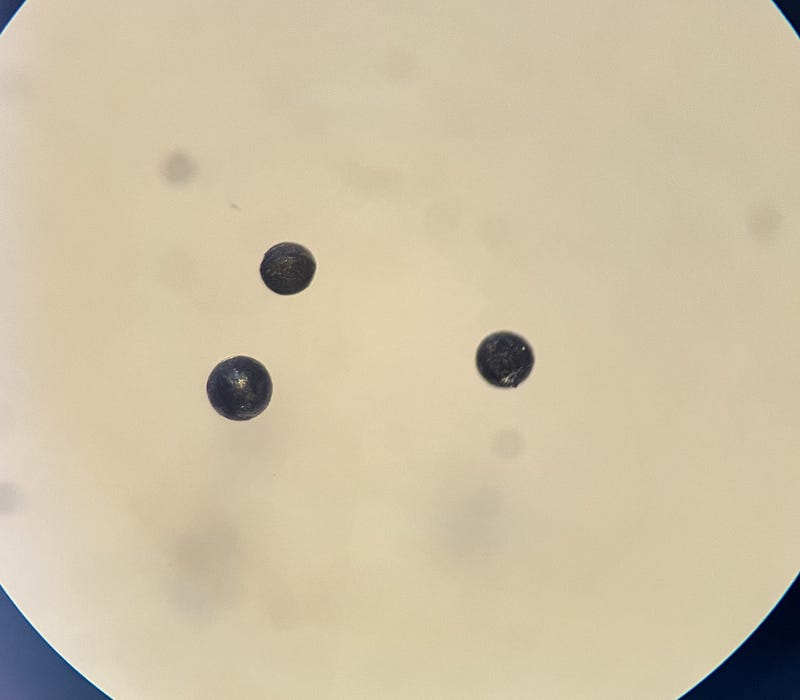
The petri dish warmed the tip of fingers. With my eyes glued to the microscope, I rotated it a few degrees to the left, revealing another section of sand-like particles to sift through. I was searching for metallic spheres that were smaller in width than a strand of hair — their possible origin, however, encapsulated the whole universe. Every time I saw a particle shimmer underneath the light, my foot bounced uncontrollably. The excitement quickly waned, though, when the source of that glimmer disintegrated between my tweezers. I leaned back in my seat and sighed. Was my task hopeless?
As a summer intern for Dr. Avi Loeb at Harvard University, it was my job to sift through the samples he brought back from his expedition to Papua New Guinea. During this trip, he and his team surveyed the ocean floor for the remnants of a 3-foot meteor labeled IM1. This was no ordinary meteor, though. When it entered Earth’s atmosphere in January of 2014, it was moving faster than 95% of nearby stars relative to the Local Standard of Rest of the Milky Way, and withstood pressures that would have disintegrated a typical solar system meteorite. This data, coupled with the calculated trajectory, suggested that IM1 might have come from outside our solar system. The only way to know for sure would be to analyze its chemical composition. In order to do that, Dr. Loeb needed samples of the meteor.
When an object from space enters Earth’s atmosphere, it is subject to intense pressure and heat. As a result, its surface will melt and pearl into tiny spheres called spherules. These spherules are often all that is left of the object and they hold invaluable information about it. The more spherules a scientist collects, the more data they can infer about the parent object and the path it took. During the ten-day expedition, Dr. Loeb and his team found 51 spherules onboard their ship — the biggest one was equal in thickness to a penny. Many of the chemical tests Dr. Loeb wanted to conduct needed more mass to reach maximum accuracy — hence why I was curled over dust, searching for gold in a pile of pyrite.
I think Dr. Loeb gave me that task only because I asked him to. I don’t think he expected me to find anything. I don’t think anyone on the expedition team did.
The day everything changed began like any other day: cleaning petri dishes and miniature glass vials. I ran each sample through a sieve, separating it into particles I could pick through and particles I couldn’t. The dishes that contained the latter were placed to the side; the dishes that contained the former were scrutinized particle by particle.
Beneath the lens of the microscope, a new world emerged. Grains of sand looked like delicate pearls and chunks of iron looked like monsters, black magnetic specks of various sizes adhered to its sides. Elongated tubes of transparent material gleamed alongside iridescent shells with scalloped edges and crystal studded spheres. As my tweezers gently sifted through the sample, I found myself able to hear the waves propagating through the deep. How many waves washed over these samples before they were dredged up from ocean floor?
My tweezers shifted over a new pile of sand, revealing a perfect sphere as black as the night sky. As the light hit it at different angles, it shone all the colors of the rainbow. I knew immediately that I had found one — my very first spherule. My heart pounded as I picked it up and safely transferred it to another petri dish. Without the microscope lens, it looked like any other speck of dust on the table. I forced myself to turn back to the larger sample. If there was one, there had to be more.
Within the next five minutes, another spherule flew towards the magnetic tips of my tweezers. And then another. And another. The petri dish that housed my first spherule become more populated with chromatic spheres and my heart pounded in my ears. Once I was done sifting through the sample, I snapped a picture of my findings and sent it to Dr. Loeb. He was ecstatic.
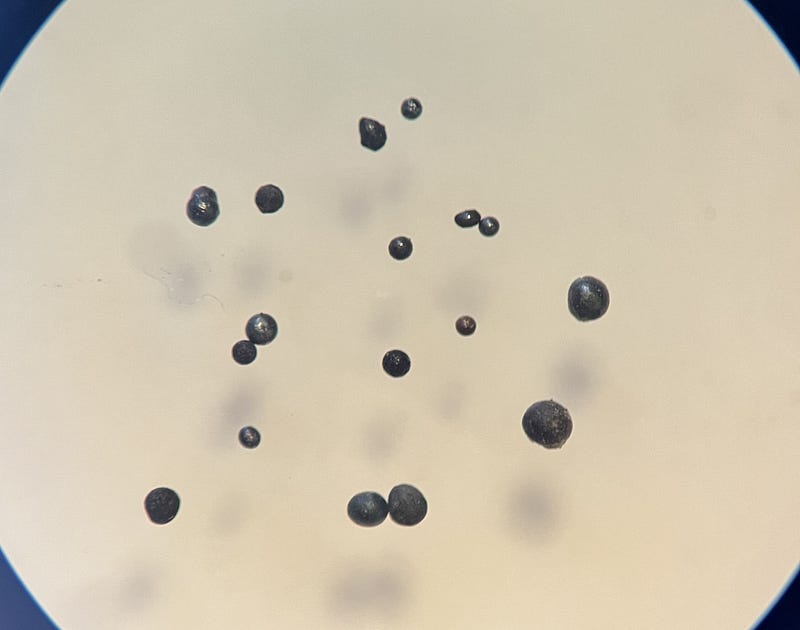
By the time I finished sifting through the samples, I found 555 spherules — more than enough to complete the compositional analysis.
Dr. Stein Jacobsen, a geochemist at Harvard, oversaw the spherules’ chemical analysis. He used an electron microprobe — a giant machine used to analyze small materials — to take detailed images of the spherules. He also used an extremely sensitive mass spectrometer, which took precise measurements of the spherule’s composition. Using both of these machines, Dr. Jacobsen and his team found a surprising result: some of the spherules displayed a drastic enrichment in beryllium, lanthanum, and uranium. This strange composition has never been seen before in any material from our solar system — were they from interstellar space?
That realization hit me like a ton of bricks: was I one of the first people to work with material that originated from outside of our solar system? We don’t know for sure whether the spherules I discovered were from IM1, but the enriched composition provides an interesting clue as to what distant parts of the universe might look like. We are making no definitive claims as to what these spherules are or where they come from, but these results open up an avenue for further research. Scientists have never encountered interstellar material, so who knows what it could look like?
I will admit that the chances of the spherules being from IM1 are slim, but, in the field of astrophysics, anything is possible. Our solar system is twelve trillion miles across; it would take light two years to traverse this distance, and other objects significantly more time. Most stars in the Milky Way galaxy are tens of thousands of light years away. It is hard to believe that IM1 found its way to Earth and that my internship happened to overlap with its discovery, but it is even harder to discount scientific data. To those who say we found coal ash, I can assure you that is not the case.
My last day at Harvard aligned with the Galileo Project’s annual conference. I sat in awe as Dr. Loeb shared our preliminary results, labeled me as the official “spherule huntress” of the expedition team, and detailed the possibility of a future expedition for other outlier objects. It was bittersweet — I wanted to be a part of those projects, but my summer among the stars was at an end. After all, I still had to graduate college.
As I walked away from the Center for Astrophysics for the last time, I felt as if I was descending back to Earth from a distant planet; my broadened horizons were the only signs that I had been far from home.
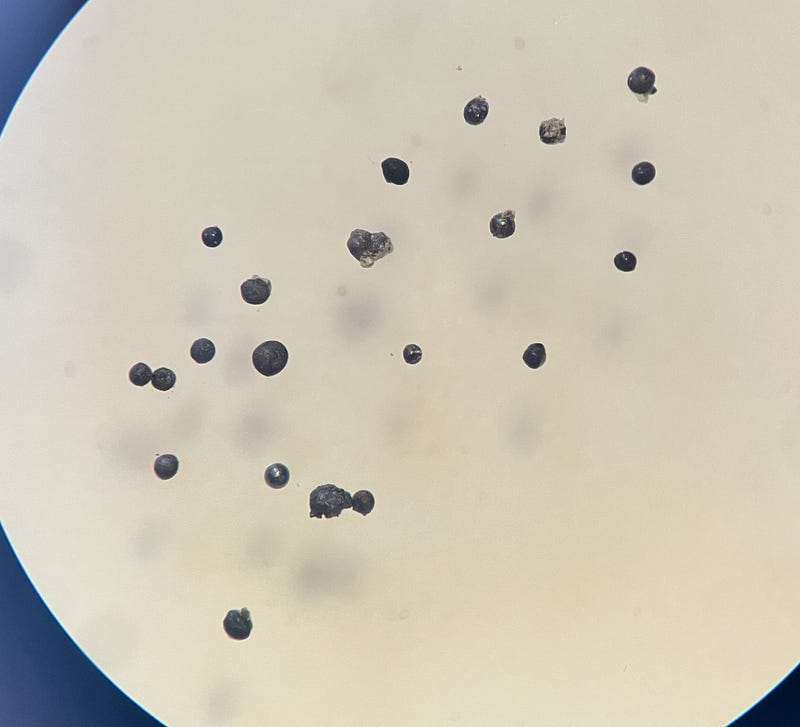
For more information, see the research article at the link below:


