
Did Hominids Who Lived 1.4 Million Years Ago Already Know Geometry?
Study of Limestone Spheroids From ‘Ubeidiya, Israel

As a lover of both geometry and antiquity, I am thrilled to share the findings of a recent study on limestone spheroids from the Early Acheulean site of ‘Ubeidiya in Israel, dated to approximately 1.4 million years ago.
Led by Antoine Muller of the Hebrew University of Jerusalem, a team of international researchers analyzed 150 spheroids using innovative 3D scanning and geometric analysis methods.
Spheroids
Spheroids, also known as stone balls, polyhedrons, or bolas, are amongst the oldest surviving lithic tool types, appearing as early as the Oldowan and continuing into the Middle Palaeolithic.
However, their purpose and manufacturing process have long been debated. Previous studies were limited by small sample sizes and subjective classification schemes.
To overcome these issues, the researchers introduced novel quantitative techniques, including edge angle measurement, centre of mass calculation, surface curvature analysis, and crucially, spherical harmonics analysis. Spherical harmonics allowed for the reconstruction of 3D shapes based on their spherical coefficients, providing a new means to quantify complex artefact geometry and compare shapes to an ideal sphere.
The study found that as reduction proceeded, the spheroids became significantly more spherical, requiring skilful knapping to remove high-angled flakes from a spherical platform.
Spherical geometry
This intentional imposition of a spherical geometry was achieved through a deliberate reduction strategy, indicating sophisticated cognitive capacities.
“Surface smoothness can be the result of natural phenomena, while sphericalness, where an item’s geometry approaches that of a true sphere, is very rare in nature,” the paper said. “River cobbles can become smoother with more rounded edges after long periods submerged in running water, but they almost never approach a truly spherical shape.”
The study argues that spheroids represent another early manifestation of hominins desiring and imparting intentional form and symmetry upon stone tools through careful reduction, comparable to Acheulean handaxes.
The research provides the most extensive quantitative analysis of spheroids to date, revealing patterns indicating these objects followed a deliberate, premeditated manufacturing process aimed at achieving a spherical morphology, rather than representing discarded cores or hammerstones.
Hominin symbolic cognition
The discovery that ‘Ubeidiya spheroids were intentionally shaped has important implications, as they constitute some of the earliest evidence for hominin symbolic cognition outside of Africa.
Their widespread geographic dispersal and longevity also suggest spheroids played an enduring and significant role in Paleolithic cultures over vast periods and space.
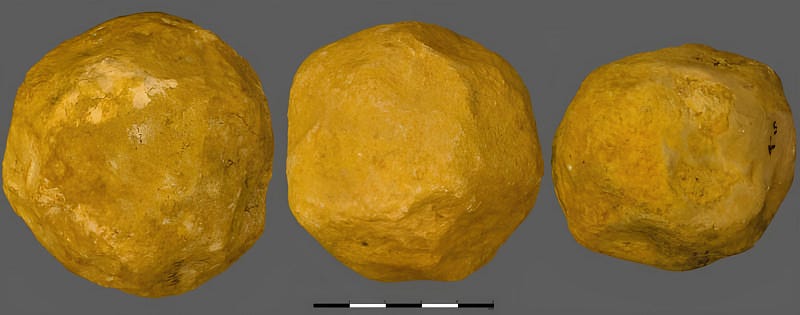
The study highlights the cognitive complexity of early Acheulean hominin cultures through their calculated imposition of three-dimensional geometry upon simple raw materials.
Enigmatic artefacts
The secrets of these enigmatic artefacts are slowly being unravelled through the innovative application of digital technologies to the archaeological record.
In addition, the researchers found that all spheroids possessed a distinct “primary surface” from which much of the subsequent flaking occurred, systematically smaller and possessing higher edge angles on more reduced artefacts.
This flaking pattern was not random but indicative of a deliberate reduction strategy, contradicting theories of spheroids resulting from expedient flaking or percussive tasks.
The study provides unprecedented insights into early hominin stone tool-shaping abilities and cognition through a comprehensive analysis of enigmatic spheroid artefacts from the Acheulean site of ‘Ubeidiya in Israel.
The research was published in 2023 in the peer-reviewed open-access journal Royal Society Open Science, and I encourage all interested in geometry and antiquity to read the full article.
Conclusions and Takeaways
The mystery of these artefacts has lasted for two million years, but now, thanks to new multidisciplinary studies integrating experimental archaeology, technological analysis, and mathematical models, we are close to unveiling it.
And to better understand the cognitive complexity of our prehistoric ancestors, capable of creating artefacts with elegant and standardized forms in an age we imagine dominated only by instinct and the struggle for survival.
What do you think about this article?
Thanks for reading.
Sources:
Grosman, L. (2023). The limestone spheroids of ‘Ubeidiya: the intentional imposition of symmetric geometry by early hominins? Royal Society Open Science, 10, 230671. https://doi.org/10.1098/rsos.230671
Assaf, E., Preysler, J.B., & Bruner, E. (2023). Lower Paleolithic Shaped Stone Balls — What Is Next? Some Cultural–Cognitive Questions. Quaternary, 6(4), 51. https://doi.org/10.3390/quat6040051


