Did Hitler Sleep Through D-Day?
A grave error
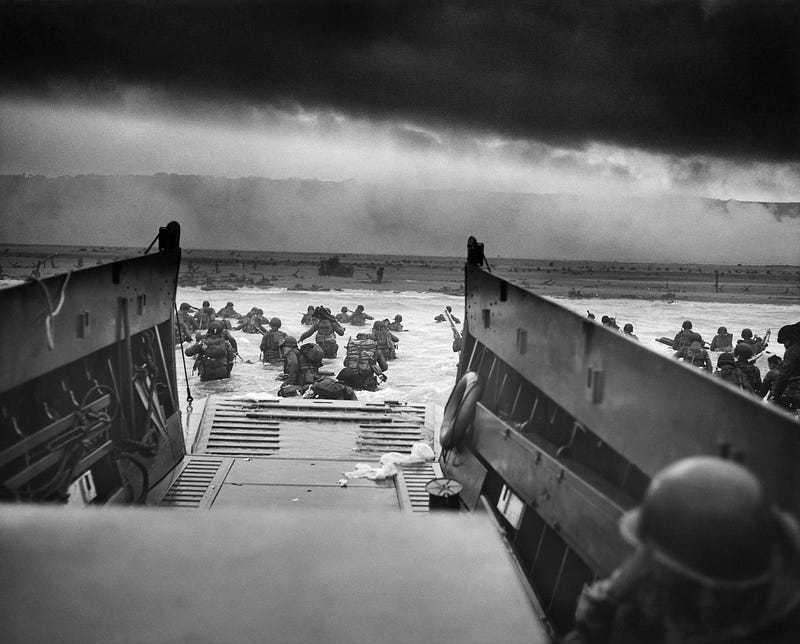
Just after midnight on June 6th, 1944, paratroopers from England began dropping into France for the precursor to the D-Day landings. These drops were made to disrupt German communication lines and seize key crossings, bridges, and crossroads. In the earliest hours of the day, under the full moon's glow, the largest amphibious operation in history was underway. Meanwhile, hundreds of miles away in his fortress in Germany, the Führer slept soundly.
The early hours of the invasion were pure chaos for Germany. Commanders on the ground were demanding reinforcements to counter the blow, but no one could get anyone on the phone. Army elements were stuck in position around the port of Calais, and no one had the authorization to release them. The only person who could direct large movements of troops was Hitler himself. As the military situation continued to degrade from 1943 into 1944, Hitler took a more direct hand in the running of the military. Instead of leaving decisions to his commanding officers, he took it upon himself to make sweeping strategic decisions. Ordering troops on the ground to new locations or ordering an unauthorized retreat could incur the wrath of the Führer — a potentially fatal mistake.
Interestingly enough, one of the reasons that Germany was late in responding to the massive attack on their Atlantic Wall was due to the sleeping habits of their erratic leader. Hitler was known for staying up into the wee hours of the night, strategizing, thinking, and ranting. He would then retire to bed in the earliest hours of the morning and demanded not to be disturbed until he woke naturally, usually around 11 AM.
So, while the first paratroopers began hitting the ground in France, Hitler was retiring to bed in Germany, and he would not wake for many hours.
The Sleeping Führer
The first troops hit the beaches of Normandy around 6:30 AM under a heavy barrage of fire. Some of the landings were incredibly bloody, but it quickly became apparent to the officers on the beaches that the invasion was going to be a success. The Allies had an unbelievable amount of soldiers and equipment rolling into Normandy while the Germans’ best troops were scattered across Northern France.
By mid-morning, the Allies had a toehold on the shore. Hitler was still asleep. His attendants were terrified to wake him as it was against his express wishes.
By noon, massive amounts of supplies and equipment, including heavy guns and tanks, were rolling onto the sand. Hitler was just getting out of bed.
From the initial time of the landings (6:30 AM) until Hitler finally got out of bed (around noon), roughly five hours had passed. While that doesn’t seem like a large amount of time in the grand scheme of World War II, it was critical in Normandy.
If Hitler had been roused and was able to order the movement of the large Panzer groups sitting idle around Calais, the resistance to the bridgehead could have been much fiercer and much quicker. Instead, they dawdled as Hitler slept in.
(It is a good time to point out that Hitler was not the only ranking official at fault here. Generalfeldmarschall Erwin Rommel, who was in charge of the defense of coastal France at the time, was retired to the interior of the continent for his son’s birthday party and was also thus unavailable.)
The Grand Deception
Even when Hitler woke up and began pouring over the reports coming into his bedroom, he didn’t believe that the Normandy landings were the main thrust. He believed that it was a diversionary tactic aimed at drawing his forces away from Calais. Hitler did not believe that the Allies had the ability to land appreciable amounts of troops on a beach with no nearby port. Conventional wisdom said that such a move was impossible, which is exactly why the Allies made it. The Allies had spent months deceiving the Germans into believing that an eventual invasion of the European mainland would come at Calais or into Norway before sweeping south through the Netherlands. Hitler took the bait and, therefore, was hesitant to commit the bulk of his forces in Normandy. The delay would prove fatal.
Between the five hours that Hitler was asleep and the belief that no threatening landing could take place in rural Normandy, the Germans reacted too slowly to stop the invasion at the beachhead.
Verdict
Did Hitler sleep through D-Day? One could make that argument. He was definitely asleep during the critical early hours of the invasion. The first moments of any amphibious assault are the most important. A flexible defense and concentrated firepower are often able to thwart an invasion (or at least contain it.) The Germans were able to contain a similar invasion at Anzio in Italy earlier in the year by hemming in the beachhead. The Allies were contained and stuck in place for nearly six months. A similar fate could have befallen the Allies at Normandy if a better defense was mounted.
It is impossible to say if the outcome would have been much different in the long run if Hitler had been awoken at a reasonable hour, but the fact is that the Führer was definitely asleep during the earliest hours of the invasion of Normandy. Hitler slept through the first five hours of the D-Day landings, which could have had a grave role in what happened next.
Hitler is denigrated for many of his military decisions during the war, but few people remember or like to point out that he was literally asleep at the wheel during the most fateful moment of the war in Europe.