
Did George Washington have wooden teeth?
Here’s the uncomfortable truth & the funky history of George Washington’s ‘wooden’ teeth.
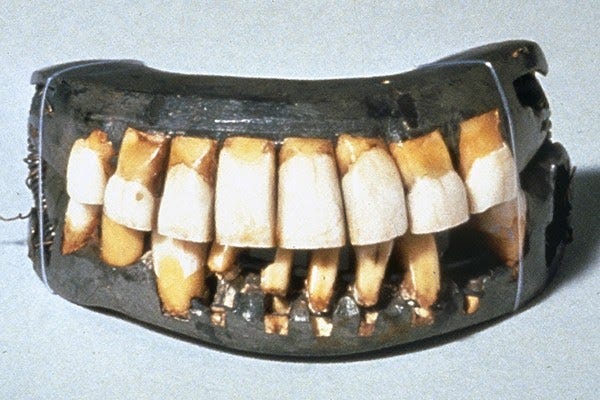
Washington having wooden teeth is nothing but a myth — but this myth is easier to accept because the teeth speak for themselves.
While still young, Washington started losing his teeth owing to the poor diet, but mainly genetics. According to founding father John Adams, several stories stand behind Washington’s poor oral health, like, cracking walnuts in his youth and being treated from mercury when he suffered from smallpox.
It is recorded at the age of 24, and he paid five shillings for getting a tooth removed. The issues about his worsening oral health are documented in letters and communique reflecting misery Washington had to go through — sometimes in the shape of tooth scrapers, denture files and medications. Interestingly, when he became president in 1789, he only had a tooth left.
Fashioning of Horrific Dentures
Dr. John Greenwood handled Washington’s dental case. He made a hole in the denture, taking into account one remaining tooth over which he carefully snuggled the frame. But, eventually, the last tooth, the lower-left premolar, had to get extracted. Wondering about the new home of remaining Washington’s original tooth? Well, Greenwood carefully dropped it into a locket attached with a pocket watch. Interestingly, the locket is also preserved in the New York Academy of Medicine.
Greenwood’s crafted dentures were composed of various materials like gold, brass and hippy ivory. Apart from the ivory, the top teeth had various sources like horses and donkeys. Similarly, the lower teeth hosted teeth from sources like cows and other humans. The base fitted on the jaw was made of lead. Owing to the compositional materials, the teeth housing in lead frames were not only disappearing but tastefully awful. As the fake teeth deteriorated with time, they revealed wire which held them all together.
One can still find his lower denture in the NewYork Academy of Medicine — a pair which will horrify many to wear in today’s day and age.
Now are you all the while wondering where the myth of Washington’s wooden teeth spread from? Describing it more of a misunderstanding than a myth is justified, as ivory discolored over time, leaving a brown hue that confused wood.
Awful Problems those Dentures Caused
Even the most scientifically advanced dentures of the late 18th century were painful and flawed — causing Washington difficulty talking and eating.
No doubt assail that Washington not only had a problem while speaking but also while keeping shut. Why? Well, the dentures were controlled by metal springs, so to keep his mouth closed, he needed to stiffly clench his jaw — a posture which popularized his expression of appreciable composure and stoicism.
The guy was insanely self-conscious about his set of fake teeth and took them as a sign of weakness. Sensing his profile will affect his credibility, Washington decided to give the first inaugural speech from the senate chamber instead of addressing assembled masses in the federal hall.
Additionally, the reason behind Washington’s shortest inaugural address of March 4, 1793, was the difficulty posed by his dentures. Being in awful pain, the president gave a two-minute speech of just 135 words — the shortest in history.
Not only did the dentures cause internal pain, but they reflected changes in the way he looked, disfiguring his face to the extent that his lips noticeably stuck out.
But, dentures were the only options Washington had, so he was more than grateful for them.
One thing is established — Washington didn’t have wooden teeth. But an interesting point to deliberate here is his fight with everyday struggles of speaking or eating.
He struggled like a commoner, becoming more relatable to the general public. His severe dental condition humanizes him — a person who seemed remote with an idealized image.
More from the author:


