
Dialectic of Enlightenment
Adorno and Horkheimer on the Contradictions of Modernity
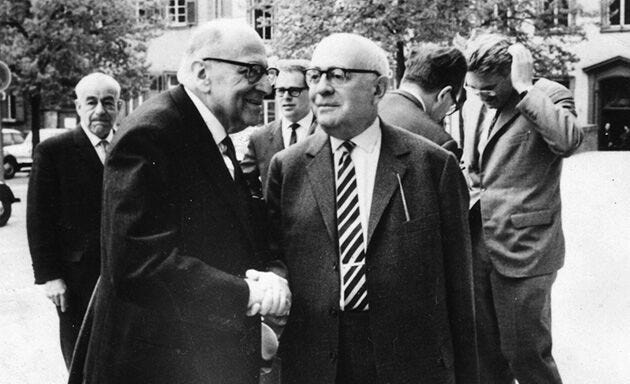
“Dialectic of Enlightenment” is a provocative essay collection addressing the so-called Age of Enlightenment and its counterintuitive impact on society. Written by Theodor Adorno and Max Horkheimer, two German Jewish intellectuals living in exile in New York, the text was officially published in 1947 but had been circulated among friends three years earlier under the title “Philosophical Fragments.”
The fragmentary nature of the text often begets frustration, with commentators lamenting the sprawling and, at times, under-explained—even contradictory—subject matter. Perhaps this is by design. As two central members of the Frankfurt School of Critical Theory, Adorno and Horkheimer were philosophically committed to critically examining society and its contradictions rather than offering a positive account of how society ought to be, fearing that the latter risks crystallization into ideology, which has historically lent itself to dogmatism and domination.
They place a high value on negative thinking, which attempts to strip away or ‘negate’ aspects of society identified as harmful, blaming the perpetuation of unnecessary human suffering on an uncritical acceptance of the status quo. By leaving the text open-ended and thus open to critique, Adorno and Horkheimer implicitly encourage such negative thinking, which to them represents our best hope of overcoming the predicaments of modernity.
The text’s starting premise is that the Enlightenment’s promise of a more civilized world has not come to pass:
“Humanity, instead of entering a truly human state, is sinking into a new kind of barbarism.”
As Jewish refugees writing at the time of the Holocaust, Adorno and Horkheimer had good reason to use such charged language. In addition to the Nazis’ persecution of Jews in particular, the two were deeply disturbed by the generalized dehumanization occurring in a society defined by the domination of humans over one another and nature. To be sure, domination has been present throughout human history. But the development of military, industrial, and communications technologies has enabled types of domination previously unseen.
How is it that a society embracing the Enlightenment’s Reason could become so irrational as to countenance genocide, mass exploitation, and ecological destruction? Adorno and Horkheimer do not blame the Enlightenment per se, but rather its “lapse into positivism.”
As the name suggests, positivism limits possible knowledge to positive knowledge, or knowledge of what currently exists, obtained by applying reason to information received through the senses. If a claim is not amenable to logical proof or empirical verification, it is written off as “meaningless.” Auguste Comte, the founder of modern positivism, advocated studying society just as one would study chemistry or biology: with scientific testing and observation rather than unverifiable philosophical speculation.
Adorno and Horkheimer objected to this approach on the grounds that limiting social analysis to the world as it is risks mistaking socially contingent phenomena for brute facts. If the present order is perceived as the ineluctable product of natural laws, people are more likely to acquiesce to it, perpetuating injustice.
Positivism did initially enjoy revolutionary applications; Comte’s successor, Fabien Magnin, for instance, founded the Circle of Positivist Proletarians. While possessing important differences with positivism, Marx and Engels’ scientific socialism conceptualized social change empirically, suggesting that revolution would occur spontaneously once certain objective conditions were met—namely, capitalism’s impending “crisis of overproduction.”
But as the 20th century rolled on and revolutions failed to materialize, or just plain failed, while capitalism proved itself more resilient than anticipated, positivism began manifesting itself in an acceptance of capitalism as the demonstrative ‘end of history.’
This resigned ‘going along’ with the prevailing system is further entrenched by what Adorno and Horkheimer call the culture industry—a sort of entertainment machine that churns out unchallenging ‘art’ designed to be consumed rather than questioned.
By disseminating predigested media—TV, film, radio—that merely reflect society’s norms, the culture industry instructs its members how to think and act and what to value, condemn, and dismiss. The result is a thoroughgoing conformity that deprives humans of their subjectivity by dictating behavior. Simultaneously, objects—factory machinery, television sets, etc.—gain de facto subjectivity by prescribing conduct at home and in the workplace, which individuals “compulsively rehearse.”
Adorno and Horkheimer repeatedly point out that by rewarding obedience with paychecks and praise and punishing dissent with poverty and social ostracization, those in power all but guarantee compliance. In this way, individuals in material disagreement with their society are brought into accord with it. But the artificial absence of conflict dialectically implies the presence of a much deeper one: that of submission on the part of the exploited worker. In the authors’ words,
“The untroubled harmony between omnipotence and impotence is itself unmediated contradiction, the absolute antithesis of reconciliation.”
The achievement of a docile citizenry is made all the easier by the Enlightenment’s emphasis on individualism. It should be reiterated that when Adorno and Horkheimer critique the Enlightenment, they are going after its excesses and misuses rather than it in itself or as a whole. This harks back to their fundamental belief that positive ideologies, by asserting epistemic power, become, if successful, material powers and, as such, are inevitably appropriated as instruments of violence and dominance. In this case, what began as an affirmation of individual rights over and above the church and state now serves as a justification for the alienated condition of modern humanity.
A ‘pseudo-individuality’ prevails: we are individualized in the literal, physical sense of the word, spending the majority of our time alone in our cars, cubicles, and apartments. However, we lack individual thought in a culture so heavily mediated by ideology and individual expression in a system that requires us to perform socially prescribed roles. In another gripping dialectic, individualism in reality makes people “more and more alike.”
With fewer and fewer communal spaces, isolated individuals lose the ability to form new ideas with one another through unmediated discourse and instead become passive recipients of the same top-down instructions. The end product is a social life that, for the vast majority, is “defined by self-preservation through adaptation.” Again, Adorno and Horkheimer nod toward the Enlightenment, whose embrace of Darwin’s evolutionary theories was later used to justify running society based on “increasing or decreasing the natural survival prospects of the human species.”
But, in a third compelling dialectical move, the authors point out that enshrining self-preservation as the guiding principle of human conduct brings about self-destruction. When everyone is striving to increase their survival prospects, we begin to treat one another and nature as objects, raw materials to be wielded for our own gain. This mentality is blamed for nuclear proliferation, economic exploitation, environmental degradation, and the many other destructive tendencies of the modern world. As the authors see it,
“Human beings are so radically estranged from themselves and from nature that they know only how to use and harm each other.”
Adorno and Horkheimer have a reputation for pessimism, leaving little room for escape from today’s ‘totalizing’ socio-cultural system. But if there’s any chance at all, they say, it lies in the critical philosophy and its ability to resist society’s “overwhelming suggestion.” To this end, the two make a radical proposal to redefine truth as “the thought that repudiates injustice.” This begins with an attack on market logic, recognizing that a system in which “each party receives its due but social injustice nevertheless results” could never be genuinely logical.
While Adorno and Horkheimer refrain from fleshing out what a more rational system would look like—for reasons mentioned above, they prefer exposing society’s problems to prescribing comprehensive solutions—their incisive highlighting of the barriers to a humane society remains as instructive today as it did when this seminal text was first written.


