
Detroit Invented ‘the Job’ — Here’s the Upgrade
DETROIT — Detroit invented “the job,’’ says Kelly Services CEO Carl Camden, but a new generation of workers calls traditional full-timers “wage slaves.’’
“Permanent employment is now an oxymoron,’’ Camden said, adding we are returning to an old classic: “Learn a good trade.’’
Camden was the most talked-about speaker at last week’s Original Equipment Suppliers Association (OESA) Outlook Summit. Addressing “The Talent Crisis: The Changing Nature of Work,’’ Camden argued:
- More than half of U.S. workers are expected to become independent contractors. More than 41 million already work as consultants, freelancers, contractors, temporary or on-call workers.
- Independent contractors earn 20 percent more than people in comparable traditional jobs with technology allowing them to be more mobile and entrepreneurial.
- Seventy percent of Millennials change jobs every two years. Many wonder if two years is too long to stay at one job, a trend that startled the manufacturing executives gathered at OESA since they are already in a war for talent. They contend it takes most of their workers a couple of years just to get totally up to speed.
21st-century workers — like 19th-century farmers?
A century ago, most Americans were still farmers, working from or near home, setting their own hours, running their own businesses, taking their products to market, competing in an ever-changing marketplace.
Workers were often tied to a trade but not necessarily to a single employer or place.
My Great Grandpa Cezary Serwach, for example, was a newspaper printer who learned his trade, taking progressively more important roles at newspapers in Poland then New Jersey then Ohio, and finally, in Detroit.
1914: Birth of ‘The Job’
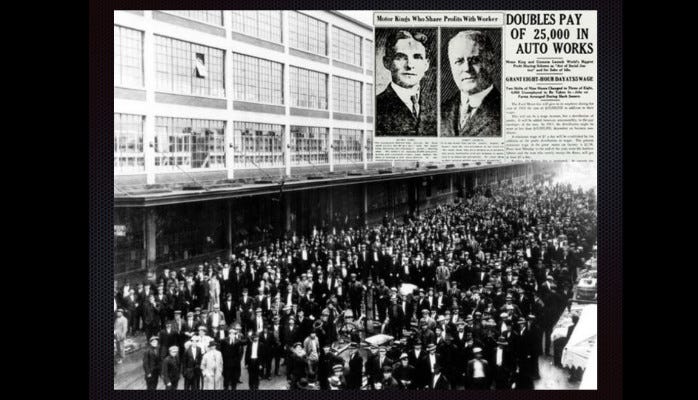
In contrast, my Great Grandpa Alex Jamiolkowski, was making $12 a week at a Yonkers, N.Y. sugar mill when he was lured to Detroit by Henry Ford’s promise to double salaries and pay workers $5 per day.
The original Ford plant hired craftsmen, experts who knew trades. But a decade later, in April 1913, Ford started the first assembly line to speed up and standardize production of the hugely popular Model T.
The first assembly line immediately alienated Ford’s craftsmen, who had no interest in standing in place doing the same thing hour after hour. As soon as the assembly work began, Ford started losing workers as fast as they could train them. Ford’s turnover rate was more than 300 percent.
The $5 day was announced in 1914 as an effort to keep workers from leaving. It worked.
The incentives of higher wages (and later, better benefits) worked so well that workers decided a high-paying role at a big company was too good to leave. They spent their careers there.
The Good Job: “Find a big company with good benefits’’
Our parents smiled approvingly if they’d heard of our newest employer. Startups would have worried them.
Instead of telling their children to learn a trade or build a business, Camden notes, 20th-century parents began encouraging children to “find a good job with good benefits’’ at an established, big organization. When the focus shifted from the trade to the job, workers focused more on organizations than their fields.
Detroit, thus had “Ford guys’’ and “Chevy guys’’ loyal to one brand, one employer and foreign rivals barely got any attention — until they were forced to pay attention.
Starting a century ago, Ford got people to stay for the higher wage (with strings attached).
But once employees were primarily working for the money over the devotion to a craft, there were constant reminders that assembly work was brutally tough. Ford and rivals cut wages when the Depression hit (leading to the rise of FDR and the UAW).
World War II and its aftermath ushered in industrial booms and Detroit pioneered all the hallmarks of what we today recognize as “The Good Job.’’ These included healthcare (an incentive begun when wages were briefly frozen after the war), payroll deductions (begun when the United Way began in Detroit), and defined-benefit pensions.
My Great Grandpa Alex only worked at Ford a few years before moving to the Chevy Gear and Axle plant in Hamtramck, just a short walk from his home. He worked at the plant from the 1920s through the 1950s and his son, Cass, also worked there for several decades.
Uncle Cass got my dad a job there for a brief time but my dad escaped to his own dream job: being a police officer. The plant, built in 1917, was later sold to American Axle in 1994, which recently tore it down.
Many Michigan families proudly boasted of multiple generations landing a “good job’’ at the same big company or government agency.
Business owners and a younger, more entrepreneurial generation call them “wage slaves’’ beholden to an organizational master. Those “good jobs’’ seemed safe for decades but that’s changed in a time. No job seems totally secure.
Are traditional jobs like Oldsmobiles? Remember when two or three generations of a family could spend entire careers working for a single big company? Such jobs, apparently, are like Oldsmobiles: mostly out-of-date (though several are still left plugging along as they have for years).
10 trends killing traditional jobs
1. Self-reliance is replacing “trusting institutions.’’ During the turbulent 1960s and 1970s, we learned not to trust government. Subsequent scandals made Americans lose faith in other big institutions including corporations, churches, and bureaucratic organizations. Americans now hate bureaucracies.
In 1991, the Soviet Union fell. In 2009, both General Motors and Chrysler entered bankruptcy, and Detroit itself just came out of bankruptcy. So few now take it for granted that any institution will last forever.
2. The eBay economy. Companies, as well as individuals, are constantly online shopping for the best value. Few things are actually made entirely in one place any more. We go to stores and check online for better alternatives.
Increasingly, we can tap our social networks seeking new work or business opportunities. WhiteTruffle.com acts as an online matchmaker connecting people with work opportunities.
3. Personal Branding: We now outlive the companies we work for. Most of the companies that dominated the world 50 years ago are either out of business or shadows of their former selves. The result: personal branding is now more important than finding one big brand to count on.
I was proud to work for Knight-Ridder Newspapers and Arthur Andersen, both massive, long-established companies at the top of their industries. Both went out of business in the last decade.
I worked in higher education, which is seeing part-time faculty replace tenured spots. I then spent a year helping a newly elected governor market the state of Michigan.
Government is the last bastion of traditional jobs, powerful unions, and bureaucracy yet bureaucrats are overwhelmed with anxiety. In a bureaucracy, you are like a caged duck beholden to and dependent on your rulers (which changes with elections and other political changes).
In the free market, you’re master of your own ship, free to take off or crash on your own. There are no guarantees in a free market, certainly, but increasingly there are no guarantees anywhere else either.
4. Healthcare less tied to “the job.’’ For years, an unfortunate number of job and even marital decisions have been connected to “getting good healthcare.’’
The one part of Obamacare most Americans like is that Americans 26 and under can now stay on their parents’ healthcare. As a result, young 20-somethings don’t have to get “the job’’ to be insured.
The more controversial aspects of Obamacare? The mandates. Mandates provide an incentive for workers to save money by becoming independent contractors while encouraging employers to offer more contractor positions over “the job’’ to similarly avoid the costs and hassles related to health insurance.
3. Traditional Pensions with meager guarantees vs. market-based higher risk/higher rewards. Many traditional pensions are under-funded and less certain to be around in 30 years than Social Security and Medicare. If they work, the payoffs are typically low.
My old newspaper job in Harrisburg, Pa. had a defined benefit pension that would vest if I stayed through age 65. When I left at age 31, I was told I couldn’t cash out, that I would get $102 a month at age 65.
When the company offered me a lump sum to cash out years later, I gladly moved the money to an IRA knowing I can invest that money and get a far better return than I would have received from the pension.
Since mutual funds became popular in the 1980s, employers have found the opportunity to build a large nest egg becomes some substantial when they pick funds with aggressive investment strategies.
4. Tying company stock to 401(k) and “profit-sharing.’’ Companies used to make their stocks a key part of the pension and incentive plan, which showed workers (and companies) the folly of putting all your investment eggs in one basket.
Ford stock that was worth more than $20 a share in the 1990s dropped to $1 in the 2008 recession and has since rebounded to $15, a fantastic six-year return but still below its 1990s level. Similarly, a Rochester, N.Y. university went from one of the strongest to the weakest endowments because much of its investments were tied to Kodak (digital photography killed demand for film and Kodak never recovered).
5. Politicians trying to “save jobs’’ often kill them instead. Government mandates to “protect jobs’’ like Obamacare, raising minimum wages and failed efforts to legislatively protect union deals are all intended to preserve traditional jobs.
Efforts to protect “good jobs’’ too often result in employers replacing jobs with freelancers, creating more small business people in the process.
Between 2005 and 2010, the number of independent contractor positions grew 10-fold from 4 million to 40 million. Every law or regulation making it harder or more expensive to hire someone for a traditional job makes freelancers and subcontractors more inviting.
6. Flexibility is the №1 perk. A recent national survey found 75 percent said a flexible work environment is the most important perk workers look for. You get flexibility as a freelancer, a part-timer or contract worker.
7. Fewer, later marriages means we move more. More than half of Americans are now single (compared to just 37 percent in 1976). If someone doesn’t want to be married to another person, why marry yourself to a job?
8. Cubicles were as bad as dark factories. I’m not sure who invented the cubicle but when you see rows and rows of them in a big enough operation, they begin to look something like a cell block in a prison.
9. Making things. Big companies have always promoted themselves and their jobs. To attract young talent, we found it was easier to sell the idea of being able to make things (see our videos below). Again, the trade has more appeal than the job.
As our friend, Detroit Public TV President Rich Homberg, says, “We no longer hire people to fill jobs. We hire people to solve problems.’’
10. Smartphones freed us from being chained to desks or work stations. Remember life before the smartphone? Having to be at a desk at a certain time, unable to leave until the clock hit 5:00?
Mobile devices made it easier to come and go as we please. But they also reminded us that work requests now can come at all hours.
So it’s always better to focus first on doing something you love.
Originally published at https://www.linkedin.com.


