Destroying art destroys climate action support
I often write about the climate crisis, while in other articles, I often refer to the paintings, writing, or life of Vincent van Gogh. It’s an example of the wide range of subjects I cover in this newsletter. And until today, I often feared that I asked too much flexibility of my readers to be able to appreciate this seeming lack of focus.
Climate crisis
But today, the hashtags “climate crisis” and “VanGogh” are trending topics on Twitter. Suddenly both issues that I like to write about were connected. I learned it only needed a can of tomato soup.
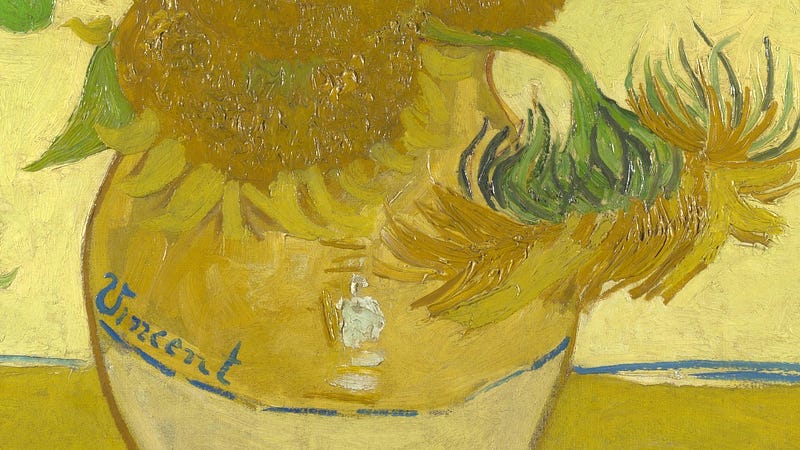
In case you missed it (did anyone?): activists from the action group Just Stop Oil threw tomato soup over Vincent van Gogh’s Sunflowers at the National Gallery in London.
I know the painting so well that I can even describe from memory the route you have to walk in the National Gallery to view it. It is one in a series; Vincent most likely made twelve still-life paintings of sunflowers lying on the ground or in vases.
Unfortunately, one of these was destroyed in WWII. I have seen six of the remaining eleven. The tomatoed (if I may) version was likely important to Van Gogh. He chose this version of the original series as the model for the last three repetitions he produced.
Arles
Some years ago, I went to Arles to experience what Vincent saw when he briefly lived there with his Gaugin in 1888. It was there that he gave him two of these paintings. But when Gauguin later claimed one more of the Arles versions, Van Gogh was upset and wrote:” I am definitely keeping my sunflowers in question. He has two of them already”.
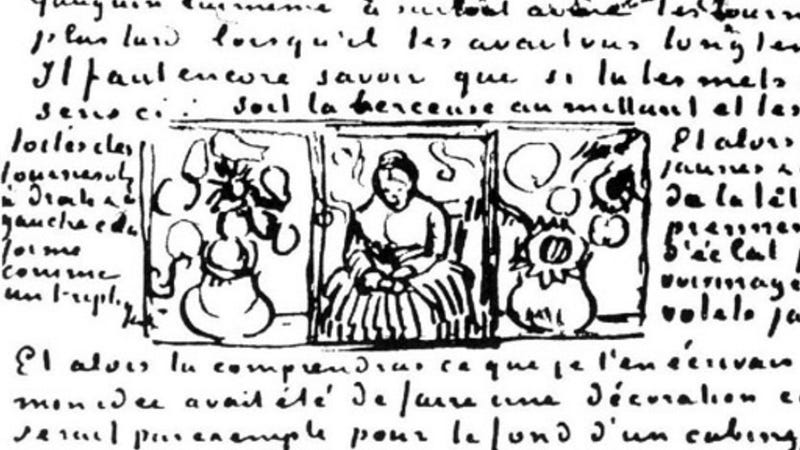
His fondness of the series is also evident in a letter to his brother Theo in 1889: “I picture to myself these same canvases between those of the sunflowers, which would thus form torches or candelabra beside them, the same size, and so the whole would be composed of seven or nine canvases.” He added a sketch in his letter. The painting in the middle is one of the versions of the Berceuse.
Van Gogh would be upset to learn that activists today used this masterpiece to get attention for a cause he had never heard about in his lifetime. The protective glass worked, but that doesn’t mean I approve of this act. Like school shootings, terrorists driving trucks through a crowd, or something as innocent as the Ice Bucket Challenge, there is sadly a clear trend that acts that get attention in the media will be followed by others.
Is this effective climate action?
But isn’t the climate crisis so alarming that the importance of one painting is negligible? The activists seemed to think so when they shouted: “Are you more concerned about the protection of a painting or the protection of our planet and people?”
It is the wrong question to ask. These two issues are just as little connected as they have ever been in my writing. If destroying one Van Gogh would save the planet, I would be happy to burn it for you. But leaving the extra emissions aside, after millennia of offerings to the gods, we know by now that climate action requires more than destroying what we love. Climate action is about protecting what we care about.
I wonder what these women are trying to achieve. Of course, those already alarmed about the climate crisis won’t need more convincing by tomato-souping works of art. So I suppose they hope to convince the rest that we all must work toward solutions to the climate crisis.
Imagine a typical climate change denier; would he or she now be convinced by the strengths of these activists’ arguments? Do they suddenly realize that climate change should be taken seriously because Van Gogh’s sunflowers are at stake?
Since when are climate deniers and art lovers in the same category? I always assumed to be amongst educated people in a museum. So why didn’t they target a drive-thru hamburger chain full of meat eaters in polluting cars?
What did Vincent van Gogh, an impoverished artist who made the world more beautiful with his art in the late 1880s, ever do to deserve this?
I made this 15-second video (using AI to create a Van Gogh painting of a polluting airplane) and posted it today on social media.
If you find articles like this valuable and want to support my work, consider signing up to Medium. It’s $5 a month, giving you unlimited access to all my articles AND all stories on Medium.
If you sign up using my link, I’ll earn a small commission, at no additional cost to you.