
“Destroyer of worlds” J. ROBERT OPPENHEIMER
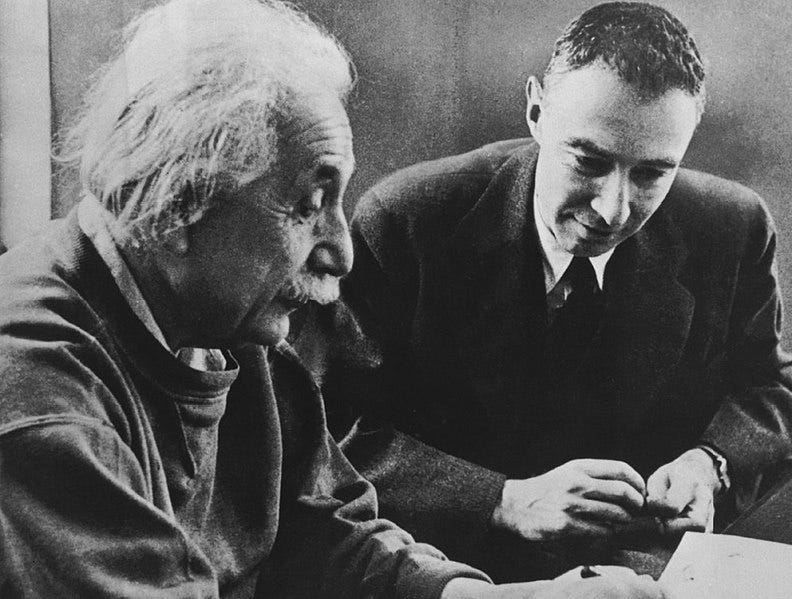

He might have succeeded Albert Einstein. Instead, Robert Oppenheimer wasted his abilities on fad science and political scheming, which deeply hurt him.
We KNEW THE WORLD WOULD NOT BE THE SAME. A FEW PEOPLE LAUGHED, A FEW PEOPLE CRIED. Most PEOPLE WERE SILENT. I REMEMBERED THE LINE FROM THE HINDU SCRIPTURE, THE BHAGAVAD GITA: VISHNU IS TRYING TO PERSUADE THE PRINCE THAT HE SHOULD DO HIS DUTY AND, TO IMPRESS HIM, TAKES ON HIS MULTI-ARMED FORM AND SAYS, “NOW I AM BECOMING DEATH, THE DESTROYER OF WORLDS.” I SUPPOSE WE ALL THOUGHT THAT, ONE WAY OR ANOTHER.’ J. ROBERT OPPENHEIMER, 1965
Unusual leadership
He was an unexpected choice to oversee a highly classified government weapons program. J. Robert Oppenheimer, the stick-thin, chain-smoking physicist with an affinity for left-wing politics and a very unscientific interest in mysticism, was initially associated with what became known as the “Manhattan Project” not long after President Franklin D. Roosevelt approved a plan to develop an atomic bomb, two months before the United States entered the Second World War in September 1941.
Oppenheimer was impressed by the manner in which he plunged himself into his responsibilities with pleasure as a member of a group of American and European scientists tasked with figuring out the sequence of events that would lead to the successful detonation of an atomic weapon.
Oppenheimer was chosen to supervise the project’s secret weapons laboratory when the Manhattan Project was first established in June 1942 by its director, Brigadier General Leslie R. Groves of the US Army. Many were taken aback. Oppenheimer had no prior experience managing significant projects. Since the initiative would bring together some of the best brains in America and Europe, his absence from the Nobel Prize was particularly troubling. Would they be content working under a leader who hadn’t won the most prestigious award in his field?
Cometh the hour, cometh the man
Oppenheimer ended up being the ideal candidate for the position. Groves had seen in Oppenheimer qualities that many others had overlooked, including a mind that could comprehend the intricacies needed in developing an atomic weapon, a vast breadth of knowledge, and a solitary ambition to complete the mission. Groves named Oppenheimer the principal scientist in September 1942. He would tenaciously take the project through to its wildly successful conclusion, as the Brigadier had said.
Groves and Oppenheimer rapidly realized they required a centralized, secret location to house the facility that would conduct the bomb’s research, development, and testing. Oppenheimer suggested purchasing a boy’s private school close to the city of Santa Fe. He had a penchant for the heat and seclusion of the New Mexico desert after recovering there from a case of TB before the war. Groves concurred, and the Los Alamos Ranch School was transformed into the Los Alamos Laboratory. From a small group of scientists in early 1943 to over 6,000 in 1945, the laboratory quickly expanded into a vast complex in the desert.
The Manhattan Project
The project’s objective was to use nuclear fission to develop a weapon with unmatched destructive capability. It was crucial and urgent that the Allies arrive first because of concerns that the Germans were also planning to develop an atomic bomb. $2 billion, or the equivalent of $24 billion in today’s dollars, was invested in the project in total.
The project, which had its headquarters in Manhattan (hence the name), was divided up among three different locations: Oppenheimer’s Los Alamos laboratory in New Mexico, which was in charge of bomb design, construction, and testing; Hanford in Washington; and Oak Ridge in Tennessee, which was in charge of uranium enrichment.
Two different types of bombs were successfully developed by scientists at Los Alamos: “Little Boy,” which utilized uranium-235, and “Fat Man,” which used plutonium-239. ‘Trinity’ was the codename used for the testing of the second variety of these weapons. The Italian-American physicist Enrico Fermi made light-hearted bets that the bomb’s blast would burn up the Earth’s atmosphere and end all life as the clock for its detonation ticked down. Sadly, history has forgotten his exact strategy for winning this bet.
‘I am become Death, the destroyer of worlds.’
The Trinity bomb was successfully set off at 5:29 a.m. on July 16, 1945. A line from the Hindu Bhagavad Gita came to Oppenheimer’s mind as he witnessed the biggest artificial explosion the world has ever seen:
“The splendor of the mighty one would be like the radiance of a thousand suns bursting at once into the sky.”
Oppenheimer was ecstatic following the test, even opining that it was unfortunate that the bomb had not arrived in time to be used against Nazi Germany. Oppenheimer, however, experienced a sudden change of heart when the bomb was dropped on Hiroshima on August 6 and Nagasaki three days later.
His colleagues and he were unable to understand the justification for the bombing of Nagasaki, so he traveled to Washington to present a letter to the US Secretary of War. Oppenheimer wrote a letter in which he conveyed his anguish at the bombing of Nagasaki and his desire to see all nuclear weapons eliminated.
Oppenheimer went farther after being given a meeting with President Harry Truman in October 1945. He expressed to the president his conviction that he had “blood on his hands.” This enraged Truman, who remarked that he never wanted to see him again to his Under Secretary of State. The Oppenheimer war was over. He had successfully let the genie out of the bottle.
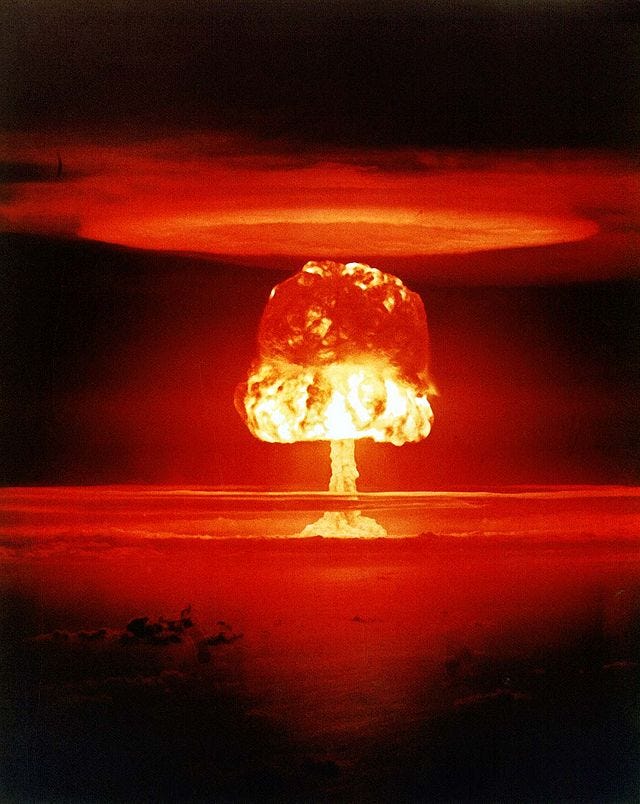

subsequent to the bombing.
On August 11, 1945, Japan submitted, putting an end to the bloodiest war in human history. Oppenheimer’s work on the first atomic bomb, which detonated over Hiroshima, was a top-secret project up to that point, but he immediately rose to fame as a national hero and appeared on the covers of Time and Life magazines.
Oppenheimer became a prominent opponent of the hydrogen bomb and a critic of nuclear proliferation after the war. In 1949, J. Edgar Hoover’s infamous House Un-American Activities Committee even inquired about Oppenheimer’s prewar communist sympathies. Due to this, Oppenheimer eventually had his security clearance revoked in 1954, ending his career as a government scientist. He issued dire warnings against creating the hydrogen bomb, which was far more devastating. On November 1, 1951, the United States tested the first thermonuclear weapon successfully. In 1952, the British did the same, and in 1955, the Soviet Union The world would never be the same after a nuclear arms race.
Oppenheimer lectured across Europe and Japan for the remainder of his life. He received the Legion of Honor, France’s highest honor, in 1957, and he was chosen as a member of the esteemed Royal Society of Great Britain in 1962. In 1963, after receiving the Enrico Fermi Award from President Kennedy for his contributions to science internationally, he was able to rebuild his life in his native country. Following Kennedy’s killing in 1963, President Lyndon Johnson gave him the award and a $50,000 tax-free stipend.
Oppenheimer, a lifetime chain smoker, received a throat cancer diagnosis in 1965. At the age of 62, he passed away on February 15th, 1967.
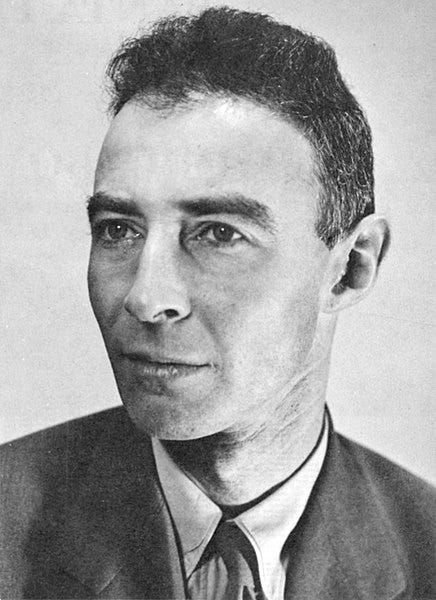

A somber chapter in humankind’s collective consciousness was permanently inscribed by the horrific events of the atomic bombings in 1945. Cities were turned to ash and debris during those tragic days, and they still stand in ruins today. The charred bones carried the chilling echoes of silent screams, bearing witness to the unfathomable destruction wrought upon innocent souls. The depths of the human soul were penetrated by the sadness that permeated Hiroshima and Nagasaki and knew no bounds. Children’s tears, permanently recorded in history, served as a moving monument to the suffering and agony endured by a generation shattered by the atom’s unleashed wrath.
I am MUSA AYAZ. I write about poetry, tech, business and self-improvement, and interesting trending topics to revolutionize writing in a way you have never seen before.
-Runner up on promptly written poetry competition 2023
Follow me [email protected] for work
MY PREVIOUS ARTICLE https://readmedium.com/why-has-andrew-tates-conversion-to-islam-sparked-such-controversy-f14de6bdbf1f?sk=bdf4f3cb69ecd8593ede70364907bc55