
Destroyed: When A Wealthy Black enclave was Razed down by White Rage
Flushed with Dollars, Black people in this District had it all together.
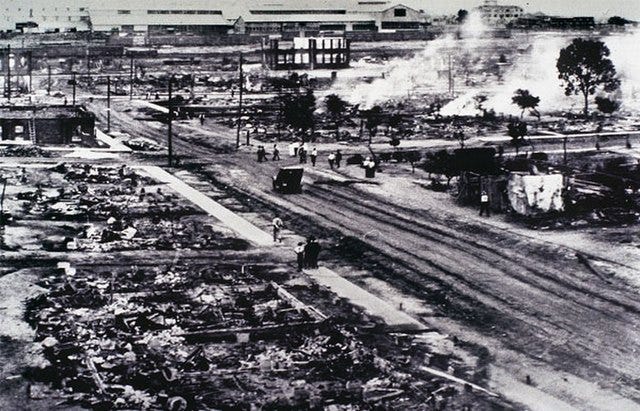
A community created by segregation thrived. A Black community tacked in Tulsa prospered. Beautiful brick homes dotted the landscape. Banks, grocery stores, hotels, billiard halls, nightclubs, theaters, and churches lined up wide boulevard streets. This was Black Mecca, a place of limitless possibilities.
It was an affluent Black city built by Black people for Black people. A breath of fresh air for a segregated people, a city of refuge for hardworking Black people escaping the rigors of Jim crow’s south.
In 1905 Booker T. Washington’s toured Oklahoma. During his trip to Tulsa, he was amazed by the cooperation, economic independence, and prosperity enjoyed by the Black Community. Greenwood residents elected their own leaders raised capital and supported each to grow their businesses.
The residents had named their district Greenwood, after Greenwood District Washington had established in Tuskegee, Alabama.
Booker T. Washington christened the District “Black Wall Street.” And Black Wall street- it became right to the day it was razed down by a frenzied racist white mob enraged by Black prosperity.
Educated and professional Black people segregated by Jim crow, unable to shop or live in white neighborhoods, flocked to this new enclave. Money circulated. Black businesses flourished. The community prospered. Black-owned Banks, Restaurants, Clothing stores, Jewelers, Movie theaters, nightclubs, and churches nestled for Greenwood’s Black dollars.
Black professionals, doctors, dentists, lawyers, and clergy served Black elites. Their offices sat pretty along Greenwood’s main commercial thoroughfare. Two Newspapers kept everyone informed.
Black wall street was flush with Black dollars. Stylishly dressed residents cruised in luxury cars. Its Black community of 10,000 residents had found a city of refuge a place to build better lives for themselves and their families away from racial hate and bigotry. They dreamt of a wealthy Black city, a Black person’s utopia, a city where Melanin didn’t block their economic growth.
But the dream was about to be aborted. All because of skin pigment. What was supposed to be an antidote to racial oppression became a target of racial rage.
On the morning of May 30, 1921, Armed white rioters, deputized by local police descended on Greenwood District, they looted, razed, and destroyed businesses, homes, schools, churches, hospitals, hotels, public library, newspaper offices, everything, nothing was spared.
It all started when a young black man, Dick Rowland, who worked shining shoes, rode the elevator of Tulsa’s Drexel building. The white elevator operator screamed. Dick Rowland ran. Rumors spread. Rowland was arrested, Sarah Page the elevator operator refused to press charges.
It was rumored they might have been secret lovers involved in a lover’s fight. It wasn’t the first time Rowland was riding the elevator. He had to ride to the top floor every time he needed to go. The ‘colored only’ washrooms were on top of the building.
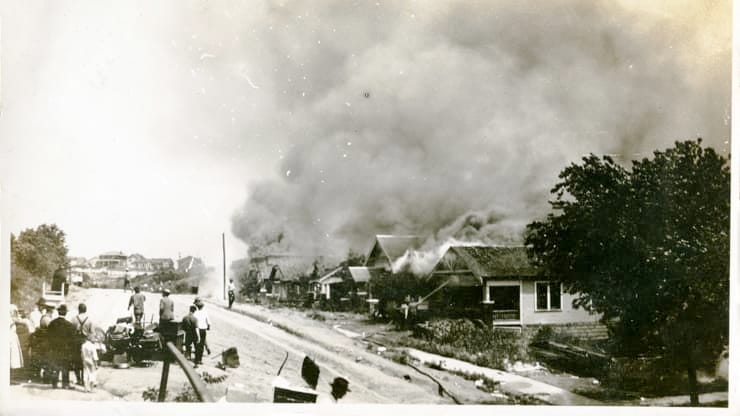
Vengeful white Tulsans had their excuse and didn’t care. Miscegenation was a crime worth dying for a black person anyway. Talks of lynching Rowland circulated. The Tulsa Tribune fanned the flames. “Nab Negro for Attacking Girl in Elevator,” splattered its front page.
Black men hoping to defend Rowland from being lynched gathered outside the courthouse. Many were World War 1 veterans. Seventy-five armed Black men lined the courthouse to protect a frightened black man from being lynched by an incensed white mob, They were one too many.
Word spread -“a Negro Uprising!” Those two words turned white Tulsans into raging racists. “Get a gun and get a nigger” they roared. As one man They converged on the courthouse, not one, not two hundred, -but a thousand strong white men, old and young, guns cocked and ready for battle.
They were Baying for black blood waiting for a spark.
Fifty more black men joined the first fifty. The white mob marshaled more boots, another contingent of one thousand joined the first. One hundred and twenty-five Black men looked down two thousand barrels in the hands of a murderous white mob.
Tension escalated a white man jumped on a black man, forcibly trying to disarm him. He was shot. That was the spark. All hell broke loose, Guns suddenly blazed. Black men dived for cover- shooting back. When the guns fell silent, twelve people were dead, 10 white two Black. White-hot anger consumed the attackers.
Greatly outnumbered and outgunned the Black men retreated to Greenwood district. The white mob followed.
As darkness descended on the raucous white rioters’, rampage filled their souls. Their eyes burned with a dark foreboding hatred. They unleashed terror on Black families. House to house, store to store, they looted, torched, and razed down buildings.
Greenwood men many of who had come back from war, took sniper positions greatly outnumbered they had to make every shot count. The murderous mob retaliated, they called back up. Low-flying planes sprayed bullets on families. rained bullets and fiery turpentine inflammable.
Mary E. Jones Parrish a journalist in the Greenwood district documented in her book Events of the Tulsa Disaster;
“Fast-approaching airplanes — more than a dozen airplanes went up and began to drop turpentine balls upon the Negro residences. She quoted an eyewitness who saw low-flying airplanes belching fiery balls that left entire blocks a mass of flame as they passed over the district.
A ten-page legal pad manuscript yellowed by age discovered in 2015 written by Buck Colbert Franklin, a Greenwood Black attorney who spent his life defending survivors of the massacre reveals terrifying twenty-four hours.
“Lurid flames roared and belched and licked their forked tongues into the air. Smoke ascended the sky in thick, black volumes and amid it all, the planes — now a dozen or more in number — still hummed and darted here and there with the agility of natural birds of the air.
Planes circling in midair: They grew in number and hummed, darted and dipped low. I could hear something like hail falling upon the top of my office building. Down East Archer, I saw the old Mid-Way hotel on fire, burning from its top, and then another and another and another building began to burn from their top.
The sidewalks were literally covered with burning turpentine balls. I knew all too well where they came from, and I knew all too well why every burning building first caught fire from the top.
I paused and waited for an opportune time to escape. ‘Where oh where is our splendid fire department with its half dozen stations?’ I asked myself, ‘Is the city in conspiracy with the mob?”
Franklin escaped. He lived, a witness to what would have been possible.
The Massacre was buried. White conspiracy gave it a name, — “Race Riots.” The nation’s conscience was massaged. Greenwood’s residents — those who hadn’t died, fled. As white rioters razed down Black Wall Street. Tulsa’s chief of police ordered his officers to go to all the photography studios. They confiscated all pictures of the carnage.
Governor Robertson declared martial law. The National Guard took reign. As the White Mob marauded brazenly. All black people were deemed a threat to law and order. Every Black person who wasn’t dead was arrested.
In what would be reminiscent of Nazi Germany. They were detained in convention centers and fairgrounds. No member of the white mob that murdered and pillaged was arrested.
Instead, Victims became defendants. Kept under armed guard. A Black person could only be released if vouched for by a white person. The White person had to accept responsibility for the detainee’s future behavior.
For months, many Black people remained in detention.
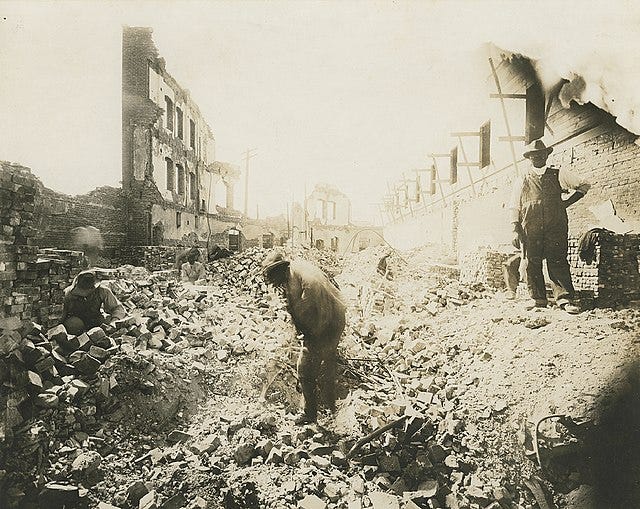
The county government refused to contribute financial help in rebuilding Greenwood. In fact, municipal authorities impeded rebuilding. As Tulsa’s officials turned away outside help for the victims. A few kind-hearted white people in Tulsa and neighboring communities offered to help. They assisted relief efforts by the Red Cross.
“Not only did Tulsa city officials cover up the bloodbath, but they also deliberately shifted the narrative of the massacre by calling it a “riot” and blaming the Black community for what went down” noted Alicia Odewale, an archaeologist at the University of Tulsa.
Deafening silence descended. Graveyard silence, the terror, violence, and destruction simply vanished. It was as if Black Wall Street never existed.
Victims did not speak for fear of retaliation. Perpetrators went to great lengths to erase it from annals of history. For decades It was not mentioned in history books, classrooms, or in private. Black and white people alike grew into middle age, frivolously unaware of what had happened.
In May 2021, one hundred years after the massacre, 107-year-old Viola Fletcher testified before Congress:
“On May 31, of 1921, I went to bed in my family’s home in Greenwood,” she recounted. “The neighborhood I fell asleep in that night was rich, not just in terms of wealth, but in culture…and heritage. My family had a beautiful home. We had great neighbors. I had friends to play with. I felt safe. I had everything a child could need. I had a bright future.”
A 100 years later the rampage is still vivid in her mind “I still see Black men being shot, Black bodies lying in the street. I still smell smoke and see fire. I still see Black businesses being burned. I still hear airplanes flying overhead. I hear the screams.”
On June 1, 2021, on the 100th anniversary of the massacre, President Joe Biden visited Greenwood. He met survivors of the Massacre. In a speech that pricked the nation’s conscience he said;
“Some injustices are so heinous, so horrific, so grievous, they cannot be buried, no matter how hard people try.”
References: