
Destiny or Free Will

It’s not comforting to think that everything we do and say is pre-determined and nothing we can do could have any effect because what is going to happen has already been set in stone. Unfortunately, bodies of knowledge seem to provide us with this knowledge as the basis on which the universe operates.
Traditionally, most religions provide us with a view of an omniscient God. A being who knows the past, present, and future of our universe. I grew up as a Christian and there were a few chapters that specified Jehovah’s omniscient nature like Psalms 147: 5 stating “Great is our Lord and of great power: His understanding is infinite” according to the King James Version. What this means is that if there is knowledge of our future universe, assuming it is definite and true, then our universe would have a definite state of existence in the future, also referred to as Determinism. If this is true, whatever we think and do is already bound to happen and our actions are irrelevant in the grand scheme of things.
You can’t be more than what you are”
This line of thought leads to so many questions, like:
Why am I responsible and judged for my actions if they were meant to happen?
If there is a definite determined future, isn’t God just a character in the grand scheme of things just that he’s in the stands?
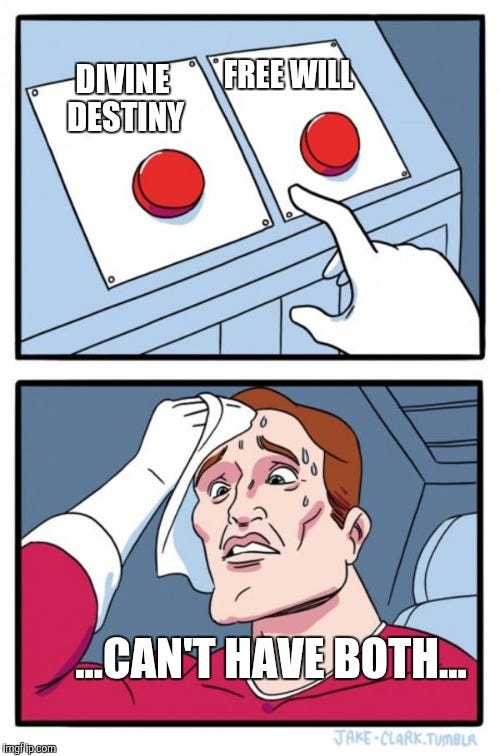
Religion is not the only body that provides support to Determinism. Science also provides a version that can be more relatable and easier to understand, the concept of Universal physical laws.
Let’s assume that there exist true physical laws governing all entities in our universe, then if the physical characteristics — energy, mass, position, velocity amongst others — of all particles at time (t) are known
Then
The physical characteristics of all particles at the next instant of time, t + Δt = t₁ can be found by the application of the physical laws.
And so on for t₂ → t∞.
Imagine a game of pool where you perfectly know the initial position, speed, and direction of every ball on the table (time, ‘t’). If you have complete knowledge of the physical laws governing the interactions between the balls and the table surface, you can predict with certainty how each ball will move and where it will be in the next instant (t₁). Knowing the conditions at t₁, you can then accurately determine their positions at the subsequent instant (t₂), on and on till the game is over.
In this example, the trajectory and positions of all the pool balls are predetermined by the rules of physics, assuming no external influences like air resistance, friction, or impact from other objects. Similarly, if the universe operates under true and definite physical laws, the future states of particles could be calculated based on their current conditions, suggesting a pre-determined course of events.
Despite all these religious and scientific proofs of a pre-destined world, it feels counterintuitive to believe that there is no free will. Our decisions are what make us look the way we do and seeing as we all look different, we make decisions every day based on our will.
Another perspective on free will involves viewing it as our ability to make choices. Regardless of the circumstances, whatever universe or time we find ourselves in, choices remain accessible to us. Our freedom is defined by the multitude of choices available, unlinking free will from the specific state of the universe. Instead, it emphasizes free will in terms of an individual’s interaction with the universe. With countless ways to choose how to relate to the universe, individuals are inherently free. However, this freedom comes with the responsibility of fully owning and taking accountability for the choices made.
“For every action, there is an equal and opposite reaction” — Newton’s Third Law of Motion
Subscribe to my page to get more content like this.
Until next time, au revoir!!!


