
Finding Health Within Using The Mind-Body Connection And The Circadian Rhythm
Your brain is constantly searching for patterns to make your experience easier. For this reason, you may not think about how you are going to drive a car or put your pants on in the morning…you just do it.
Actions habitually completed become “second nature” because our body takes over the “thinking” that our brain would otherwise do while doing something to save your brain the energy.
So it makes sense then…why it feels so difficult to break the usual pattern of bad habits that seem to follow us everywhere.
These actions are not just thoughts or fancies. They are chemical signals released in the body.
Starting small — smaller than you think — and building on it is what is going to create the consistency you need.
In my recent article, I mentioned changing your environment as an integral part to changing or creating new habits. You should check it out.
Let’s understand the key concepts that shape our day first.
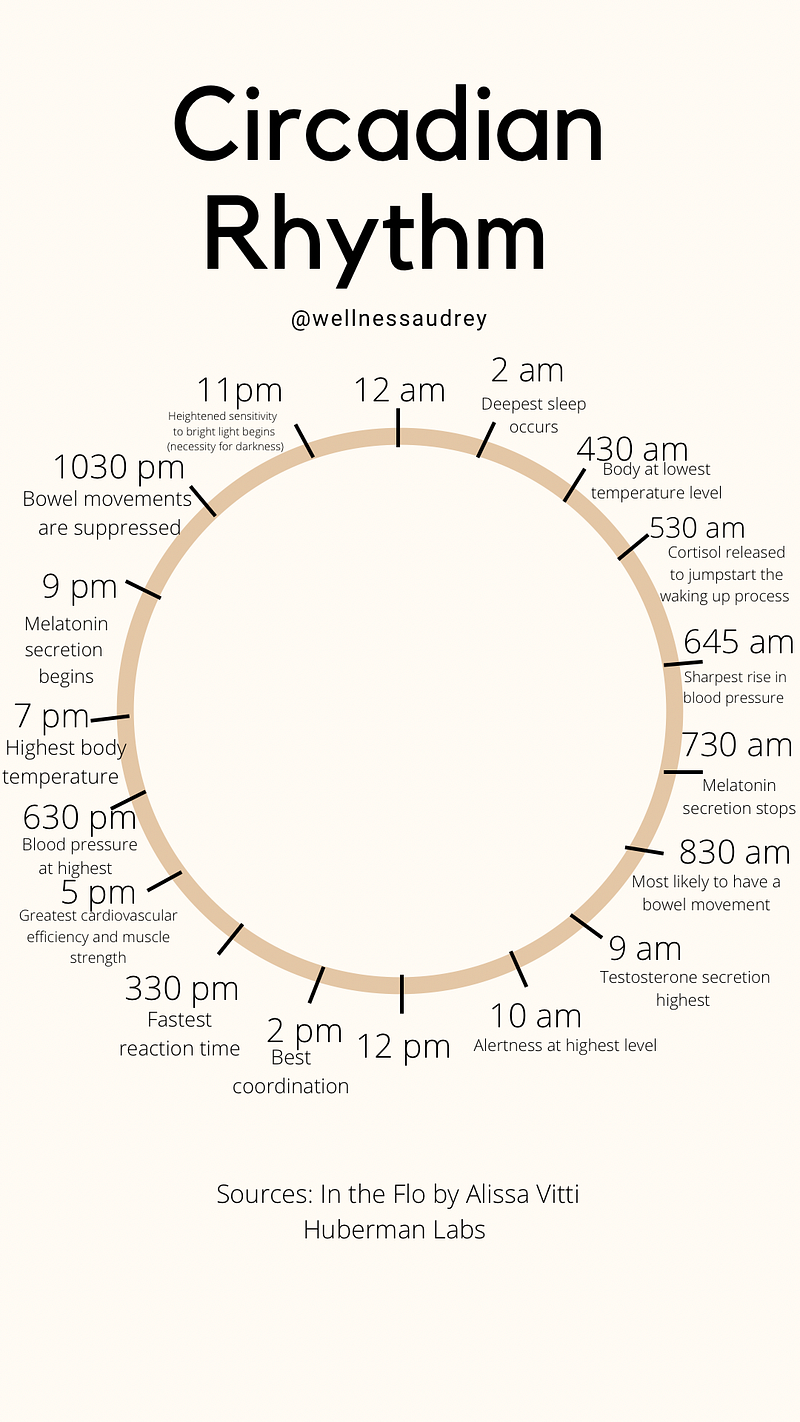
Your body’s internal circadian and diurnal rhythms release hormones throughout the day, making you more alert at certain times and more relaxed at others. These rhythms make you hungry at lunch or creative in the afternoon but also can make you not hungry at all and fatigued all day if your body is out of sync with them.
You don’t think about these changes, but you certainly feel the energy shifts.
We can use the power of our brains and the daily, natural rhythm of the body together to create a cohesive approach to master the lifestyle that works for our own unique mind and body.
Great. How can we do that?
Align to the human circadian and, if possible, diurnal rhythms while challenging the thoughts and actions we usually take to mindfully interrupt unwanted behaviors.
First. Align to the natural rhythm humans were meant to live by.
It’s no wonder that humans almost immediately respond to waking with the sun and falling asleep not too long after sunset during studies where scientists follow indigenous peoples or simply regular westernized persons who were placed in a natural environment (i.e. out in nature while camping).
Ancient health systems like Ayurveda and TCM assert that humans are creatures of the sun and suffering begins when interrupt our natural sleeping pattern. We become more prone to stress, depression, anxiety…mental conditions that have become all too prevalent in our modern society.
On top of poor sleep hygiene, we are snacking ALL day. Our digestive system has no time to rest in between meals, and our blood sugar does not receive the minimal three and a half to four hours of not eating to stabilize post meal.
Then we snack or have late meals before we go to sleep for the night, the time where our digestion has significantly slowed in order for our bodies to fall asleep to start recovery and detoxification processes.
Please see the diagram below for a visual representation of healthy circadian and diurnal rhythms.
Now for the hard part: challenging your brain to break old behavior patterns and create new ones.
This process requires a brain-body team effort.
1. Find small changes you can make in your environment.
Embrace the discomfort of changing the order of how you get ready for the day. Maybe put on your left shoe first instead of your right. Put on your shirt before you put on your pants. Sit at a different chair for breakfast. Use a different coffee mug.
These slight shifts of perspective can start a waterfall of micro-changes to lead you to the macro-changes that you want because these subtle interruptions get your brain’s attention that something is going to change.
2. Before you eat something, go somewhere, or do an activity, question yourself and/or what you are thinking.
Am I hungry? Will this nourish me? If I’m not hungry, why am I reaching for food? Am I trying to “feel better” emotionally by eating this?
Do I actually want to go to this event or am I doing this out of obligation? Will this event make my life better in any capacity? Have I been sedentary for a while and do I need to go for a walk?
How do I feel buying this right now and do I really need it? Is this anxious thought I’m having about this situation true? Why do I feel this way when my partner asks me XYZ? How come I got angry earlier when I talked to my parents/family member?
This process is simply questioning your daily thoughts and actions to discover the source of your internal discomfort and look at it with compassion and gentleness.

3. Find the smallest version of the habit you want and integrate it into your day.
Let’s say you want to live a low-stress life. Start by breaking down the concept into smaller bite-size pieces of actionable steps. Then think even smaller.
Maybe this means meditation every morning…but that seems kind of daunting for someone who has been living a high strung life for years.
The smaller step of meditation every morning might mean 10 slow, deep breaths while sitting up in your bed after waking and doing this for two weeks. Then reassess. Maybe move on to 20 slow, deep breaths or simply three minutes of body scanning.
If it’s eating healthier, add one serving of vegetables to one meal and assess how you feel after doing this for a week or two. Then move onto adding one serving of vegetables to two meals during the day. Or maybe you add what would be a late morning snack to your breakfast for a heartier meal to last you four to six hours until your next meal.
You have the power to design the reality you want. Unfortunately, the changes you want in your health will not simply appear because you really want them to happen.
The best thing about this is that there is no need to start with a bang. Starting small — smaller than you think — and building on it is what is going to create the consistency you need.
I challenge you to take an inventory of your health (or any other aspect of your life, really) and have gratitude to be where you are today. The fact you are even considering personal growth is profound.
Shifting into a natural rhythm and questioning the little mean voice in your head will soon not feel like such a feat. We just have to give ourselves the time and grace we willingly give to others.


