
Designer’s New Journey in the AI Era: Bridge Machine Code to Human Touch
In the ever-evolving digital landscape, the acceleration of AI technology continues to reshape our lives in ways we can scarcely fathom. While the precise ramifications remain elusive, the pervasive influence of AI is palpable.
Dr. Maeda is a technologist with a design background. In his book How to Speak Machine, he elucidates complex technology with elegant simplicity, beaconing designers seeking to grasp the essence of computation and its transformative potential. Through his insights, designers are empowered to cultivate a mindset primed for learning and leveraging new technology to expand their design horizons.
As I read How to Speak Machine, several questions emerged in my mind:
⭕ What are the core properties of computation, where does its prowess lie, and what are its limitations?
⭕ What are the Unique Paradigm of Computational Product Development compared to traditional hardware product development?
⭕How can designers recalibrate their mental models to harness the power of AI, and what capabilities must they cultivate?
Core Properties of Computation
Computation, at its core, possesses unique attributes distinct from the human mind. These include:
Looping Mechanisms: Machines excel at repetitive tasks, facilitated by loops and recursion in programming. Typical examples of loops and while loops are commonly found in most programming languages. The program iterates repeatedly over a sequence of instructions until a specified condition is no longer valid. This forms the bedrock of automation, enabling machines to undertake laborious and iterative tasks with precision.
Scalability: The human brain can only handle one major thing simultaneously. Unlike the human brain’s limitations, machines can simultaneously process vast amounts of data. This scalability enables feats such as personalized recommendations on platforms like TikTok, catering to millions concurrently.
Velocity: Machines exhibit unparalleled processing speed, exemplified by real-time applications like Uber and Google Maps, which seamlessly adapt to dynamic environments.
Exponential Evolution: Computation gets exponential growth. Computing can learn at an exponential rate. The same goes for its increasing capability to do all kinds of tasks; this exponential growth enables rapid learning and adaptation, as witnessed in AI models like ChatGPT. It can leverage millions of data to answer human questions timely. From ChatGPT3 to ChatGPT4, its memory capacity, reasoning, and ability to accurately respond and solve problems have been greatly improved. We tend to think linearly, so it’s hard to really imagine anything moving faster than an exponential curve as AI evolves…
The Boundaries of Computation/AI
Despite its prowess, AI encounters limitations:
Scope of Neural Networks: Even if AGI comes out, it will be impossible to break away from neural computing and formal logic to grasp the truth of nature. It is more like a “super brain,” not a complete individual. In human culture, “knowing” is also a whole-body experience, and we never conceived of knowing as a brain-only, disembodied activity. It has a huge “knowing” that exists in human experience but cannot be computable. For example, scientific research ultimately requires you to have a direct connection with nature and involves the use of external tools and external information.
Creative Originality: From zero to one is the hardest part for AI to create. Image generation tools, like Midjourney, can create upscale pics from big image data. But it can’t “image” a new thing that doesn’t have any reference in its database. Furthermore, the AI-driven imaging generation tool seems to have “low-level creativity” to combine different images or styles. Still, it cannot generate original content, not to say it can provide aesthetic surprise and arouse human emotion with its “creativity.”
Feel people and create Human Connections:Only humans can seriously care about others. It comes from our perception, not just from our brain. AI’s simulation of empathy notwithstanding, it falls short of establishing genuine emotional connections with humans, underscoring the irreplaceable role of human empathy and interpersonal bonds.
Value Formation: Humans are meaning animals. Each of us has unique and distinctive values in mind, and we strive for meaning by following the inner value standard. However, AI lacks intrinsic values, necessitating alignment with human values to impart meaning and significance to its outputs. It can’t provide meaning to humans, although it can greatly improve efficiency and productivity.
The Unique Paradigm of Computational Product
Distinct from conventional product development, computational product development adopts a dynamic approach characterized by the following:
Continuous Improvement: Computational product design and development do not strive for perfection but for continuous improvement. Iterative enhancements are driven by user feedback and facilitated by agile development methodologies. It further leads to the evolution of UX research and design methods. The most obvious change is to leverage user evaluation in the entire life cycle at a higher frequency. A/B tests are more widely adopted, although traditional usability tests are still helpful in getting valuable feedback from a small sample of users offline. That’s what Dr. Madea mentioned: “The computation product is to strive for “timely design” rather than “timeless design.”
Data-driven Behavioral Understanding: We spent more time online. Being online means that all our behavior is digitized and can be monitored and understood by the computation product. Further, computation systems can leverage data to comprehend and anticipate user behavior, enabling personalized and anticipatory services. Nest shows how Intelligent machines and humans adapt to each other. It starts by recording data from its sensors and users’ behavior. Then, Nest acts on its users’ behalf. It creates a schedule that changes the temperature that acts on what it believes users would want based on its known user preference. That predictive behavior is the magic that makes the product more valuable to users than just sensor networks connected to the net.
Automation: Automation is inevitable. The proliferation of AI-driven automation, streamlining complex tasks and augmenting human capabilities. We are in the between times to hand over part of the human manual work to the computation product. For example, in simple traffic conditions, like on highways, the user can hand over the driving to the Tesla Model X itself. In the future, computation products will become increasingly mainstream in automatically completing various heavy or repetitive tasks.
How designers adapt to the change (speed-up computation/AI)
How we think about AI affects how we adapt to change. When considering new technology, we should consider how to use it to amplify our value rather than its potential threat. This is fundamental. Maintaining a negative mentality will make us more uneasy and pessimistic, while we should keep a proactive mentality. It directly affects our behavior when interacting with artificial intelligence.
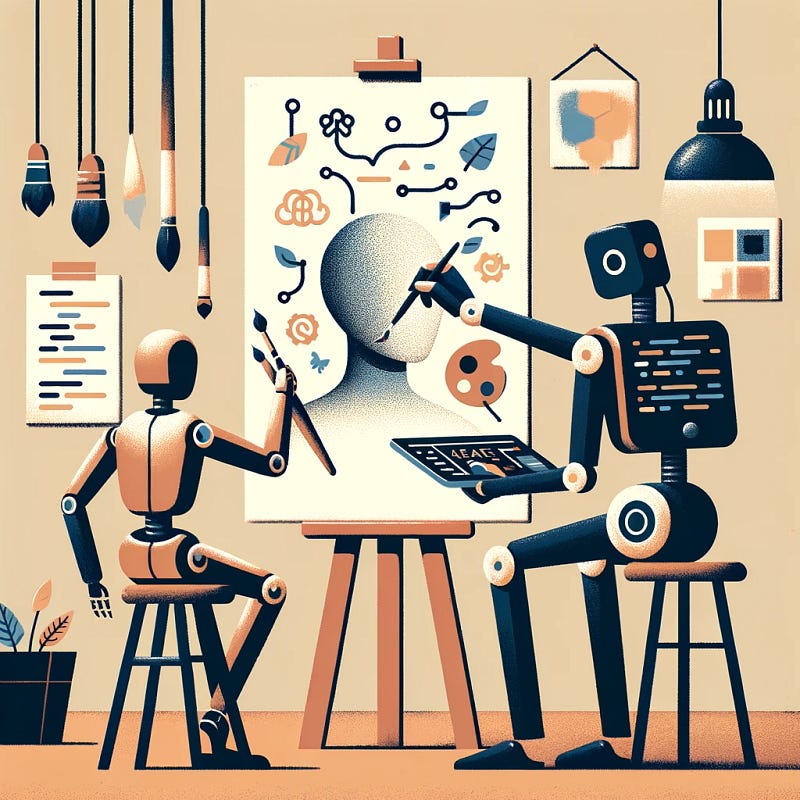
In navigating the swift currents of computational innovation, designers must:
📚 1. Learn computation deeply and use it for your purpose
Our worries often come from a need for a clearer understanding of new things. The more deeply we understand, the easier it is to evaluate the value and possible threats accurately it brings. Being fully open to it and learning the fundamentals of this new technology. Learn and try new AI tools to see how we can leverage new tools to benefit our design work. Deepen our understanding of AI and integrate it purposefully into design workflows. For example, design prototyping takes designers a lot of effort. We can experiment with new AI tools to evaluate whether there are any tools we can leverage to speed up the process and improve productivity.
🐱🚀 2. Exhibit Audacity
Audacity and courage are uniquely human qualities. Be audacious and unafraid to leap into the unknown. As we recognize the magnitude of the challenge, draw upon our courage and experience to embrace it, leveraging AI as an enabler rather than a threat, and actively add more human value to it.
🪂 3. Stay dominated
We control and take responsibility for the final result, not AI. When co-working with ChatGPT on an article, you should know the big ideas you want to express, and you decide on the topic direction. Also, you should monitor the details to confirm that there is No false or untrue factual content; you should show your personal style in the article, not AI, and act on your behalf. When you do a design, AI tools can help brainstorm and extend your thinking, but you should be responsible for judging and deciding which design direction you will go. So don’t give the initiative to the machine.
💡 4. Keep critical and innovative
Continue to think critically about what we do. AI lacks the cognitive processes associated with human critical thinking up to now. Critical thinking involves questioning assumptions, evaluating evidence, and considering different views. AI systems cannot question underlying assumptions or challenge established norms. Further, they do not possess creativity, intuition, or the ability to generate novel ideas, which are essential aspects of human critical thinking. The highest level of work is discovering new possibilities. Humans can think creatively, solve complex problems, and innovate in ways computers cannot. While AI excels at processing large amounts of data and executing repetitive tasks, they lack the capacity for original thought and creativity. Designers are responsible for generating novel ideas, envisioning new possibilities, and pushing the boundaries of what is possible, even within the framework of computational tools.
💖5. Explore Humanity and Address Ethical Implications
Dr. John mentions that computation systems are incomplete since they are built by techies and are laden with human biases. It must address the imbalance between technology and humans in the computational era. In his earlier book Megatrends, John Naisbitt pointed out the idea of “High Tech: High Touch.” The more we rely on machines, the more we need human touch. This means that the success of any technology depends on how deeply it shapes the human experience by understanding humanity deeply. AI technology alone will not lead to a better future for humanity. As the core role in creating new things, designers must work with other roles to give future technologies a distinctly human character.
The core of humanity is the moral value of human beings. Humans possess a sense of ethics, morality, and values that guide their decision-making and behavior. Computational products raise ethical and societal implications for privacy, security, fairness, and transparency. Designers play an active role in assessing these implications and making ethical decisions that prioritize the well-being of users and society during the computation product development process.
As we journey through the AI-computational era, the role of designers transforms. No longer mere creators, designers emerge as custodians of human values and sensibilities. Yes, embracing AI is crucial — learning, exploring, and harnessing its capabilities in novel ways. Yet, our true essence lies in humanity, critical thinking, and originality.
Navigating this era entails delicately balancing human intuition with computational logic. It’s not just about adopting new technologies; it’s about leveraging our innate abilities to steer through the complexities of the technique landscape, and emphasize human value and meaning.


