
Descriptive and Stochastic Models: An In-Depth Guide
In the realm of modeling, both descriptive and stochastic models serve as indispensable tools for understanding and predicting real-world phenomena. Let’s embark on an exploration of these models, unraveling their concepts, applications, and significance.
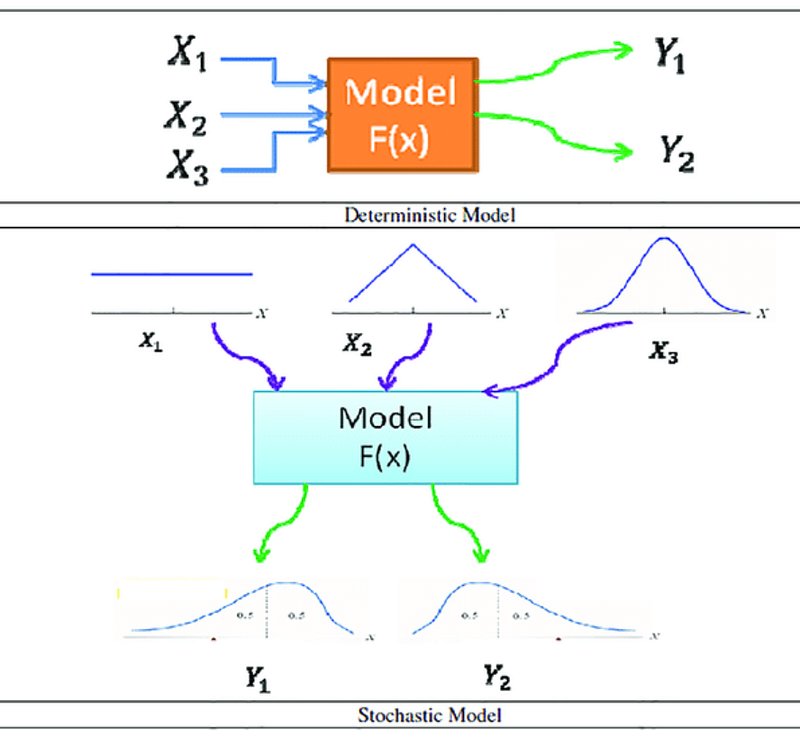
Descriptive Models: Unveiling Realities
- What are Descriptive Models?
Descriptive models encapsulate existing data to portray and summarize characteristics, patterns, or behaviors of a system. These models seek to describe and understand the past or present without predicting future outcomes.
2. Types of Descriptive Models:
- Statistical Models: Utilize statistical methods to describe relationships between variables.
- Simulation Models: Mimic real-world processes to understand system behavior.
- Data Mining Techniques: Unearth patterns and relationships within large datasets.
3. Applications of Descriptive Models:
- Business Analytics: Forecasting sales trends or customer behavior.
- Epidemiology: Analyzing disease spread and patterns.
- Financial Analysis: Predicting market movements based on historical data.
4. Advantages:
- Insights from Data: Reveal underlying patterns and relationships.
- Decision Support: Aid in making informed decisions based on past trends.
- Visualization: Provide intuitive representations of complex data.
Stochastic Models: Embracing Uncertainties
- Defining Stochastic Models:
Stochastic models integrate randomness and uncertainty into predictions, generating multiple outcomes with associated probabilities. They account for variability and unpredictability inherent in real-world systems.
2. Types of Stochastic Models:
- Monte Carlo Simulations: Iteratively sample random inputs to assess various outcomes.
- Markov Chains: Model sequential events where the outcome depends on the previous state.
- Stochastic Differential Equations: Describe systems subjected to random fluctuations.
3. Applications of Stochastic Models:
- Finance: Assessing risk and forecasting stock prices.
- Weather Forecasting: Predicting weather patterns considering uncertain factors.
- Supply Chain Management: Optimizing inventory considering demand fluctuations.
4. Advantages:
- Risk Assessment: Capture uncertainties to evaluate potential outcomes.
- Robust Decision-making: Enable planning for multiple scenarios.
- Realism in Modeling: Reflect the dynamic nature of real-world systems.
Bridging the Gap: Harnessing Complementary Strengths
- Integration of Models:
Combining descriptive and stochastic models offers a holistic approach. Descriptive models provide insights into historical data, while stochastic models factor in uncertainties for predictive analysis.
2. Challenges and Considerations:
- Data Quality: Reliability and accuracy of input data affect model outcomes.
- Model Validation: Ensuring models reflect real-world scenarios accurately.
- Computational Complexity: Stochastic models may require extensive computational resources.
Conclusion: Unveiling Insights, Navigating Uncertainties
Descriptive models illuminate past and present trends, providing a foundation for understanding. In contrast, stochastic models embrace uncertainty, enabling predictions and scenario planning. Leveraging the strengths of both models equips us to navigate complexities, make informed decisions, and steer towards robust solutions in an ever-evolving world.
Stay up-to-date on my latest work! Follow me on Medium and clap for this article to support my content creation. Thank you for reading!
Also you can subscribe and become a member ! :)