
Deriving the Effect of Solar Radiation Pressure on Orbits
A simple method for adding solar radiation perturbations to a two-body problem model
Orbits of smaller bodies, such as satellites, asteroids, comets, etc., can be quite complex. Typical mission planning includes solving the two-body problem to obtain a basic orbit. From there, complexities such as perturbing forces can be added to increase the accuracy of the model. With respect to orbital mechanics, a perturbation (or perturbing force) is a force acting on a mass other than the gravitational pull of a single other massive body. These forces can be difficult to model, but with the right mindset and understanding, they can be simplified substantially.
Perturbations
Perturbing forces can be broken down into two categories: gravitational forces or non-gravitational forces. In the gravitational forces category, we have forces such as tidal forces, gravitational pull of other massive bodies, and the effects of an oblate attracting body. The non-gravitational perturbing forces are atmospheric drag, radiation pressure, and magnetic forces. All of these forces should be considered when building a high-fidelity (high accuracy) orbit model. The effects of these forces can be crucial for mission success.
Background
With general definitions out of the way, let’s consider only a solar radiation pressure perturbing force. By the end of this article, we will have derived an expression to model the motion of a negligible mass under the influence of solar radiation pressure and a massive body’s (planet, moon, star, etc.) gravity. If you are unfamiliar with the two-body problem (2BP), I encourage you to check out the linked article that goes into detail the derivation of the equations we will be using as a basis for our new model.
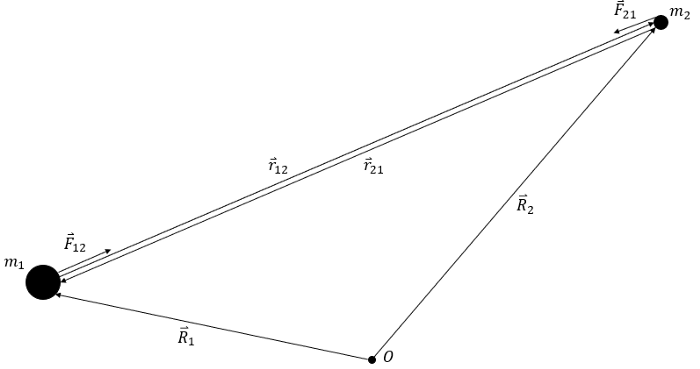
For the remainder of this article, I will be referring to our main massive body as Earth and the mass whose motion is of interest as a satellite. However, these principles can be applied to any massive body and smaller mass (needs to be negligible in comparison to the massive body). Now, from the article linked above, the diagram related to the two-body problem and the equations of motion from that system are displayed below:
The equations of motion:
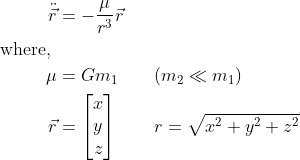
Here, x, y, and z make up the vector r that describes the position of the satellite with respect to the Earth (primary mass). The universal gravitational constant is G, m₁ is the mass of the Earth, and m₂ is the mass of the satellite. The gravitational parameter is denoted by μ. By convention, we ignore the mass of the satellite since it is negligible in comparison to the Earth. As stated earlier, we will be using the two-body problem as a starting point from which we will add the solar radiation pressure perturbation.
Solar Radiation Pressure
Now, let’s cover what solar radiation pressure is. Solar radiation pressure (SRP) is the mechanical pressure exerted by electromagnetic waves. Even though these waves are massless, they exhibit mass-like properties, such as momentum. This means the photons emitted by the Sun have momentum and can impart that momentum on objects with mass. The momentum that photons carry is very minimal, but it has an effect on orbits nonetheless. The force of the Sun’s photons have the greatest effect when an object has a large surface area, is highly reflective, is close to the Sun, and is relatively light (low mass). Without getting into too much of the physics of electromagnetism, the formula below describes the radiation pressure imparted by the Sun.

In this equation, Sₒ is the Sun’s irradiance at 1 AU (astronomical unit), or the solar constant of the Sun at the mean distance between the Earth and Sun (~1361 W/m²). The speed of light is c (299,792,458 m/s) and rₛᵣₚ₋ₐᵤ is the distance between the Sun and satellite (in AU). α is the reflectivity coefficient of the satellite. This number ranges from 0 (non-reflective/absorbing) to 1 (perfectly reflective). The ν symbol represents an eclipse factor. This is a function that determines if the satellite is in the shadow of the primary mass. Lastly, γ is the incident angle of the Sun’s rays versus the surface of the satellite.
In order to apply the effect of solar radiation pressure, we need to determine how it would accelerate the satellite. In order to do this, we will multiply the equation above by the surface area and divide by the mass of the satellite. This effectively gives the force of the pressure and then the acceleration magnitude.

Here, A and m represent the effective cross-sectional area and mass of the satellite. Since we are interested in how this acceleration takes effect in the 2BP, we will need to modify our original diagram and equations to represent this additional force. The diagram below now includes the Sun. The Sun is included to define the distances between the Earth and Sun and the satellite and Sun (the gravitational force of the Sun is not being considered here).

There a lot of vectors here, so let me briefly describe what’s happening in this diagram. The capital R vectors are describing the position of our masses (Sun, Earth, and satellite) with respect to an inertial point. This is important since an inertial reference is required to apply Newton’s 2nd law, which was used to derive the 2BP equations of motion. Next, we have the lower-case r vectors, which describe the positions of a mass with respect to another mass. We are particularly interested in the lower-case r vector with no label. This describes the motion of the satellite with respect to the Earth.
When applying perturbing forces to the 2BP, one can simply add their effects to the original 2BP equations of motion as shown below:

Now, all we need to do is define our acceleration in a vector form and apply it to the equation above. The acceleration vector will act along the position vector from the Sun to the satellite. Using the acceleration magnitude equation along with a unit vector along this position vector, we can define the acceleration vector:
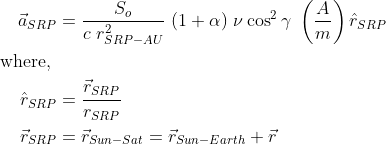
Combining the two equations above, we get the following result that describes the equations of motion for a satellite under the influence of a single massive body and solar radiation pressure.
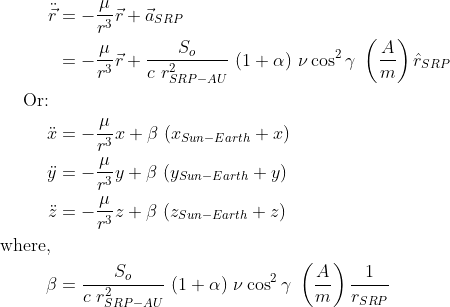
Notice the position of the Earth with respect to the Sun must either be calculated or known in order to utilize these equations. This can prove to be challenging when implementing these equations in a simulation. Below, you can see the difference solar radiation pressure makes on a satellite in orbit around the Earth.
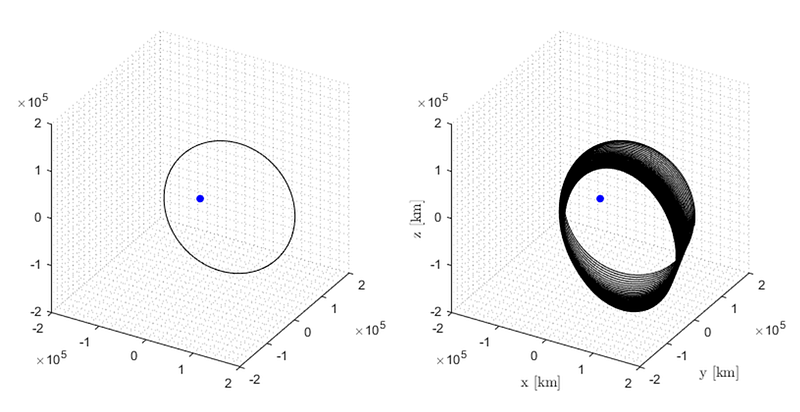
As you can see, the solar radiation pressure greatly affected the satellite in this simulation. This is an exaggerated example, but the effects still apply to all satellites. I will be writing another article soon that describes how to simulate these equations and tips/tricks that might make the process less daunting (including how to determine the position of the Earth with respect to the Sun). Once that article is finished, I will be putting a link here.
This is one of the simpler methods for calculating the effect of radiation pressure. There are many more complex papers on this topic that I encourage you to explore. The equations and methods described above will provide a good estimate of how an orbit might evolve over time when solar radiation pressure is considered. Thank you for reading the article! I hope you enjoyed reading and learned something new. Please give a clap and follow if you want to learn more about orbital mechanics, coding, and machine learning!


