
Justice & Policing
Derek Chauvin’s Lawyer Blames George Floyd For His Own Death
Attacking the victim is an old tactic when bad cops kill innocents.
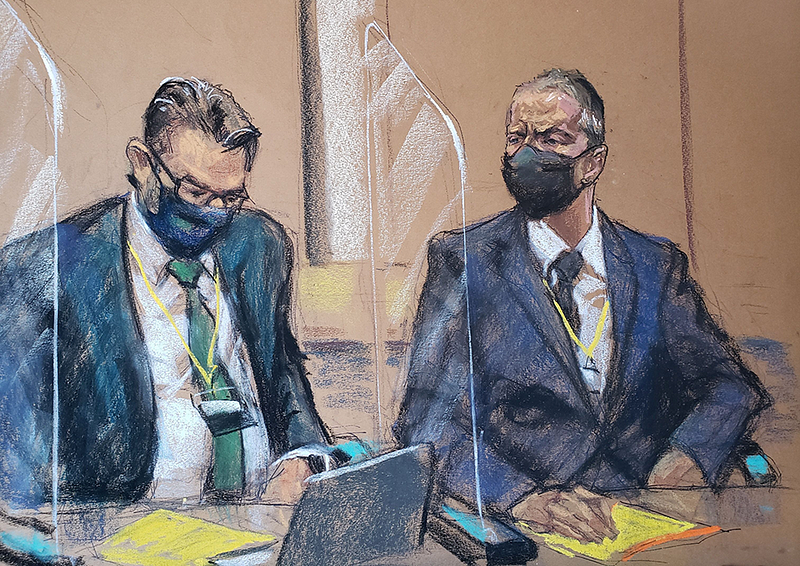
On the opening day of Derek Chauvin’s murder trial, the defendant sat stiffly enclosed behind the clear plexiglass partition of his COVID-19 cubicle, scribbling on a yellow legal pad. He wore a poorly fitting gray suit, a yellow lanyard dangling from his neck, his face covered by a mask. His posture was ramrod straight, and one gets the impression of buzzing kinetic energy from him. He seemed like a coiled spring ready to explode.
Next to him was his lawyer, Eric Nelson, a relatively polished attorney with slicked back hair and a decent suit, but with the unenviable task of defending perhaps the most notoriously brutal cop in American history. Unsurprisingly, his legal specialty is defending Minneapolis police officers, though his website also says he is a skilled DWI attorney.
His opening argument previewed his defense, which is essentially this: George Floyd killed himself with drugs.
George Floyd is not the one on trial, yet you would be forgiven for thinking that, based on the defense counsel’s opening argument. According to Chauvin’s lawyer, there are a multitude of complex interplaying factors that caused George Floyd’s death, of which his poor health and drug use are foremost.
Chauvin’s lawyer would have you believe Floyd’s death was not the result of the knee forced into his neck, that the use of force was simply police protocol, and his death an unfortunate result of drugs, stress, and bad health. But the entire world watched Chauvin callously press his knee into Floyd’s neck for almost ten minutes, as he pleaded for his life and cried out for his mother. A crowd of bystanders screamed at the police to stop, as Floyd’s life slowly drained from his body.
Toxicology reports conducted after Floyd’s death indicate there was fentanyl and methamphetamine in his blood. A later search of the squad car where the police tried to place him also revealed small chewed up pill fragments containing a mixture of those two drugs and George Floyd’s DNA.
George Floyd’s drug use is a cruel red herring, one that Chauvin’s lawyer will aggressively exploit.
Floyd’s fentanyl and methamphetamine use are a convenient scapegoat, especially within the context of his purportedly ill health. Yet it defies reality and common sense to say that George Floyd‘s death was unrelated to the knee smashed cruelly into his neck. But that is the argument.
These are old moves from a well-worn playbook. Murderous cops have been blaming their victims, especially Black victims, since forever in America.
Rodney King is an example of this. He was filmed being beaten to a pulp on the street after leading police on a car chase. Cops accused him of being high on PCP, as if this somehow justified a horde of armed cops mercilessly crushing an unarmed, unresisting human being into the concrete.
The first witness was a Minneapolis 911 responder who called a police sergeant after watching the nearly ten minutes Derek Chauvin pressed his knee into George Floyd’s neck as he lay prone on the street. This was remarkable because she was essentially calling the police on the police, and she described to the jury that she felt something was wrong as she watched the encounter.
The third witness, Donald Williams, an eyewitness and mixed martial artist fighter, was riveting. His MMA experience allowed him to describe in granular detail what Chauvin did.
He described what Chauvin did as a “blood choke,” and narrated the gruesome footage showing Floyd’s murder. He described Chauvin’s “shimmy,” or the multiple physical adjustments Chauvin made to increase the amount of pressure on Floyd’s neck.
In footage from police officer Tou Thao’s body cam, Williams can be seen on the sidewalk pleading with Chauvin to stop and for police to intervene to save Floyd’s life. He says, “Thao, check his pulse. Thao, check his pulse.”
During Donald William’s profoundly damaging testimony, the television connection suddenly died and court adjourned for the day, leaving the jury to digest what they just saw. Donald Williams is scheduled to go back on the stand tomorrow morning.
It was a damning first day for Derek Chauvin, but that is no surprise. The nation is already intimately familiar with the tragic events of that day because it was all filmed moment by moment by outraged bystanders, and we knew this trial would hinge on that gruesome footage. The facts of this murder are as glaring as they are hard to watch.
Derek Chauvin’s actions cannot be explained or mitigated. The jury simply needs to believe their own eyes, as this case seems open and shut. But that’s premature, and with such a long history of cops killing Black Americans with impunity, nothing is assured, even in a case as brutal and seemingly straightforward as this one.
As Derek Chauvin robotically scribbles, the world watches. Can America achieve something resembling justice for George Floyd? We shall see.


