
Deploying Large Language Models (LLMs) using Databricks
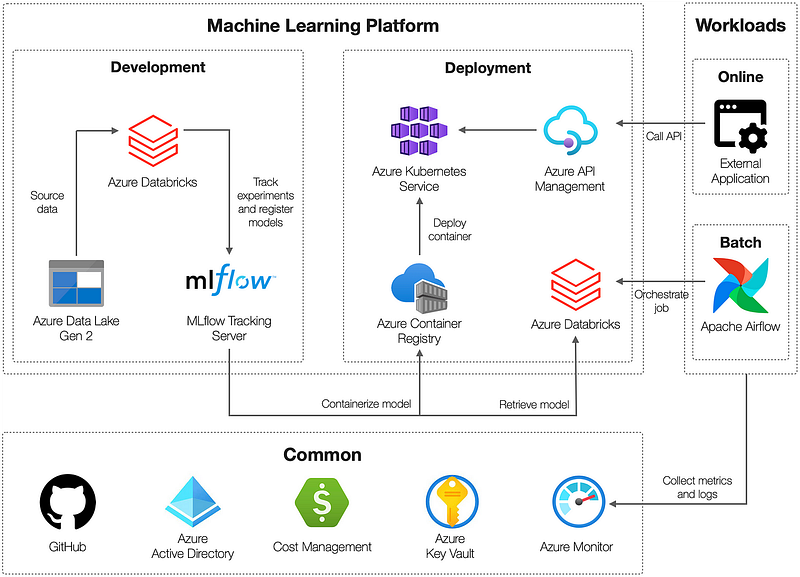
Large Language Models (LLMs) have revolutionized the field of natural language processing, enabling a wide range of applications from chatbots to content generation. Deploying these models, however, can be a complex task due to their size and computational requirements. Databricks offers a comprehensive solution for deploying LLMs, providing a unified platform for the entire AI lifecycle, from data ingestion and fine-tuning to model deployment and monitoring[1][4][8][10].
## Databricks Model Serving
Databricks Model Serving is a serverless GPU serving product developed on a unified data and AI platform. It allows you to deploy open-source or custom AI models, including LLMs, on the Lakehouse Platform[1]. The service automatically optimizes your model for LLM Serving, providing best-in-class performance with zero configuration[1][2].
Databricks Model Serving supports the deployment of various families of LLMs and their variants, including MPT-family models, LLaMA-V2 models, and Mistral models[5]. The service provides throughput and latency improvements in the range of 3–5 times better compared to traditional serving approaches[1][5].
## Deployment Process
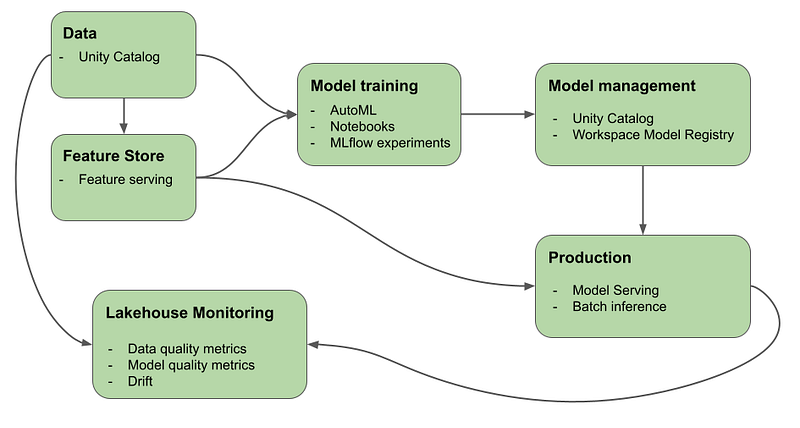
Deploying an LLM using Databricks Model Serving involves several steps:
1. **Model Preparation**: The model, along with its open-source software (OSS) or fine-tuned weights, is provided to Databricks Model Serving[1].
2. **Model Logging**: The model is logged using MLflow, a platform for managing the ML lifecycle[9].
3. **Model Deployment**: Databricks Model Serving automatically prepares a production-ready environment for your model and offers serverless configuration options for compute[2].
4. **Model Serving**: The deployed model is served as a scalable REST API endpoint, providing a highly available and low-latency service[2].
5. **Monitoring**: Databricks provides tools for monitoring deployed models, capturing requests and responses in a Delta table, and displaying endpoint health metrics in near-real time[2].
## Advantages of Using Databricks for LLM Deployment
Databricks offers several advantages for deploying LLMs:
- **Ease of Use**: Databricks Model Serving simplifies the deployment process, allowing you to focus on integrating LLM into your application instead of writing low-level libraries for model optimizations[1].
- **Scalability**: The service automatically scales up or down to meet demand changes, optimizing latency performance while saving infrastructure costs[2].
- **Security**: Models are deployed in a secure network boundary, with dedicated compute that terminates when the model is deleted or scaled down to zero[2].
- **Integration**: Databricks Model Serving natively connects to the MLflow Model Registry, enabling fast and easy deployment of models[2].
- **Performance**: Databricks Model Serving includes optimizations for efficiently serving LLMs, reducing latency and cost by up to 3–5x[1].
- **Compliance**: Databricks has implemented several controls to meet the unique compliance needs of highly regulated industries[1].
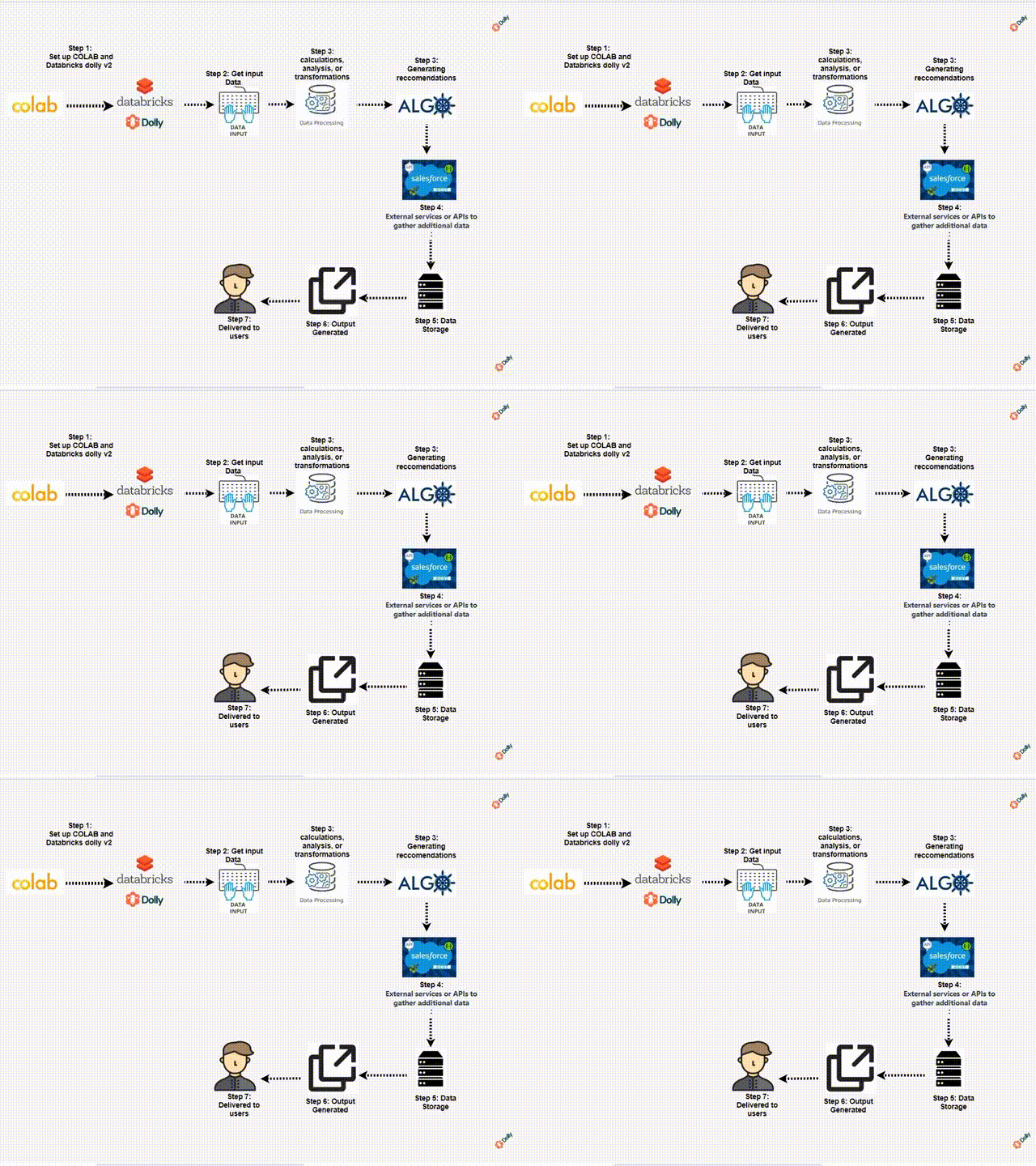
In conclusion, Databricks provides a comprehensive and efficient solution for deploying LLMs, offering a unified platform that handles the entire AI lifecycle. This allows organizations to leverage the power of LLMs in their applications without the complexities of model deployment and management.
Citations: [1] https://www.databricks.com/blog/announcing-gpu-and-llm-optimization-support-model-serving [2] https://docs.databricks.com/en/machine-learning/model-serving/index.html [3] https://www.databricks.com/blog/LLM-auto-eval-best-practices-RAG [4] https://www.databricks.com/glossary/llmops [5] https://docs.databricks.com/en/machine-learning/model-serving/llm-optimized-model-serving.html [6] https://docs.databricks.com/en/large-language-models/index.html [7] https://www.databricks.com/blog/llm-inference-performance-engineering-best-practices [8] https://docs.databricks.com/en/machine-learning/ml-and-ai-index.html [9] https://www.databricks.com/resources/demos/videos/deploying-llms-databricks-model-serving [10] https://www.databricks.com/product/model-serving [11] https://www.databricks.com/blog/announcing-mlflow-28-llm-judge-metrics-and-best-practices-llm-evaluation-rag-applications-part [12] https://www.databricks.com/dataaisummit/session/llmops-everything-you-need-know-manage-llms [13] https://www.databricks.com/product/machine-learning/large-language-models [14] https://www.databricks.com/solutions/accelerators/large-language-models-retail [15] https://www.databricks.com/learn/training/catalog/large-language-models [16] https://youtube.com/watch?v=Ve1-slllB8g [17] https://docs.databricks.com/en/machine-learning/train-model/dl-best-practices.html [18] https://learn.microsoft.com/en-us/azure/databricks/machine-learning/model-serving/llm-optimized-model-serving [19] https://www.linkedin.com/posts/databricks_deploy-private-llms-using-databricks-model-activity-7113168063306375168-q3nA [20] https://www.edx.org/learn/computer-science/databricks-large-language-models-application-through-production


