
Deplatforming, Kiwifarms, and the limits of free speech
When do limits on free speech become necessary?
After the death of a beloved programmer, the gaming community asked domain and hosting providers to refuse services for those responsible for it.
As of yesterday, the 13th of July, the domain registrar DreamHost has decided to withhold service from Kiwifarms, a cesspool of trolls and hate speech that Gizmodo referred to as “the worst site on the Web”.
This move comes after the death of programmer and emulation giant Near/Byuu, who was the victim of a targeted harassment campaign originating with Kiwifarms, a forum dedicated to stalking and harassing vulnerable individuals that they refer to as “lolcows” who can be “milked for laughs”; targeting in exceedingly cruel and creepy ways particularly those who are transgender, neurodivergent, disabled or living with mental illness.
While my main focus was on offering practical support to victims, one thing I did touch upon was deplatforming : the idea that things like Kiwifarms- where people organise to harass and bully vulnerable people- should not be on the Internet. One of the action points I was suggesting was contacting DreamHost and asking them to refuse service to the hate group.
This raises prickly issues around the limits of free speech; and as I read about DreamHost’s decision I found myself grappling with them.

When do we need to cut someone’s mic?
Here’s one thing about me: I’m originally from Romania. I was born two months before the revolution that toppled Communist dictator Nicolae Ceaușescu. My Grandma still remembers my great-Grandma burning her own books in abject fear when the Communists came after World War Two. My parents clandestinely listened to Radio Free Europe. This kind of background comes with an instinctive distrust of censorship, deplatforming or cancel culture.
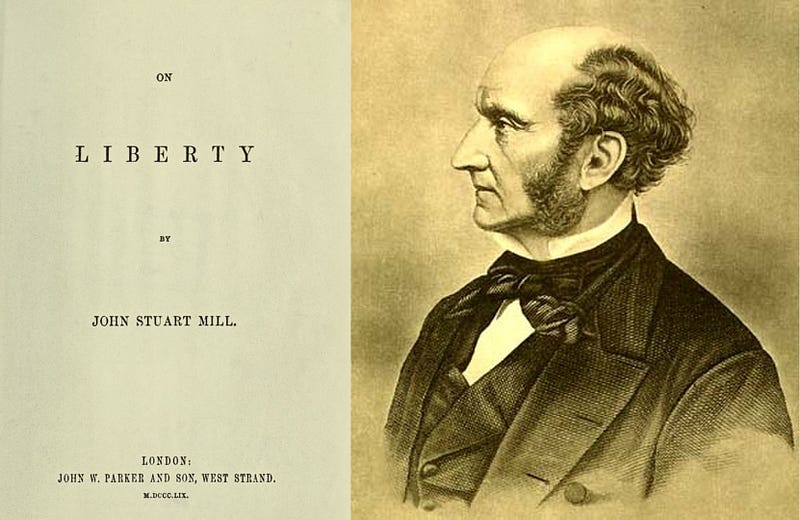
And here is one more thing about me: I studied philosophy in uni. My favourite philosopher was John Stuart Mill, whose writings in the 19th Century were highly influential for what we now think of as “liberalism”. Most notably, in his book “On Liberty”, which may have been co-authored with his wife, Harriet Taylor, he makes the point that individual freedoms - including freedom of speech and of assembly — are ultimately good for society. Which sounds perfectly common-sensical but, on the other hand, have you seen Kiwifarms? 4chan? 8chan?
I found myself thinking back to my favourite philosopher as I tried to think through where we draw the line, and when it is OK to deplatform someone.
John Stuart Mill on free speech
.jpg)

Mill is a utilitarian philosopher. That means he believed that the right thing to do is to maximise happiness and well-being for as many people as possible. In “On Liberty”, Mill makes the case for unrestricted freedom of speech from this standpoint:
The time, it is to be hoped, is gone by, when any defence would be necessary of the "liberty of the press" as one of the securities against corrupt or tyrannical government. […] If all mankind minus one, were of one opinion, and only one person were of the contrary opinion, mankind would be no more justified in silencing that one person, than he, if he had the power, would be justified in silencing mankind.
Freedom of speech, Mill argues, is a safeguard against tyranny; including the tyranny of the majority. We need to be able to freely express opinions, including unpopular ones- lest we descend into totalitarianism. His main argument hinges on the idea that “We can never be sure that the opinion we are endeavouring to stifle is a false opinion; and if we were sure, stifling it would be an evil still”.
Mill suggests that since we are all fallible human beings with no access to a magical fact-checking service that’s always right, then the best chance truthful and/or useful ideas have to emerge is to bring them to the marketplace: let them compete in free, transparent public discourse, and the best ones would be adopted. A lot of the things that look commonplace to us nowadays may have been controversial or even unthinkable before. It’s difficult to imagine, for example, how we could have ever secured the right for same-sex people to marry or- really- any progress on LGBT rights if talking about it were censored by moral guardians with typical 1950s views on the matter. Therefore, it seems, freedom of speech is necessary for progress.
But what about trolls and engaging in bad faith?

At this point you may be asking- “If the marketplace of ideas is such a great way to help us find the truth, how come that places like 4chan aren’t luminaries of academic excellence and reasoned debate?”
I have found a really good explanation for this in an online post which, sadly, I will not be able to attribute correctly, as it’s been shared and circulated anonymously; think of it as a bit of social media folklore, if you will:
The marketplace of ideas is less like a marketplace, and more like a potluck. Everyone brings their own ideas and you sample others and some are familiar with a twist, some are interesting but not to your taste, some are bad, some are lifechanging. You can get into a discussion about recipes or technique, or what have you as people talk about the good.
If someone brings mashed potatoes, you can debate the appropriateness for a potluck: is it too bland? Will it get cold on the table? Do potatoes make up too much of our diet?
But if someone puts a steaming platter of dog excrement on the table, we’re not going to debate it. And when we tell them to take it off the table, it’s not because we are afraid of eating their dog turds or that we think it’s going to revolutionize lunch but we don’t want to allow that to happen.
We tell them to get it off the table because there is no debate to be had. It’ dog turd. It’s not an open question, it’s not a matter of palettes or picky eaters.
That’s why we don’t engage with neo-nazis and white supremacists, and it’s why we don’t (or shouldn’t) let them come to the potluck.
In order for the exchange of ideas envisaged by Mill to work, it is not sufficient to merely not have the Government (or the website admin) not censor people: it is also important for all discussion participants to all play by the same set of basic rules. If you were to, say, express on 4chan and 8chan the views that we should be welcoming refugees, it’s wrong to misgender trans people and no, Donald Trump did not win the 2020 election, you will likely not be censored. Instead, you would be severely verbally abused by a long string of trolls and haters. Doesn’t quite look like the kind of reasoned debate from which truth is bound to emerge, does it?
This is the problem with many corners of the Internet branding themselves as being all about free speech: in the name of free speech, they allow the pile of dog excrement in the potluck; and the consequence is that anyone who does not care for excrement on the table self-selects out.
The paradox of intolerance and the harm principle


Karl Popper, another one of my favourite philosophers, talks about The Paradox of Intolerance in his book “The Open Society and Its Enemies”:
Unlimited tolerance must lead to the disappearance of tolerance. If we extend unlimited tolerance even to those who are intolerant, if we are not prepared to defend a tolerant society against the onslaught of the intolerant, then the tolerant will be destroyed, and tolerance with them. — In this formulation, I do not imply, for instance, that we should always suppress the utterance of intolerant philosophies; as long as we can counter them by rational argument and keep them in check by public opinion, suppression would certainly be most unwise. But we should claim the right to suppress them if necessary even by force; for it may easily turn out that they are not prepared to meet us on the level of rational argument, but begin by denouncing all argument; they may forbid their followers to listen to rational argument, because it is deceptive, and teach them to answer arguments by the use of their fists or pistols. We should therefore claim, in the name of tolerance, the right not to tolerate the intolerant.
John Stuart Mill also agrees that sometimes, free speech must have limits; his approach is informed by utilitarian philosophy: we need to put some limits on certain types of speech, if they cause harm.
For beliefs to be harmful, they don’t even need to be particularly successful in the marketplace of ideas. It is unlikely that, say “The Holocaust never happened, it was a hoax perpetrated by the Jewish Occulte who controls the world” could ever be a position that wins debates or receives serious consideration in history books. However, this type of of speech could motivate someone to commit acts of antisemitic violence. Few people would agree that people who are transgender, disabled or neurodivergent deserve to be the victims of targeted harassment for no other reason than their entertainment value; but it only takes a relatively small group of trolls with enough time on their hands to have a potentially devastating effect on a vulnerable person’s life.
The example Mill gives is: if I want to write in a newspaper that “corn-dealers are starvers of the poor”, whether I am right or wrong I should be able to write that without being censored. The public, exposed to the marketplace of ideas, can decide for themselves where they stand on corn-dealers. On the other hand, telling the same thing to an angry mob assembled in front of a corn-dealer’s house may be far more irresponsible — to the extent that such acts of speech may need to be curtailed. This is why former president Donald Trump was banned from Twitter.
So where do we draw the line?

The answer is far from straightforward; but the harm principle can provide some guidance.
In places like Kiwifarms, internet trolls congregate for the very specific purpose of causing harm to the vulnerable. Their tactics include targeting harassment campaigns, doxing, obtaining personal information fraudulently and harassing their targets’ friends and professional contacts. They republished the livestream of the Christchurch Shooter and denied a request from the New Zealand Police to hand over relevant data. Their actions are linked to the deaths by suicide of at least four people. The harm principle provides grounds for why this should not be on the Internet.
But how about less egregious examples? How about, for instance, Donald Trump being banned from Twitter?

Ultimately, this too is left to the marketplace. The right to free speech uncensored by the Government does not equal the right to be on Twitter, on TV or to have someone listening to you and nodding. DreamHost, as a private entity, has made the choice to refuse service to a customer whose behaviour was endangering others; this was based on their own interpretation of the harm principle — or rather on the pressure that other outraged customers and members of the public put on them.
The pragmatic argument: does deplatforming work?
After having read John Stuart Mill and Karl Popper, you may have some idea about what level of hate speech is harmful enough to warrant deplatforming. But you may wonder: does it work though? After all, this is a bit like moving criminals from one neighbourhood to another; Kiwifarms are expected to move to a new domain registrar, possibly one from Russia, and according to Rational Wiki, they have already secured a Dark Web domain.
There is evidence to suggest that it does work. At the beginning of June 2021, Donald Trump shut down his blog. He was no longer allowed on Twitter and Facebook, two of the world’s biggest social media platforms, and without them he was unable to generate traffic on his own.
Research shows that banning toxic cesspools can reduce hate speech overall. For instance, after Reddit has banned some of its worst Subreddits in 2017, researchers at the University of Georgia found that the move has resulted in a reduction in less hate speech on the platform. As the TechCrunch article reporting on the study notes, “bigotry is easy and those who cherish it are lazy. Make it difficult and many people may find it more trouble than it’s worth to harass, shame, and otherwise abuse online those different from themselves.”
You can read my original article about Kiwifarms and cyberbullying here:
If you or someone you know is experiencing cyberbulling, the Crash Override network provides resources and practical help. You can also find some resource for adults here and for children and their parents here. If you are in need of mental health support, check out available resources in the UK, the USA and worldwide.