
Departure
Thirsty Work — Chapter 8: I’m driving
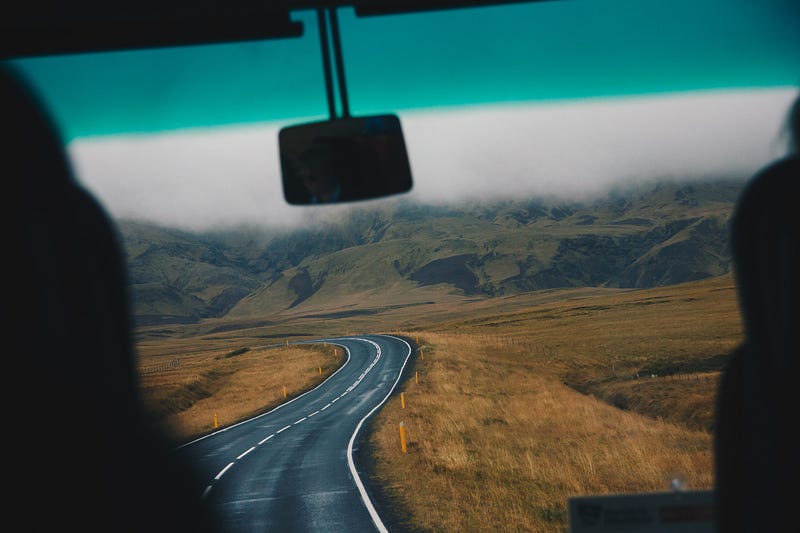
Two young women from California travel to New Orleans in search of redemption after the death of their mother. Carolee thinks she will show her little sister the world, but what they find in the barrooms of the French Quarter at Mardi Gras is more than she knows how to handle, or could have imagined back home. This is the eighth chapter of the novel Thirsty Work.
On the day of their departure, after Carolee had checked off everything on her list three times, she went back into the house to fetch their father while Cathy climbed reluctantly into the shotgun seat. It was warm for February, and she kept the car door open, smoking a cigarette while looking back at the blank, brown house. A few minutes later the pair emerged, Carolee all smiles and chatter, revved up; their father shambling numbly behind. Cathy unfolded herself out of the car to give her father a good-bye kiss on his loose, porous cheek.
“You take care now Cathy,” he told her dully, bending slightly to receive her kiss.
“Okay Daddy. We will.” She climbed back in her seat and pulled the door closed. Locked it. I wonder what he’d do if I said we weren’t coming back? Probably smile and nod.
Carolee was hugging their father now. Cathy watched him bob his head over Carolee’s shoulder. His body was rigid. His head loosely connected. He pulled away from Carolee an instant before she released him; hung his hands back in his pockets as she walked around the front of the car to the driver’s seat. Cathy heard him fingering some loose change and wondered for the first time what he was going to do all alone in that big, quiet house while they were off traveling. I should stay home and grieve over Mom’s death with Dad. It’s not too late to change my mind!
She waved again. He managed a smile. Then it really was too late because Carolee was honking the horn gaily and pulling away from the curb. Cathy leaned out the window, straining to catch the moment when her father turned and walked back towards the house. “‘Bye Daddy,” she called, but she didn’t think he heard her. The hedge already obstructed her view.
As they drove down the street, Cathy pictured her father pulling open the heavy door, padding softly into the kitchen, sitting down at the brown Formica table in one of the eight padded chairs, like she had done so many times in her childhood, coming home for lunch to an empty house while Mom and Dad worked. Sometimes, if she heard a creak and got frightened, she’d slide off the chair and hide under the table until it was time to go back to school.
“She’s not coming,” Cathy whispered. “She’s never coming.” She yearned once more to jump out of the car and run back home to Dad.
“What did you say?” Carolee turned a round, slightly sweaty face toward her.
“Nothing.”
She looked out the window at the bright, green grass of the golf course on Benjamin Holt Drive. A child skated on the sidewalk with band-aids on her knees. A red-headed woman walked a large black dog on a leash. On her right, ten identical doors made a small shopping center. A block ahead, she saw the big, concrete overpass decorated with a large, green freeway sign.
One long minute later, they pulled onto Interstate 5.
We didn’t speak for almost an hour. Cathy turned on the radio and lit a joint as soon as we hit the on-ramp. I hesitated a moment before sharing it with her. Am I supposed to be setting some kind of good example? But the excitement of the departure had me buzzing. I took a long, deep drag, held the smoke in my lungs, then handed the joint back while staring ahead.
The freeway rode high, like a levee, on the way out of town. First we looked down on the big, sprawling houses of our own neighborhood; then the smaller, neat houses of our grandparents’ homes; then the ramshackle houses of the Mexican workers who brought their families to the San Joaquin Valley to pick crops. When we took the familiar wide curve around the red brick County Hospital where an uncle had once been locked up for drinking, it felt like a large, ovoid scale fell off my back. When we crossed the heavy, black metal bridge over the muddy, brown delta, another big scale sloughed off. And when we pulled across the border of Stockton, the whole carapace peeled away.
We traveled a great distance on that first day. Our little blue car sped down Interstate 5 past Tracy, Patterson, Crows Landing, Gustine. Each town we passed dropped behind us like ballast from a hot air balloon. I stretched my arm and rubbed the back of my neck. “Jesus,” I moaned. “It feels good to get away from there. Don’t you think?”
Cathy turned to look at me. I could see her making note of the way my hands gripped the steering wheel, became conscious of tiny drops of sweat on my upper lip. “Umm Hmm,” she intoned.
We spent much of that day in the belly of California, plowing through every kind of crop ever grown. We passed juicy, red tomatoes; sturdy green cabbages; ferny asparagus, all sprouting from dirt that looked soft as oatmeal, mounded in row after perfectly organized row.
To save time and put mileage behind us, we ate in the car. Cathy cut up apples and French bread and cheese, passed a jug of warm grape juice we’d bought in a gas station. We passed Los Angeles, turned left at Highway 10, and set our sites on the Arizona border. The long hours in the car, the rumbling motion of the motor, made me excited and tired all at once. When I was exhausted, Cathy offered to drive. But I didn’t let her take over, pushing on until we found a spot to pull over and sleep in the back of the car.
In the morning, in the daylight, on the second day of our journey, we saw that Stockton was already far behind us. The earth in Arizona was brown and red and orange — not gold and green. The land was ragged — not plowed. Purple buttes rose around us like religious monuments. The air was soundless, the sky vast. And the road was so deserted that we didn’t hesitate to stop the car in the middle of the highway to take pictures. I threw myself across the hood like a model, pushing my hair up behind my head and pouting my lips. Cathy stood in the middle of the road, gave half a smile and waved with one hand, the other sunk deep in her pocket. The two-lane highway poured endlessly into the distance behind her. There was no other car in sight.
That night, we checked into our first Kampground of America. But even though we paid to camp, we still slept in the car. I didn’t see the point of putting our sleeping bags down in the dust. It wasn’t as if we were out in nature, with the sound of television wafting from the giant mobile home parked next to us. But there was a bathroom, and a fire pit, and a picnic table. After cooking an unappetizing dinner of hot dogs and beans, we crawled into the back of the VW. Cathy fell asleep the moment her head hit her pillow. I shifted and groaned, plumped up my soft backpack, and never got comfortable. Cathy was still sleeping the sun not yet rising when I pulled us back onto the road.
On the third day we stopped in El Paso at the Tony Lama boot factory that Candace, the family equestrian, had said that we had to see. It wasn’t as grand as we expected. Just a little retail store. But I picked out a pair of gold and chocolate cowboy boots with intricate stitching on the sides anyway. When I pulled them up over my socks, I became someone rougher and tougher. I liked that feeling. And I loved the tiny pop each boot made as I was pulling it on, when my foot cleared the constricting ankle area and found its snug spot over the heel. I bought a little round tin of Saddle Soap to keep the leather supple, put on my brown velvet vest, and hung a toothpick out of the side of my mouth.
“Whaddya think?” I asked Cathy. “Should I get me a couple a six shooters?”
“Nope.” She didn’t laugh. “That knife in the glove compartment is enough.”
I hoped to make it to San Antonio on that third day, but I couldn’t put the 12 hours behind the wheel that it required. No matter how many times we turned up the tinny music on the radio (when we could find a station), or poured another cup of warm grape juice, or stopped for coffee, or got into a fight, we couldn’t keep ourselves awake. The perfectly straight, flat road; the monotonous landscape; and the constant, low drone of the motor worked like a sedative. Finally, we agreed it was time to shell out some money and get a motel with a shower. We pulled almost comatose into the Longhorn Lodge and Diner in Sonora, a good two hours short of our goal.
Walking into the dark lobby, I felt like a native in my boots and vest. “How much for two single beds and a shower?” I asked with a Southern twang I hadn’t intended.
“We got no single beds,” the greasy-haired clerk answered, his blank eyes trained on my crotch. A swatch of hairy belly showed in the gap between his jeans and t-shirt. “We got two doubles we can give you for $29.”
I moved closer to the counter to shield my lower body, raised my voice and chin. “Twenty-nine dollars!? For one night? How much is one double?”
“That would cost you $26.” Now he was staring at my chest.
“Well, all right. I guess we don’t have much of a choice. We’ll take it.” I pulled two twenties out of my pocket and slapped them on the counter. The clerk finally tilted his gaze upwards, to my face. He gave me a cold, rancid look that raised the tiny hairs on my neck.
“Fill this out,” he pushed a clipboard across the counter, then turned to select a key from an array of hooks on the rough, wood wall. When he turned back he had the key dangling from a chubby index finger, a black line of dirt showed beneath the fingernail. “I got a special deal I sometimes give to single ladies,” he crooned low in his throat, waddling the fat finger. He put on a crooked smile and looked past me to Cathy.
“No thank you,” my voice was thin and high as I grabbed the key from his finger. “We’ll pay.”
In a clean room at last, Cathy threw herself across the one double bed while I turned the lock and pulled a flimsy-looking chain across the door. “Do you believe that guy?” I asked as I poked my head into the bathroom. “What a scuzzbucket!”
“I know!” Cathy wrinkled her nose. “That was really creepy. I hope he doesn’t have an extra key so he can come in here and bother us.”
“Oh he wouldn’t do that,” I said, like I knew what I was talking about. “He wouldn’t still be in business if he was molesting the customers. At least, I don’t think he would be.” Cathy groaned.
“Look, clean towels!” I held them up cheerfully, “and a bar of soap. Do you want to shower first, or second?”
“You go ahead. I just want to lay here and stretch out my legs.”
There wasn’t enough room to undress in the bathroom, so I peeled my sweaty clothes off outside the door, leaving them in a small, pungent pile on the carpet. Then I stepped into the shower, leaving Cathy in the outer room alone.
In the privacy of the cubicle, in the steam and heat and noise, I felt my tough persona disintegrate. How am I going to keep us safe? What made me think I could manage this trip? What would I do if anything happened to us — to Cathy? All the anxiety of trying to lead the expedition and maintain control piled on to the grief and guilt about my mother’s death and the disorientation that came from finally, officially, giving up my college apartment. What’s going to happen next? It felt important to act like I knew what I was doing. But I didn’t know what I was doing. I had no idea.
The hot water helped, working like a magic ablution to wash off my fears, wash away the contamination of the desk clerk’s grimy gaze, unclench my tense muscles and skim off a layer of grit and dust. I soaped my body down, mopped my hair with shampoo, and focused on the physical pleasure of the water pummeling my body: my hair, my head, my shoulders, my face, until I felt the anxiety retreating down my neck, through my chest, my belly, loins and legs, finally swirling out my toes and down the drain.
Once again, it seemed like I was shedding scales, as if I had an outer skin that I could step out of like an insect or a snake. I tilted my head forward and let the water blast against the back of my neck.
With my head bowed, chin on my chest, the hurtful vision of my mother in the hospital crept up on me again, pressing against the soft spot at the base of my skull, searching for a way in. But I shifted a little so the water could catch it and wash it away with my dead skin.
Follow the free chapter links above or buy a digital copy of the whole book:
Copyright © 2020 by Patsy Fergusson. All rights reserved.
My writing is always free to readers who follow my links from Twitter, Facebook, and LinkedIn, but if you’d like to browse more, click here to join Medium and help support my work at the same time. Want an email when I publish a new story? Click here. Find more of my fiction, including another novel, on this List. And for more of the good stuff, follow Fourth Wave, where we’re changing the world for the better, one story at a time. Got one of your own? Submit to the Wave!