
Part of the NEC SPIRITUAL EXPLAINER Series
Demystifying Mystic Philosophy
An Intro to the Non-Institutional Internal Path
If you realize that all things change,
there is nothing you will try to hold on to.
— Lao Tzu
This world is constantly attempting to provoke a response to its seemingly endless stimuli.
React to this!
Judge that!
Enjoy this!
Hate that!
And as soon as you finish engaging with one phenomena, a new one comes into view.
It’s exhausting, isn’t it?
All of the manifestations of mysticism that I’ve come across are based on the idea that the external world does not bring lasting peace. We may find it for a day, or a month or even a few years but some aspect on which that happiness is dependent will inevitably come crashing down. When we put our sense of well-being on the external world, we are Sisyphus, struggling to push that ancient boulder up the hill. Life will come rolling back down as we sigh in exasperation, throwing our hands up defeated again and again.
He who looks outside dreams, he who looks inside awakens.
— Carl Jung

Classic Americana has two achingly accurate representations of the transitory joys of the external: Elvis Presley and Marilyn Monroe. Elvis had crushingly gargantuan fame and riches and yet he died depressed and unhealthy, overtaken by the ravages of years of drug abuse. Marilyn was, and is still (more than fifty years after her death), the icon of female beauty. She was also riddled by anxiety, depression and excessive prescription drug use that ended her young life, shortly after her third divorce.
There’s really no shortage of famous, unfulfilled deaths in our society.
They couldn’t find happiness despite having absolutely everything the world has to offer. According to our society which is fixated on material acquisition, sexuality, and social status, they should’ve had happiness. Why didn’t they?
Then you have George Harrison. One of The Beatles, George was open about never feeling fully satisfied by everything they had acquired.
Imagine being a Beatle. The global popularity of unparalleled pop stardom alongside the admiration of their authentically evolving creativity. They had money, women, and their influence on music is staggering and nearly immeasurable. But as George articulates, none of those things made them truly happy. So if not there, then where?
He eventually found his peace after meeting Ravi Shankar, an Indian sitar player and philosopher in his own right.
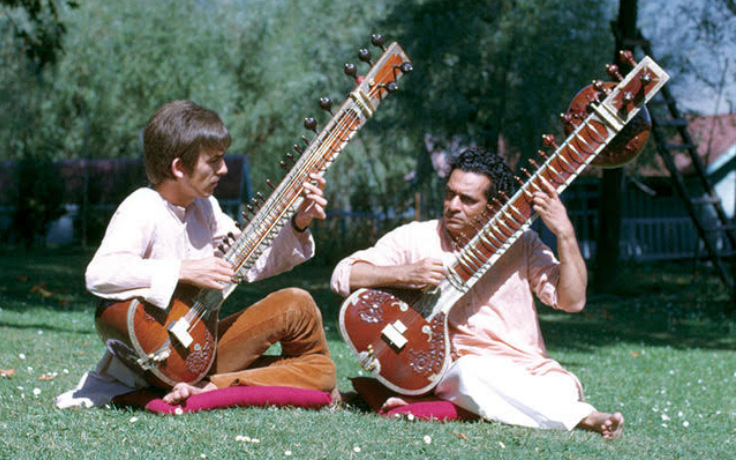
George explains,
Ravi [Shankar] and the sitar was kind of like an excuse, trying to find this connection. I read stuff by various holy men and swamis and went around and looked for them. Ravi and his brother gave me a lot of books by some wise men, and one of the books was by Swami Vivekananda who said, ‘If there’s a God you must see Him. And if there’s a soul we must perceive it, otherwise it’s better not to believe — it’s better to be an outspoken atheist than a hypocrite.’ And after all my life I had been brought up.. well they tried to bring me up Catholic. They told you to just believe what they’re telling you, and not to have the direct experience. And this for me, going to India, and hearing someone saying ‘No you can’t believe anything until you have direct perception of it..’ I thought ‘Wow, fantastic at last I’ve found somebody who makes some sense..!”
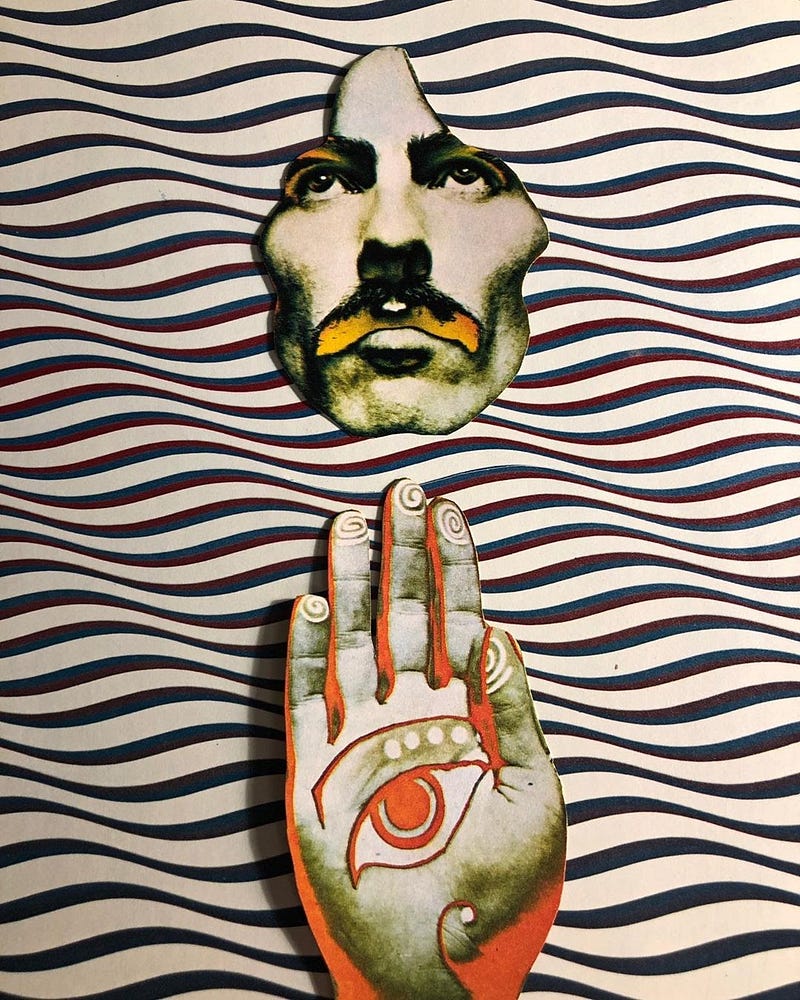
Harrison’s “The Inner Light”:
Without going out of my door,
I can know all things of earth;
Without looking out of my window,
I could know the ways of heaven...
He saw through all the traps awaiting us ‘out there’, and was able to live a long peaceful life thanks to this understanding.
Universally the mystics claim, by way of their own experiential learning, that there is a unifying connectivity between all beings. There is a Transcendent Oneness that radiates between every living thing and our ability to connect with that Unity is the only way out, or rather way in.
You aren’t going to find lasting happiness here.
Here meaning the world, the external world of form. But according to the mystics, you will find it Here, internally, within your heart in your connection to your Truest Self, beyond the influences of time and space.
You will undertake a journey, because you are not at home in this world.
And you will search for your home, whether you know where it is or not.
If you believe it is outside yourself, the search will be futile,
for you will be seeking where it is not.
— A Course in Miracles, T-11.V.5:1–3
There is a mystical “version” of every world religion, while the orthodox institutions are typically on the opposite end of that spectrum.
The Christians had the Gnostics, the Muslims have the Sufis, the Jews have Kabbalah, the Buddhists Zen, and Hinduism has the Vedanta. There are thousands of degrees in both directions for every system, but even most religious scholars will draw these parallels.
Theologians may quarrel, but the mystics of the world speak the same language.
―Meister Eckhart
Mysticism, the non-institutional internal path, is the string connecting the pearls of each major faith.
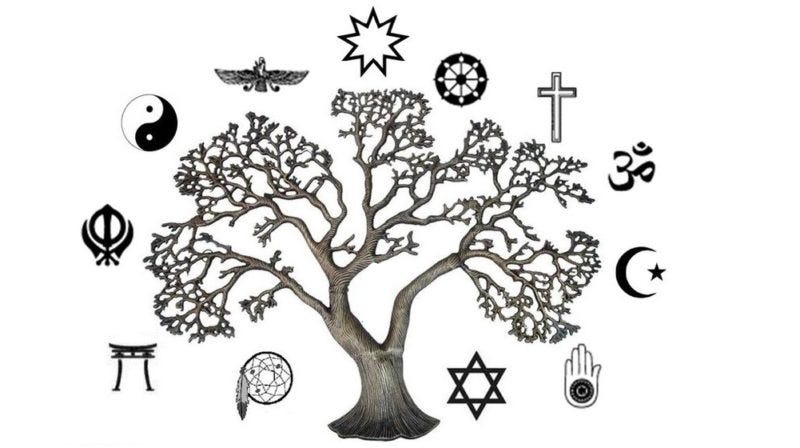
A respected religious studies scholar, Dr. Stephen Prothero, wrote a book with a spicy title, God Is Not One, which covers the doctrinal distinctions between the world religions. The book’s thesis is that it’s intellectually lazy to say “oh well they’re all the same”, and that is an important point to make.
On the institutional, exoteric side of each faith, they are very different — grossly oversimplifying for the sake of brevity: Judaism is based on following rules or commandments, Christianity is focused on the sacrifice of Christ, Islam means submission to God, Buddhism is concerned with ceasing desire and consequently ceasing suffering, and Hinduism is mainly a devotional attempt to break the cycle of birth and death.
But on the mystical, esoteric side of each faith, the formerly distinctly institutional lines of division start to blur.
It’s also important to emphasize that the mystic values the experiential understanding of Spirit. While institutional practitioners rely on the testimony of clergy, the sanctity of scripture, and the psychology of ritual, the mystic is free of dependence on anything aside from their own intimately personal experience of Divinity / Awareness / Unity / Presence.

Where the philosopher guesses and argues, the mystic lives and looks; and speaks, consequently, the disconcerting language of first-hand experience, not the neat dialectic of the schools.
Hence whilst the Absolute of the metaphysicians remains a diagram — impersonal and unattainable — the Absolute of the mystics is lovable, attainable, alive.
―Evelyn Underhill
Transcendent, but also Immanent
The mystical experience is the defining component of this internal exploration, and its importance stems from its function. While there can be similar ecstatic emotions to drug-induced states of consciousness (which is a whole ‘nother article), the distinction is that the mystical experience has a considerably higher purpose, which is that it acts as the connection between two seemingly-oppositional conceptions of divinity: the transcendent and the immanent.
The divine is both beyond this plane of existence, and simultaneously all-pervasive throughout. The Absolute is the unending substratum beneath all things, as well as the Experiencer of the world of form—and the mystical experience is the bridge between these two (ultimately unified) conceptions of the Infinite.
Swami Abhayananda covers this dynamic thoroughly in the History of Mysticism, writing:
Yet while we do not possess the written testimonies of the mystic sages of the dim past… when we examine the mythologies of these earliest civilizations, especially those myths which describe the origin of the cosmos, we find a curious similarity in the religious symbols used by widely separated cultures. In almost every instance, we may discover the legend of an original Father-God, whose first Thought or Word, symbolized in the form of a Mother-Goddess, is said to have given birth to all creation.
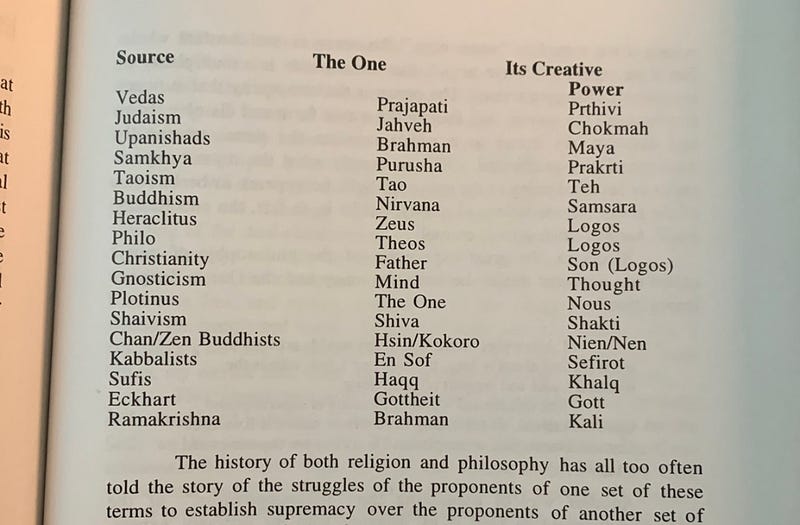
Despite their theological sophistication and spiritual practicality, the mystical sects were formerly less out in the open than they are today. There’s no shortage of extensive, academic explanations of each of them. There are bookshelves full of their ideologies, entire university careers devoted to their study. But this is a Medium article — a brief summary of the main mystic sects will suffice.
Gnosticism
In the time between Jesus’s death and the formation of what came to be modern day Christianity, there were several competing sects of Judaism: some of which were beginning to reflect the profound and newly radical teachings of Jesus, while others were holding fast to the ancient traditions of the Torah and the Jewish people. While early Christianity was primarily focused on the one major difference between traditional Judaism — that Jesus Christ was the Messiah — Gnosticism even took their beliefs a step further.
The name “Gnostic” comes from the Greek word gnosis, meaning “knowledge”, although the translation is closer to an intuitive understanding than to knowledge of the intellect. While the sect that would become Christianity was focused on scripture and faith, the Gnostics were bent on revelatory experiences: experiencing an intimately personal connection with the divine. In some Gnostic sects, this world was considered illusory, and this personal connection was the answer for how to break through the veil between this world and heaven.
Like Christ, they were reforming the way that the Jewish people came to understand God. For example, Marcion was an early Gnostic leader and teacher who taught that the God of the Old Testament was so oppositional to the God that Jesus refers to in the Gospels, that they were actually separate entities entirely. The Heavenly Father referred to by Christ has love falling like rain on the just and the unjust, as opposed to the “jealous”, wrathful Old Testament God instructing the Israelites to dash the heads of their enemies’ innocent babies against the rock. The Marcionites referred to the OT God as a false creator god named “Yaldaboath” who had misled the Jewish people by standing between them and our true Creator, a Transcendent Loving God.
Alongside their theological divergences, the Gnostics had their own gospels about the life and teachings of Christ as well. Ultimately the Gnostics were considered heretics by orthodox bishops, Irenaeus being an exceptionally notorious persecutor. By the fourth century, Bishop Athanasius of Alexandria outlined today’s canon, specifying which books became a part of the Bible and which books did not (also referred to as the “apocrypha”, from the Greek “apokryphos” meaning “obscure”). When Christianity became the state religion of the Roman Empire, many prominent Gnostic leaders and writers were executed as heretics.

Fortunately for our contemporary civilization, two of the most significant archaeological discoveries of the 20th century were rural shepherds stumbling across ancient leather-bound scrolls near the Dead Sea (in 1945 at Nag Hammadi and in 1946 at Qumran). Local shepherds stumbled upon these texts, many of which belonged to the Gnostics as they were mentioned by name in correspondence between early church fathers. Several of these Gospels we did not have surviving copies of before the 20th century, including the Gospel of Thomas, which some scholars date as early as the Gospel of Mark. Accordingly, they have come to greatly influence how we understand the formation of Christianity as well as these alternative spiritual systems by early followers of Jesus.
Split a piece of wood,
and I am there.
Lift up the stone,
and you will find me there.
— Saying 77, Gospel of Thomas
Sufism
Sufism (tasawwuf) is even more diverse than the Gnostic tradition as it is not necessarily its own sect, but rather the mystical, internalized nature of each branch of Islam. There are Sufis in both the primary Sunni and Shia schools, as well as Sufis that were disconnected from any element of traditional orthodoxy.
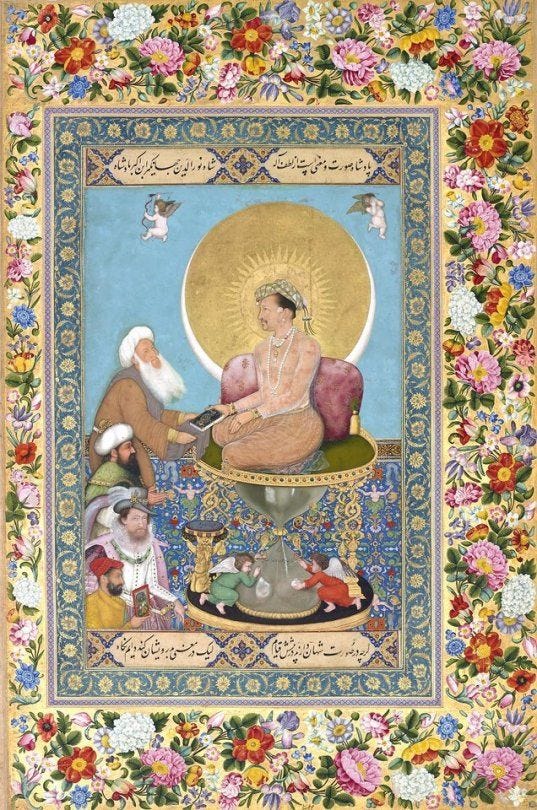
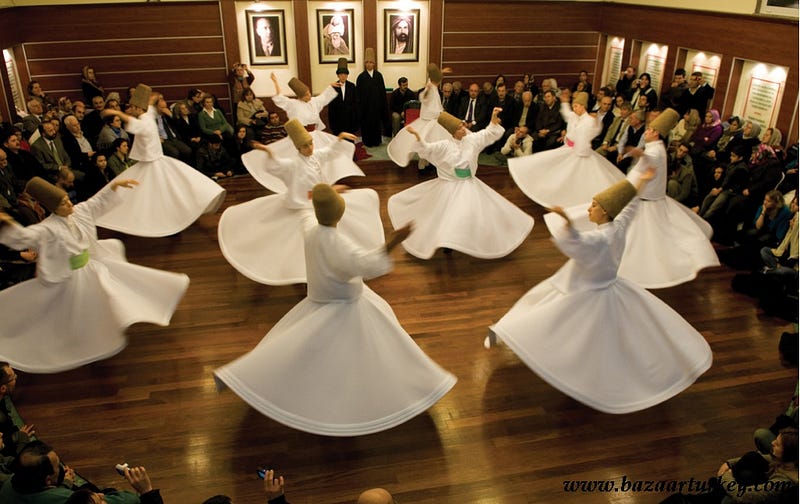
Rumi and Hafez being the two most prominent throughout the centuries, the Sufis are the poets, musicians, singers, and dancers of Islam. The “Whirling Dervishes” are one such Sufi order that spins around and around in artful dances, mimicking the intoxication of the spiritual experience.
The word “Sufi” comes from the Arabic word tasawwuf meaning to “dress in wool” referring to the woolen garments of early Islamic ascetics. But the definition of their belief is the path of the heart.
It is admonishing one’s own worldly desires in place of Love for the Beloved. To the Sufi, God, or Allah in Arabic is considered in a sense to be an intimate partner, the One and Only recipient of one’s devotion. By purifying the heart of greed, lust, and wrath we become unhindered to access the truth in our inner self, which translates to an outpouring of love to the Creator and all of creation.
Love is
The funeral pyre
Where I have laid my living body.
All the false notions of myself
That once caused fear, pain,
Have turned to ash
As I neared God.
What has risen
From the tangled web of thought and sinew
Now shines with jubilation
Through the eyes of angels
And screams from the guts of Infinite existence
Itself.
Love is the funeral pyre
Where the heart must lay
Its body.
— Hafez
In Sufism, the detachment from the world is so powerful that there comes a moment of annihilation (fana) in the love of the Divine. This is similarly referred to by Carl Jung as the “ego death” in modern psychology.
The Sufis would give exceptionally more alms, they would fast for nine months instead of one, they would pray more than five times a day — they weren’t pious for society’s sake, they were pious out of the purest love for God. When you love someone you want to make them happy, and these expanded practices were the surest way to do so.
We did not take Sufism from talk and words,
but from hunger and renunciation of the world and cutting off the things to which we were accustomed and which we found agreeable.
— Junayd
One subtle yet very important theological distinction within mysticism that I would like to point out in regards to Sufism, is the difference between “annihilation” in the Divine, fana, and the “descent” of the Divine into a human body, hulul. There have been many Muslim dynasties with shifting sectarian divisions, decrees and renunciants, too many to contextualize here, but there was a very famous Sufi who was hanged for this very debate.
Mansur al-Hallaj was a Socrates-like figure in the 8th century C. E. who got in a lot of trouble for saying “Anal al haq”, meaning “I am the Truth.”
He was accused and sent to the gallows for hulul, as his proclamation was considered blasphemous: the logic being that due to the fact that our bodies are bound by time and space, Almighty God cannot possibly experience mortality in the way that we frail humans do.
Whereas his followers considered his declaration fana, emptying the soul in order to take on divine attributes.
I have seen my Lord with the eye of my heart, and I said:
‘Who are You?’
He said:
‘You.’
— Mansur al-Hallaj
Al-Hallaj famously sang and danced to the gallows in chains. He was so intoxicated by spirit that he was beyond any fear of death. He sang, “Kill me, my faithful friends, for in my being killed is my life.” His legacy endures to this day as one of hundreds of famous Sufi mystics who found peace and joy despite the external happenings of the body.
Kabbalah
Filling out the Abrahamic representation of mysticism is the Kabbalah of Judaism. Kabbalah is the esoteric understanding of fundamental Jewish scripture.
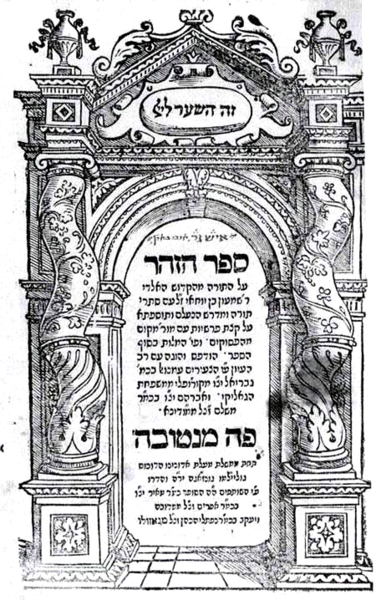
The foundational text of Kabbalah is the Zohar, (meaning the Book of Radiance) which is ultimately a metaphysical commentary of the Torah — the five Books of Moses, the central documents of the Jewish faith. The Zohar categorizes the levels of textual interpretation as follows: direct interpretations (in Hebrew, Peshat), allegoric (Remez), imaginative or Rabbinic meanings (Derash), and the inner, metaphysical meanings of Kabbalah (Sod).
A common theme within mystics across cultures is that there is oftentimes ‘hidden wisdom’ or ‘secret teachings’ withheld from the masses. Now my initial reaction to hiding anything is hesitation because that implies some kind of hierarchy between human beings, as ultimately I hold the firm understanding that we are all One. Or at the very least, we’re all in this together. Ironically that sort of elitism is something that made me (and so many others) thoroughly question organized religion and start to look elsewhere.
However, the more I work with these kinds of ideas I do very plainly see that they are not for everyone, and that someone not living within these perspectives could easily misinterpret them. (I might be guilty of doing that myself!) So in that sense I understand some of the intention behind this type of concealment.
The Zohar was allegedly written (or transcribed) by Shimon bar Yochai during the 2nd century C.E. but was revealed to public at large in the 13th century C.E. by a Jewish writer named Moses de León, although there is still a lively debate among Jewish rabbis and scholars over the original author being de León or Shimon bar Yochai.
Regardless of its author, the Zohar offers a radically mystical read on the human being’s relation to God, written as Ein Sof, which is translated as the “Nameless Unending Infinity”.

It also discusses our purpose, and the nature of our existence in this universe. The Zohar’s commentary and insights have been appreciated by wider Jewish audiences for centuries and in recent decades the Kabbalah has become more closely associated with New Age movements and a variety of universalist aspirants.
Zen
I almost left this paragraph blank.
But that’s too pretentious because the point is to give some necessary background, not be showy flashy guy. Or maybe I was worried about people thinking about formatting errors. I’ll just start.
Buddhism is already a fascinating system. Even in its most general sense, the Buddha’s search for truth is so penetrating and profound that you might think there wouldn’t be a reformation required. Ultimately it is still a religion after all, one that has been similarly institutionalized over the centuries like all the others, and because of this we have the emergence of Zen, a lotus sprouting up from the mud.
Zen does not confuse spirituality with thinking about God while one is peeling potatoes.
Zen spirituality is just to peel the potatoes.
— Alan Watts
A sub-school of the Mahayana branch of Buddhism, admittedly Zen does not meet every aspect or every definition of “mysticism”: the predominant mismatch centering on theism — being that Buddhism is generally considered an agnostic spiritual system or practice — but many academics do consider Zen to be a branch of “esoteric Buddhism”, which is why I include it here.
Zen is also thought of as an intersection between Buddhism and Taoism, the ancient Chinese religion of Lao Tzu and the later writings of Zhuangzi, as Buddhism came to China in the 5th century C.E., brought by Bodhidharma, a semi-legendary Western Buddhist monk, credited for Zen’s pioneering transmission.
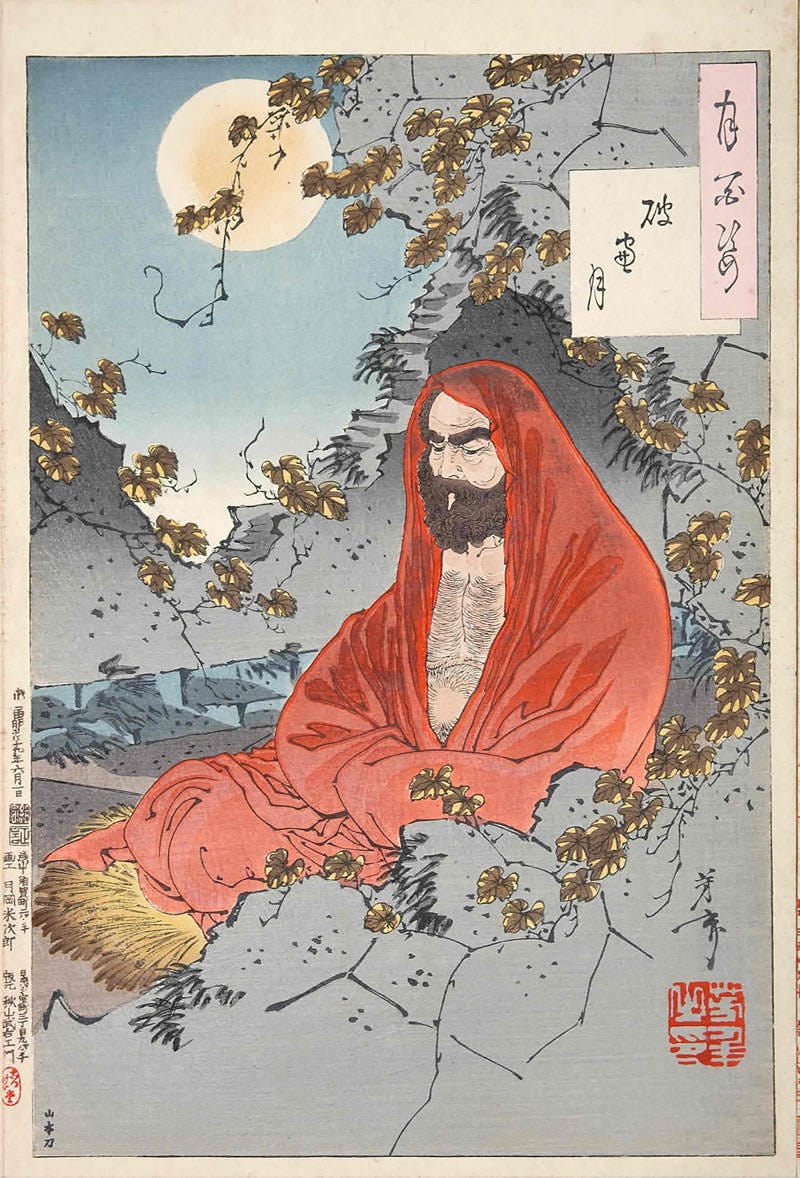
People of this world are deluded.
They’re always longing for something-always, in a word, seeking.
But the wise wake up.
They choose reason over custom.
They fix their minds on the sublime and let their bodies change with the seasons.
All phenomena are empty.
They contain nothing worth desiring.”
—Bodhidharma
The real beauty of Zen is its absolutist focus on presence and awareness so profoundly that no other thoughts come in, or are not made manifest by the lack of noticing.

The main practice of Zen is zazen, meaning sitting meditation, where the goal is essentially to concentrate on the breath and suspend all thought.
If you are unable to find the truth right where you are,
where else do you expect to find it?
—Dogen
I am not compelled to speak at length about Zen because there’s something funny and contradictory with speaking about Zen, whereas Zen is feeling the rhythm that my fingers find the keys as I type out these words filling these pages. Being right here and nowhere else.
Zen koans are an example of how useless form is to them — they are conceptual riddles designed to help us break out of our conceptual thinking.
There have been great many Zen masters from Bodhidharma to Dogen to contemporary teachers like D.T. Suzuki, Alan Watts, Shunryu Suzuki, and Thich Nhat Hanh, all of which have helped many minds find the “no mind”.
Advaita Vedanta
Hinduism as a whole tends to exemplify spiritually “mystical” traits across a much wider breadth than the religions of the West. Reiterating the definition of mysticism as a direct, personal connection to the divine within one’s own heart, this description holds for the Vaishnavas (worship of Krishna) as it does for the Shaivites (worship of Shiva).

The Vedanta is one of many schools on the incredibly rich spectrum of the Hindu tradition, which literally means “the highest purpose of the Vedas”, reflecting the philosophies within a series of texts known as the Upanishads. The integration of Upanishadic thought contributed to bringing India from ancient Vedic ritual to new modes of philosophy and institution. In addition to the Upanishads, Vedanta also draws heavily from the Brahma Sutras as well as the Bhagavad Gita.
Myself, this is mine, that is yours, is a petty way of people in seeing reality;
for those with noble consciousness,
the whole world is a family.
— Maha Upanishad, Verse 71
Distinguishing within the Vedanta school of Hindu philosophy, Advaita is a sub-school that I would like to draw attention to for the purposes of this book. It is the earliest system of “non-dual” thought, which is an important concept to understand. Non-duality, meaning “not two”, is the idea that the Atman (individual soul) and Brahman (formless Divinity) are one and the same. According to Advaitists, they are separate terms in concept only, ultimately there is no distinction.
The Indian philosopher and guru Adi Shankaracharya (8th century C.E.) was the most prominent contributor to the development of Advaita Vedanta, as he wrote copious commentaries on Hindu scripture and traveled extensively to further improve his treatises. Shankara’s efforts helped to solidify the sanctity of Vedic scripture, revitalize monasticism, and profoundly influenced the discussion regarding the unity of Atman and Brahman across many other schools of Indian philosophy.
Once we become conscious, even dimly, of the Atman, the Reality within us, the world takes on a very different aspect. It is no longer a court of justice but a kind of gymnasium.
Good and evil, pain and pleasure, still exist, but they seem more like the ropes and vaulting-horses and parallel bars which can be used to make our bodies strong.
Maya is no longer an endlessly revolving wheel of pain and pleasure, but a ladder which can be climbed to consciousness of the Reality.
— Adi Shankaracharya
New Age
After the breakthrough scientific discoveries of the Age of Enlightenment, religion was reeling from a global shift towards rationalism and a more sophisticated, scientific worldview. While many religious sects regressed into an overly orthodox way of interpretation, from the Amish to the Wahhabis, many of the aforementioned mystical sects and related schools were similarly rejuvenated.
There are many antecedents for the modern “New Age movement”, all contributing to a growing patchwork of spiritual beliefs from as early as the 1830s to the late 20th century:
- American Transcendentalist authors (Ralph Waldo Emerson, Henry David Thoreau, Louisa May Alcott, and the great poet Walt Whitman, among others) themselves influenced by Kant and German idealism, emphasized the inherent purity of the individual, personal freedom, and the guidance of intuitive direction
- Helena Blavatsky and her Theosophical Society (formed with Henry Olcott) originated out of contact and study under an alleged secret brotherhood of Eastern mystics and their scriptures; her followers included Annie Besant, Charles W. Leadbeater and Jiddu Krishnamurti, who ultimately left the organization and rejected the Theosophists’ messianic expectation around his youth, famously defending his departure by maintaining that “Truth is a pathless land”
- Phineas Quimby’s New Thought and Mary Baker Eddy’s Christian Science both focused on the power of the mind and its role in spiritual healing
- The work of Carl Gustav Jung, a psychoanalyst and colleague of Sigmund Freud, who founded analytical psychology and made contributions to many fields of knowledge, including mysticism and comparative mythology
- Edgar Cayce, a Christian mystic who gave over 14,000 channeled readings in a trance state — his psychic readings provided answers on healing, reincarnation, and a variety of predictions; as well as a new genre of channeled texts from a variety of sources, with the most popular works being A Course in Miracles by Helen Schucman and the Abraham material by Jerry & Esther Hicks
- The 20th century physicists, notably Einstein, Planck, and Heisenberg, many of whom were interested in questioning scientific materialism, with Einstein’s relativity theory and the larger field of quantum physics pointing to the potential of consciousness as fundamental to the universe, as opposed to matter
- Unitarianism, an emerging Christian denomination in the early 19th century considering Jesus a human being, and rejecting the doctrines of original sin and Biblical infallibility
- Early religious academics helping to document and in some ways legitimize the esoteric: from Max Muller translating Eastern sources, to Rudolf Otto’s syncretistic commentaries, to William James pioneering a psychology understanding of mystic states, and Evelyn Underhill’s theological exploration of mysticism
- George Gurdjieff, an Armenian and Greek mystic philosopher who emphasized the unification of mind-emotion-body in a series of teachings he called “The Work”
- The arrival of Hindu swamis and Buddhist teachers to America — Swami Vivekananda, Paramahansa Yogananda (the founder of Self-Realization Fellowship), Maharishi Mahesh Yogi (the founder of Transcendental Meditation), Osho, and Swami Prabhavananda, while Shunryu Suzuki set up the San Francisco Zen Center and began to lecture Westerners in the 1950s on Buddhist teachings and practices
- The Beat authors (Jack Kerouac, William S. Burroughs, Allen Ginsberg, and others), a collective of writers embracing non-conformity and spontaneous creativity and the later 1960s “Counterculture movement” of American hippies embracing the use of psychedelics (due to work of Dr. Timothy Leary, Ram Dass, Aldous Huxley, and others), as well as sexual liberation, and questioning the societal norms of previous generations
Beyond these overlapping oceans of modern sources, “New Age spirituality” also tends to have an appreciation for ancient beliefs such as shamanism, Vedic tantra, various forms of astrology, channeled literature and other pagan practices. It generally refers to an amalgamation of most interfaith understandings of spirit in what might be previously dissimilar capacities.
In conclusion, mysticism is simply a focus on connecting to the internal when everyone and everything else is focusing on the external. Every religion has a spectrum with exoteric orthodoxy on one end and esoteric mysticism on the other, and throughout history those who have controlled the power behind religious institutions have persecuted these mystics, either by excommunication or death.
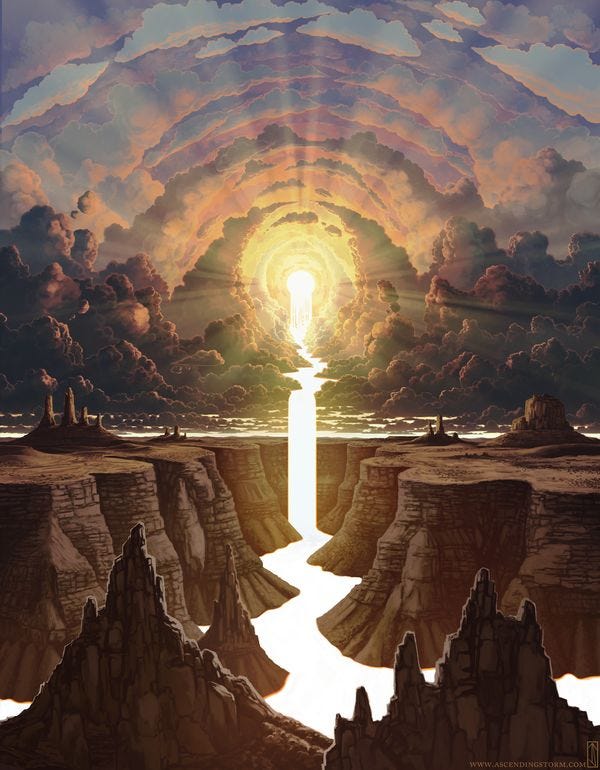
Fortunately we live in the 21st century where not only has this condemnation lessened significantly, but the public at large has gained access to formerly withheld esoteric scripture, ritual, and practice, along with a larger cultural movement embracing mystical and alternative perspectives on traditional religion and spirituality.
This is all to say that, it is a hell of a thin read to associate all spiritual thinking as being ancient irrelevant “fairy tale” mythologies.
That dismissive attitude neglects so many multitudes of sincere seekers, diverging from institutional norms, who have transcended the everyday drudgery of this world by way of authentic mystical experiences reflecting the beauty and peace within.
Listen to our podcast episode on this topic here:
Listen on Spotify Listen on Apple Podcasts Watch/Listen on YouTube
Further reading:
Mysticism: A Study of the Nature and Development of Man’s Spiritual Consciousness by Evelyn Underhill The Transcendent Unity of Religions by Fritjof Schuon Forgotten Truth: The Common Vision of the World’s Religions by Huston Smith History of Mysticism: The Unchanging Testament by Swami Abhayananda The Gnostic Gospels by Elaine Pagels Zen Mind, Beginner’s Mind by Shunryu Suzuki The Perennial Philosophy by Aldous Huxley