
Demons of Past Haunt Turkey as 770 People’s Assets Frozen
Turkey’s rulers moved to freeze the assets of 770 citizens (living abroad) on dubious legal grounds. It reflects a practice that never fades into oblivion both in the country and the world.
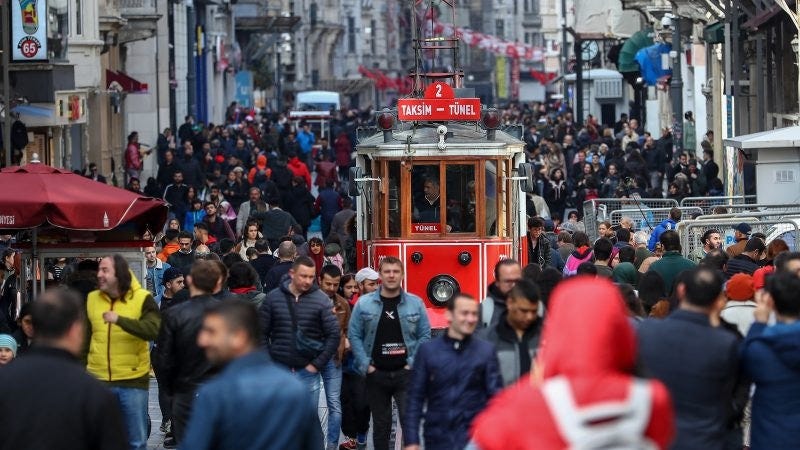
On Friday, the Turkish government moved to freeze the assets of 770 citizens over alleged terror links. At least 454 of the targeted victims are affiliated with the U.S.-based Muslim cleric’s organization, designated by the Turkish authorities in 2016 as an outlaw outfit. However, the official rationale presented in the Official Gazette with a publicized list of the targeted figures is far from convincing people even with a rudimentary knowledge of the state of affairs unfolding recently in Turkey’s ever-shifting political context. To begin with, this massive assault on people’s private properties on dubious legal grounds is not unprecedented. On the contrary, the historical precedents of wealth grab through political channels have unfortunately been well established through the various phases of modern republican history.
Historical Context
It would be prudent to tackle the issue in a larger historical context before wading into the peculiar nature of the political war on property in Turkey’s recent memory. Since the Babylonian exile of Jewish aristocrats and the ruling class in the 6th century B.C., wealth grab has become the defining feature of military conquests, dislocation of the defeated populations, and regime change in a certain country at a particular historical moment. It has been deeply woven into the psyche of societies throughout history. It has had many forms and shapes in many eras. The property seizure during the civil conflicts in ancient Greece and Rome, the persecution of the early Christians during the Roman era, and the dispossession of religious minorities across Europe during the religious strife that tore apart Christendom in the 16th and 17th centuries after the emergence of the Protestant Reformation appear as the moving examples of pre-modern wealth change. The Thirty Years Wars (1618–1648), as British historian C. V. Wedgwood succinctly demonstrates, can also be read, among many other sub-themes and political matters, as a zealous effort either by Protestant forces or Catholic powers to dispossess the enemies of true faith (both sides regarded theirs as the only true path) as much as possible.
The Jacobin Terror in France in the 1790s after the French Revolution robbed an entire aristocratic class of their assets and lands under the pretext of creating an equal, classless society. With his sublime literal power of expression, Charles Dickens reveals the moral cost and unfathomable social scope of this total war on aristocrats in his masterpiece, A Tale of Two Cities. It is surprising to see that the Victorian-era writer, whose characters mostly came from the downtrodden and left-behind groups of the modern capitalist society, lends most of his sympathy to the losers and victims of the Revolution without entirely ignoring the pre-Revolution elites’ aloof and repressive class policies, which had laid the ground for the social storm that later shook the entire continent for the span of several decades in the early phases of the 19th century. The far-reaching repercussions of the French Revolution even went beyond that historical epoch, as the ideals espoused by the revolution continued to shape most of the modern political and social systems (in the form of universal concepts such as the nation-state, self-determination, constitutional rights of citizens, liberty, fraternity, equality, meritocracy).
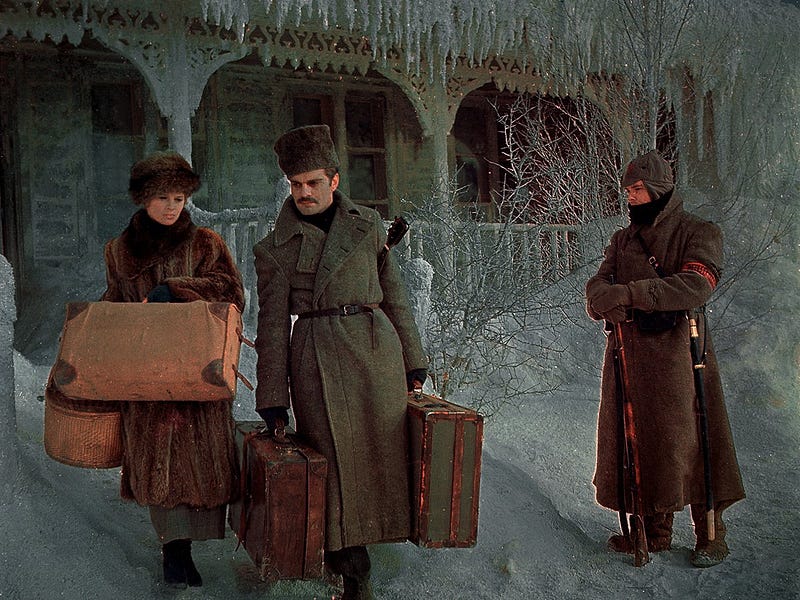
The Bolshevik terror against the feeble Russian bourgeoisie (read and watch Dr. Zhivago), the Nazis’ mass property seizure of political enemies and German Jews throughout the 1930s, and the socialist takeover of middle-class assets in Cuba and elsewhere are among the prime examples of modern theft engineered and justified by fascist or socialist ideologies under the guise of class warfare.
Against this bleak backdrop, the modern law and political systems that emerged in the West after the Second World War have tried to establish certain guardrails and protections against arbitrary practices by authorities to seize the properties of political opponents, with varying degrees of success. In liberal democracies, property rights are considered sacred and cannot be molested in any circumstance. This has become the defining aspect of Western liberal democracies that distinguish them from the rest of the world. In many places, however, the property is not seen as sacrosanct as it is in the West.
Historically speaking, the modern Republic of Turkey has been built on shaky ground from a property perspective. Unless subscribed to the regime's official narrative over its founding story, it is hard for most reasonable people to dismiss the credible charges of massive wealth grab, especially from the Christian Armenian population, during the dying days of the Ottoman Empire. This dispossession and dislocation of Ottoman Armenians en masse in an ill-fated attempt to re-settle them in faraway Syrian deserts for security reasons in the context of the Great War have vexed historians and victims of that policy ever since. Critics of Ankara even went on to claim that the new republic was found on the stolen property on a grand scale. It would be inconceivable and unfair to relate the republic’s birth to the historical scene on one element. However severe the charge might be, the issue was and is certainly not limited to the Turkish case. Most of the European nation-states in the modern era, the decolonized and liberated countries across Asia and Africa during the decolonization period in the early decades of the Cold War, saw a remarkable amount of wealth transfer from former land-owning classes and rulers to the political winners of the day.
The U.S., which, in its founding myth, was presumably built on a Puritan spirit in a sharp departure from the sullied European past, was no exception in this respect. The displacement and eradication of the Native Americans, as Dee Brown recounts in his groundbreaking Bury My Heart at Wounded Knee, set the stage for winning the frontier, not through the wisdom of self-reliant, freedom-loving, self-organized communities of the 19th century in Tocquevillean sense, but through the mass massacre of local inhabitants who lived in those lands long before the descent of the White man.
The book covers only 30 years -1860 to 1890- but they are the years in which the West was won, as they say, and the culture and civilization of the Indians lost. (N. Scott Nomaday, New York Times, 1971)
This brings us to the need for reckoning with a past marked by the indelible stain of property confiscation. Some countries, like Germany, however painful and self-debasing it might have been, chose to face that dark past, while others did not. Turkey, unfortunately, belongs to the second category along with other countries, including the U.S., which only partially restored the rights of some dispossessed Indians, while the naked logic of capitalism still encroaches on the sacred lands of Indian Americans in stark violation of the treaties signed and guaranteed by the federal government.
Wealth Grab: A Republican Story
Rather than singling out Turkey as solely responsible for this universal guilt, this piece probes to what extent authorities in this country can go through self-reflection, correcting terrible wrongs, and the ability to learn from the mistakes that recur in vicious cycles in various periods of the last century. The answer is not promising: none. Unlike some liberal Western democracies, political authorities in Turkey seemingly have never learned anything from the country’s controversial historical record. What is more remarkable is that the property seizure ensues on a scale not seen since the notorious Wealth Tax decimated the economic might of Turkey’s non-Muslim minorities in 1942, as the whole world’s attention was distracted by the Second World War.
As Ankara found itself in dire need of securing funds to finance its mobilized army of one million troops during WWII amid the uncontrollable inflation rise, it sought to craft creative strategies to redress its ever-shrinking budget. The war deprived the country of coveted raw materials and industrial goods imported from Europe, amplifying the deprivations of the urban dwellers while the agricultural production plummeted by the mass draft of working men for national security. In this distressing socio-economic context, the rulers devised a nasty plan to levy a disproportionate capital tax on non-Muslims, dealing an immense blow to their economic security and social well-being almost overnight with a decree in 1942.
Prime Minister Sukru Saracoglu portrayed the government plan in glowing terms as an essential step to “give the Turkish economy to Turks.”
“We are Turks and Turkists forever. We do not wish for the dominance of any palace, class or capital. We just want to ensure the dominance of the Turkish nation.” (Prime Minister Sukru Saracaoglu, 1942.)
The public impression regarding uneven economic advantages accrued to the non-Muslim population for several centuries was entrenched. To win a groundswell of social support, the architects of the wealth tax sought to justify their acts by airing the longstanding historical grievances of the Muslim masses. What emerged was a social tragedy of great magnitude, stripping the authors of the tax policy of any moral justification whatsoever.
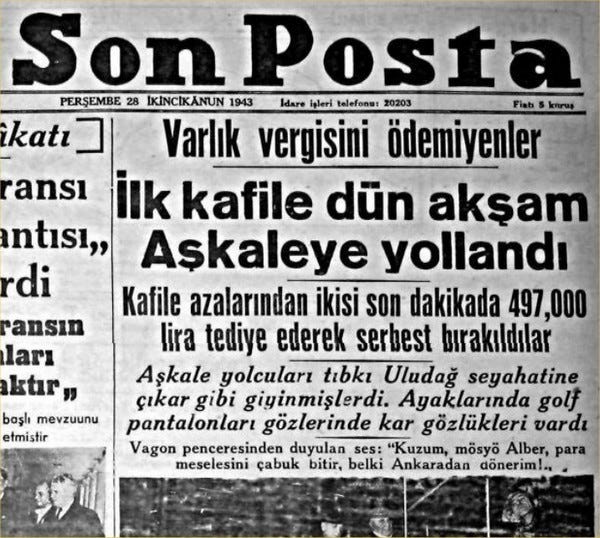
Those who could not meet the requirements of the new capital tax were sent to an enforced labor camp in the Askale district of Erzurum in the punishing winter of eastern Turkey.
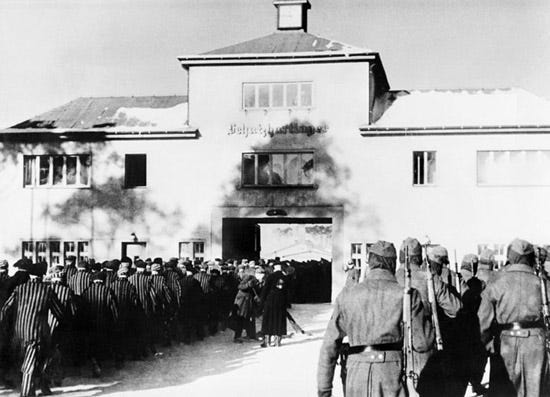
Many of the older and frail men never made it home again. The episode remains a shameful chapter of the republican history as the paramount political objective of Turkification of the economy veered off its moral track, creating a grotesque example of injustice down the line.
The designers of the Askale camp, according to some scholars, even imitated the Nazi organization technics for the management and day-to-day run of the labor camp in Askale, albeit without gas chambers and other lethal methods deployed against the vulnerable Jewish inmates in Germany, Poland, and other parts of Eastern Europe during the WWII.
The pogroms against Christians and Jews in Istanbul on Sept. 6–7, 1955, are now universal knowledge. After the outbreak of a fabricated story of a provocative attack against Ataturk’s birthplace in Thessaloniki, the frenzied residents of Istanbul retaliated against the business stores and workplaces of non-Muslims in the affluent district of Taksim.
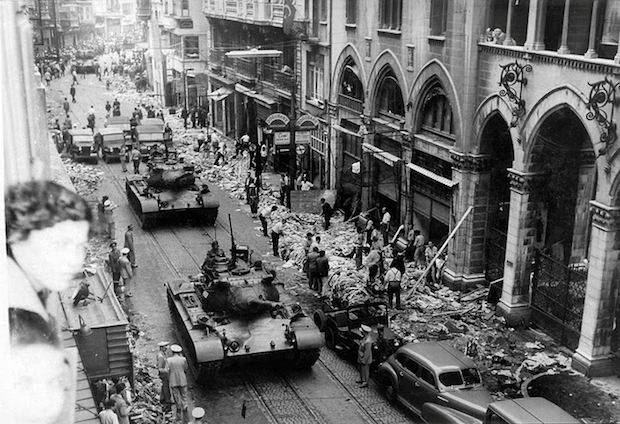
For two days, the non-Muslim Istanbulites in the Taksim area, the western province of Canakkale, Izmir, and some other parts of Anatolia where non-Muslims were used to live suffered horrors of a high order as a blind mob ransacked their businesses and attacked residences. At least 12 people were killed, 400 wounded, and tens of women were sexually assaulted. The Turkish government placed a curfew in Istanbul and deployed tanks in the historic Istiklal street after spasms of violence subsided.
The living witnesses of the mob assault still decry the lack of public accountability and responsibility on behalf of authorities to thoroughly investigate the roots of the events. Who did orchestrate the attacks? Did the mob act spontaneously without any leadership or pre-organization? These questions never got a persuasive answer through legal channels at a court. But in 1991, retired Gen. Sabri Yirmibesoglu, former Undersecretary of Turkey’s National Security Council (MGK), conceded in an adlib confession to a journalist during an interview that the September 6–7 attacks were a perfect job pulled off by the military intelligence (OHD). (After his remarks were published in a book about him, the former general publicly denied his statement later.)
The September pogroms were reckoned to play a vital part in the Turkification of major sectors of the national economy previously controlled by non-Muslims. The wealth or capital tax, the 1955 pogroms, and the last wave of deportation of non-citizen Greeks living in Istanbul in the early 1960s proved to be major cornerstones of a long-running state objective to drive the religious minorities out of the country and dismantle their positions in the economy. The authorities saw targeting the minorities as the precondition for creating the national bourgeoisie. In the end, the Turkish government might have achieved its goals, but not without a great moral cost and humanitarian tragedy.
Speaking to the Birgun daily nearly seven decades after the incidents, Agos Editor Pakrat Estukyan reasoned that what happened in 1955 could repeat any time as nobody was brought to court as part of a deliberate political choice to cover up the entire saga. It was, he noted, “a manifestation of a culture of impunity” that remains ever-present today.
The Dispossessed Under the Erdogan Rule
This aspect — the perpetuity and ever-present reality of wealth transfer — warrants immediate scrutiny. Time and again, purge and confiscation have become frequently-appealed political weapons of choice to mete out punishment on a broad scale against designated enemies of the day.
The systematic targeting of Kurdish businessmen on clumsy charges of affiliation with the outlaw Kurdistan Workers’ Party (PKK) offered a once-in-lifetime opportunity to people associated with the “deep state.” The goons of then-Interior Minister Mehmet Agar and other corrupt security bureaucrats pulverized the assets of some Kurdish companies and high-profile businessmen over trump-up charges in an all-war against the PKK across southeastern Turkey. Many businessmen had to pay a ransom or hefty bribes to security officials to avoid being wound up in a counter-terrorism investigation file, which would legally pave the way for the full-scale seizure of their assets. A similar playbook has been shrewdly invoked by the creative criminal minds within the police department and Interior Ministry to pilfer considerable amounts of money from some businessmen by threatening to add them to ongoing “FETO” investigations since 2016.
The total war against political enemies of the government also manifested itself on the property front. After the abortive coup in 2016, the Turkish government seized properties worth tens of billions in U.S. dollars. In this regard, the Friday announcement even pales compared to what emerged after 2016. The government justifies its unjustifiable acts on the grounds of terrorism or national security. Needless to say, this argument reeks of gross logical errors, given how arbitrarily and indiscriminately the government deploys this policy without any semblance of due process. It has immensely contributed to the erosion of property rights across Turkey.
This post-2016 wealth grab significantly alters the politics of enrichment that usually occurs with major political changes in Ankara.
As the balance of political power shifts with the formation of a new government, so does the financial complexion of big economic players that shape the country’s domestic production. Seen from this angle, the development of Turkey’s middle class and the emergence of the national bourgeoisie correspond more with the state of political affairs than with the natural course of the economic progress in Turkey. That economic progress, when it happens, owes its origins more to the political dynamics than the mere economic ones in a way that may corroborate the Weberian notion of autonomous political power to re-design the economic sphere. In what is termed patrimonial capitalism, new regimes and governments of Turkey arbitrarily dole out lucrative economic rewards to loyal allies and pliant businessmen. Since Erdogan came to power, a new class of immensely wealthy pious/conservative groups has emerged alongside the already-established urbanized secular segments of society that had been the backbone of the Turkish economy since the foundation of the republic (thanks to the political engineering of wealth transfer from minorities.)
The redistribution of national economic resources has long been regarded as a progressive policy as part of a redistributive justice paradigm to reduce politically dangerous socio-economic inequality in a society. But in Turkey, the situation went far beyond that after more than a decade of economic empowerment and the elevation of the lower classes to a new social status. The redistributive agenda of the Erdogan government has taken a completely new reality of its own. The direct takeover of critics’ properties embodied a politically sanctioned theft on a national scale. The arbitrary invocation of counter-terrorism laws as the legal pretext fails to obscure this unjust wealth grab that manifested in the aftermath of the 2016 putsch.
Evoking the religious justification of the large-scale dispossession of perceived enemies during the 17th-century religious strife in Europe, some clerks, working in tandem with the government, betrayed no scruples when offering a green light to the looting of the properties of the Gulen community. During a so-called democracy watch rally in Istanbul a week after the failed coup, Metin Balkanlioglu, a religious scholar associated with the Istanbul-based Ismailaga community, called on the demonstrators to freely make use of the properties of the people affiliated with the Gulen movement. He deemed those properties as legitimate spoils of war, and they are perfectly up for grabs for the nation. Certainly, his line of thinking was not an isolated one, but rather was a reflection of a mindset prevalent and deeply rooted among the new rulers of Turkey.
Expectedly, his public calls did not remain in theory or on paper. What transpired thereafter lent credence to the religious view of the crackdown as some form of a holy war against the “enemies of the public,” with their assets, properties, and belongings wide open for seizure justified by a medieval-era interpretation of religious doctrines regulating the affairs of war and peace in Islamic jurisprudence. In this regard, the private jets and hotels of businessman Akin Ipek have been doled out as personal gifts from Turkey’s all-powerful monarch to his loyal followers. More than 1,000 schools and 15 universities were confiscated with an emergency decree one week after the putsch, only to be redistributed to pro-government religious communities in a massive property transfer on the national scale.
This brazen, abrasive redistribution has nothing to do with the reformist agenda manifest in the democratic politics of the social welfare countries of the Scandinavian peninsula or the Democratic drive that seeks to mitigate the uneven results of the capitalist economic production in the U.S. The post-2016 Turkey even goes back to the pre-Tanzimat era when the public servants’ properties were not under any legal guarantee in the Ottoman Empire. Unless sealed under the protection of vakif or foundation system (See Abu Rifa’at Ali Abou-El-Haj’s work on the modern Ottoman state), the wealth of most of the Ottoman bureaucrats was transferred to the state treasury after their death. This practice came to an end when the Sublime Porte pledged to respect the private property of all citizens and public servants with the declaration of the famous Tanzimat Edict in 1839, recognizing the inheritance law for the workers of the government bureaucracy.
The Erdogan government’s initial moves against Kent Bank, Cem Uzan’s companies, the controversial takeover of ATV and Sabah by the Saving Deposit Insurance Fund (TMSF), a semi-autonomous government agency that regulates the sale and seizure of bankrupt companies, throughout the 2000s and the pre-2016 seizure of Koza Ipek Media later evolved into a routine sport in the past five years. During this time, the government has cultivated considerable know-how on how to wean the ownership of profitable companies from their legitimate, original owners through a combination of subtle legal shenanigans under the shield of political protection.
Another often overlooked aspect of the post-coup crackdown is the existence of a mechanism called the “FETO blackmail market,” as the indiscriminate purge of more than 130,000 public workers and the mass property confiscation spawned an era of organized robbery by some government bureaucrats and police officers. Amid the frenzy of purge lists, some creative minds manufactured names, profiled figures who have no links either to the 2016 coup or to the Gulen movement at large. (“FETO” is a derogatory term the government employs to refer to the Gulen community.)
The corrupt officials simply blackmail rich businessmen by threatening to include them in ongoing FETO trials in return for handsome bribes. Organized crime boss Sedat Peker also revealed this lucrative scheme and conceded that many businessmen had to pay millions of dollars to government members to remove their names from FETO lists. The scheme involves high-profile party officials, minister advisors, an Izmir-based Dokuz Eylul University rector, businessmen, police officers, prosecutors, and party apparatchiks.
It works like this: the architects and practitioners of the scheme select a rich person as a target and pay a visit to him/her. “Mr. X, we discovered your name is on an investigation file as part of FETO trials. We’ve had a very long relationship with you. It would be a great regret for us to see you in prison. If you can help (bribe) us, we can do our best to remove your name from the list.” Startled by the threat's revelation or gravity, many people seemly cave in and shower their largesse to avoid any prosecution that would consume many of their years indefinitely in Turkey’s politicized courts.
The Freezing of Èmigré Wealth
The Friday crackdown on the assets of political opponents, most of whom were already living abroad, resembles the revolutionized confiscation of the émigré wealth in Paris after the French Revolution. As many aristocrats and members of the emerging merchant class fled abroad or were stranded on foreign lands in the aftermath of the revolution, their assets were confiscated by a special tribunal comprising radical revolutionaries.
Among 770 misfortunate people are Kurds, Alevis, leftists, some non-loyalist pious figures, and the Gulen folks. They all share the same tragedy that beset countless victims before them in modern history. Why now, and why target the people already living abroad? If the previous parts of the essay elucidate anything, it is that there is no specific reason. In a country ruled by the whims of a single personality, searching for structural trends or reasonable analytical explanations would be a waste of time. One reason might be the boundless nature of this timeless punishment that goes beyond borders. The other, as a journalist conceivably mused, would be intimidation and deterrence against journalists reporting human rights violations inside Turkey to the outside world. One cannot fail to realize that the targeted names were the outspoken ones against the political persecution in Turkey, while the government passed on richer but less active people who simply prefer to keep a low profile in the relative tranquility of diaspora life. Those three female journalists saw all their properties frozen. But their struggle is alive and well-justified, no matter how much the government seeks to silence its critics living beyond its reach.
In the court of history, if not in an actual courtroom due to the delicate political context, the judgment is left for future generations. And it is mostly, universally against the political thieves (perpetrators of wealth grab), not the victims.
Originally published at https://abyasun.substack.com on December 24, 2021. This piece has been updated with some changes.