
Improve Your Exercise Recovery With Regular Delaods
Take a break from the gym to prime yourself for better results and build more strength and muscle

Has your progress in the gym reached a plateau?
Do you keep pushing and pushing your exercising to the point of fatigue, but you’re still not getting the results you deserve?
You may need to deload.
If you’re doing high-intensity workouts regularly, deload weeks are extremely important. Your body needs time to recover from all the stress working out creates.
Otherwise, you risk burnout or injury.
So, consider taking a week off the gym every once in a while (or periodically).
This article, we’ll explore the deload in the context of exercise and why taking a step back could mean stepping forward in the gym.
What is deloading?
A deload is what the strength and lifting community refers to as a period dedicated to letting the body recover.
Typically lasting a week, the focus of deloading shifts away from intense workouts and toward recovery — rest, nutrition, and sleep.
These periodised blocks of rest and lighter training can be leveraged to help optimise ongoing performance and results over the long term.
Many people still train during a deload but at a reduced intensity and volume.
Why do we deload?
We deload to give our body a break from the stress of training, allowing us to recover from fatigue and/or injury.
If we’re continually pushing ourselves to the limit physically and mentally with our training, the fatigue we accumulate is temporarily masking our improvement.
Taking this break flushes out the fatigue, priming us to continue to train at a high intensity.
“…An athlete’s training plan should account for fitness and fatigue after-effects in an effort to maximize the effects of training.” — Chiu & Barnes, 2003
According to the fitness fatigue model, we increase our fitness and fatigue anytime we train.
We want to improve our fitness — this could be strength or muscle. Fatigue, on the other hand, should be avoided. It includes metabolic waste, muscle damage, and nervous system fatigue.
If fitness and fatigue are both high, our performance will suffer. And because performance ultimately drives better results (e.g. muscle, strength, fitness, performance), we always want to perform at or near our best.
Many bodybuilders and other gym-bros don’t seem to realise the effectiveness of a deload.
Bodybuilders can get so hung up on the go-hard or go-home mentality that they forget that we make progress outside the gym when the body rests and can recover.
This mindset to not take time off the gym often results in plateaus or worse, injury.
The best way to break through a plateau isn't training harder; it is training smarter. And that means allowing our bodies to recover.
Once our body recovers, we can continue to train hard and improve.
“These stressful periods result in large fitness and fatigue after-effects. As the duration of the fitness after-effect is longer than the fatigue after-effect, a period of rest allows fatigue to diminish while fitness remains high.” — Chiu & Barnes, 2003
Who needs to deload?
We’ve just learnt about some of the advantages of deloading to relieve fatigue and stress from training. But how do we know if we require a deload?
Generally, anybody trying at a high intensity regularly will need to deload.

Strength athletes/powerlifters, strongmen, elite bodybuilders, cross-fitters, professional athletes, endurance athletes — if you fit into any of these categories, you should be deloading at least occasionally.
There are a few reasons why we might have a deload week. There are as follows:
- Deload periods are programmed periodically into our training — we’ll get to this.
- You’re not progressing and struggling to train at the usual intensity.
- Your body often feels tired and sore from exercise.
- You’re preparing to hit a PR one rep max or a powerlifting competition
- You’re sick or injured, keeping you from training at the required intensity
- You’re going on holiday (don’t do it two weeks before the holiday)
Who doesn’t need to deload?
Not everybody will benefit from a deload. Most of us won’t generate enough fatigue to justify a deload.
Newbies, that’s anybody with fewer than two years of serious training experience (some people never pass the newbie phase); you won’t be training heavily enough to generate much fatigue.
Half-assed lifters, the same goes for you. And to be brutally honest, that’s most gym-goers. I’ve seen it every day of my 15-plus years in the gym, and research also suggests that most people don’t train hard enough.
Check out the below article for more about that.
Train harder!
When and how often should you deload?
A deload week is either scheduled periodically into an exercise programme or when feeling the warning signs of overtraining.
Typically, the more advanced a person is in the gym, the more often they need to deload because they must train harder to keep progressing, generating more fatigue.
Many strength training programmes will have a deload period once every 8–10 weeks at the end of a training block. But we can run a deload week at any stage of a training cycle.
You may choose to deload during a stressful time at work or home. Or, as mentioned above, you might deload when you’re often feeling fatigued. If weights feel heavier than usual and you can’t lift as much as you’re used to, this is a good sign of fatigue or “overreaching”.
Finally, it could be a perfect time to have a deload period when you go on a business trip or holiday and can’t optimise your training sessions.
Programmed deloads vs autoregulated deloads
There are two approaches to an active deload week — a programmed deload or an auto-regulated deload.
Many serious strength athletes program regular deloads into their training.
Other lifters or coaches prefer reactively/ autoregulating deloading. Meaning, you’ll only deload when you feel like you actually need one.
Both strategies have their strengths and weaknesses.

In an ideal world, we could schedule everything perfectly. But that’s not most of our realities — which is the reasoning for the autoregulated approach. We could have a programmed deload, then we get sick a week later, the kids get sick, or we have a deadline on a big project at work.
Some things in life are hard to predict. And most of us can’t focus 100% of our time and energy on our sport or training — there’s a bunch of life variables that can affect our routine.
The biggest downside of the reactive approach is that it is actually hard to tell when your body requires a deload. Why? Because research indicates that not all our soft tissues and tendons are well-innervated with nerves. Therefore, we could be accumulating substantial amounts of joint stress without even realising it until we get an injury.
How To: Deload week
Before we get to the exercise routine for a deload, there are three types of deloading — a full week off, the taper week, or the standard deload.
Some people like to take a week off the gym when they go on holiday or when life is a bit hectic, which is absolutely fine. A lot of bodybuilders did this back in the 1970s.
However, there’s a lot more research illustrating the benefits of active recovery than there used to be. Moreover, after a week off the gym, you can feel out of the “groove” and the weights may feel heavier.
Thus, the lifting community’s default approach to deloading has become an active deload.
And, If you’re anything like me, you HATE taking any time off the gym!
But you shouldn’t worry about losing your hard-earned gains if you take a week off — research shows that you can take up to three weeks off training without risking any muscle loss.
“Evidence suggests that short (~3 weeks) periods of detraining in trained persons does not incur significant muscular atrophy and might stimulate greater hypertrophy upon return to training.” — Fisher, Steele and Smith, 2013
Make sure your nutrition is on point — get plenty of protein and micronutrients through whole foods such as meat, fruits, and vegetables.
We need to ensure our bodies gets everything we need to optimise our rest and recovery.

Try to get more sleep than usual during your deload week.
The more sleep we get, the more our body can recover and heal. If you’re only getting 4 hours of sleep a night and then smashing 2-hour workouts 6-days a week, that’s a good reason you need to deload!
Deload workouts
What kind of workouts should we do during deload week?
The two main rules for deloading are reduced volume and/or reduced intensity.
Volume is the total number of sets and reps, and intensity is how heavy the weights are and how close to failure we train.
Here are some typical guidelines for deload workouts:
- reduce the weight
- reduce the number of sets
- reduce the number of reps
- avoid or minimise barbell work
- minimise compound exercises
- increased light cardio
Now, we’ll discuss how the workout methodology differs between the two active deload weeks, the taper week and the general deload week.
Taper week
The first type of active deload is the taper week.
It is common for strength athletes to have a taper week when peaking for a competition or training to hit a PR in the gym. They deload a week before this test of maximum strength and thus, primed for the best opportunity to reach their absolute maximum lift the following week.
During taper week, you still train at a high intensity, as in heavy, but the volume is reduced. We also remove the accessory lifts (e.g., hamstring curls and leg extensions for legs) this week.
For example, if we’re testing our squat — We might be running a 10-week programme leading up to the day we test our maximum lift.
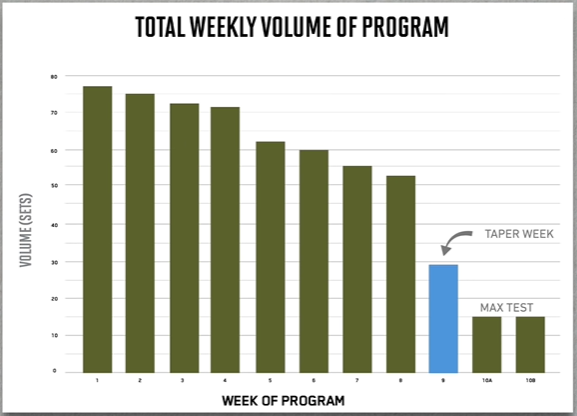
In week one, we do the highest number of sets of the training block. Volume (number of sets) tapers off slowly as we progress through the period.
In week eight, training volume is still following the slow progression of tapering off; but in week nine (the taper week), we reduce our volume to around 40% of the total number of sets we did in week one.
General deload week
The second type of active deload is the general deload week, which should be used by most people training in the gym.
It doesn’t have to be just before testing your maximum strength — it can be programmed periodically into any programme; or, you can deload when you “feel” your body needs a rest.
Essentially, we’re doing most of the same exercises but at a reduced weight/intensity and for fewer reps and/or sets.
You should reduce the total volume by around 40–50%. So, if your usual workout totals 20 sets aim for approximately 10 sets— do 1 or 2 fewer sets per exercise.
In terms of intensity, if you usually stop a set 1–2 reps short of failure, stop around 3–5 sets from failure on deload week.
You can even take a step further by removing all barbell compound exercises from your deload week workouts, such as squatting. The reason we might do this is that these exercises create the most fatigue — and fatigue is something that we want to avoid.
If you keep doing compound lifts, reduce the weight to around 50–60% of your one rep max.
Final Thoughts
In conclusion, consistently pushing our bodies in the gym at a high intensity will increase our fitness, but we also accumulate fatigue.
High fatigue means our performance will suffer.
Hence, we need to let our body rest periodically, which is where the deload week comes in.
If you don’t have regular deload weeks programmed into your training, you should learn to listen to your body and take feedback from performance decreases and extra aches and pains as a time to give your body a break.
Deloading will decrease your fatigue and help you blast through plateaus, increasing your gains in the gym over the long term.
Thank you for reading.
If you enjoyed the content, you might be interested in this article about whether we should train to failure in the gym.
Subscribe to be notified when I publish new content.