
Deicide Interview. Glen Benton, 1995
Let’s start with a little context. After all, it’s been 25 years.
Once Upon The Cross was released on April 14th, 1995. This interview was conducted between myself, and the Deicide frontman, Glen Benton, around March of the same year. I’d been able to get three or so listens of the advance tape in (yes I mean cassette!) before the call took place. Already well versed in the band’s first two abominations, it was more Benton’s temperament I was curious about.
He seemed a little frictious at first, contrary throughout, but it resolved in an enjoyable interview. Granted, he didn’t stop to shoot any vermin during our conversation (he saved that for Jason Arnopp if memory serves), but he played his part well, and I wasn’t disappointed.
I’ve included two versions of the interview. It was published on four separate occasions, but these two represent the most comprehensive overview of our conversation, and there’s a noteworthy variation in each to make it worth your time.
These are from commercial print publications, and as a result, read like it.
Metal Masters, Australian Glossy, 1995.
“I’m in a grumpy mood today,’’ croaks Glen Benton, vocalist and bassist with Florida’s most notorious blasphemic death metal quartet. The voice of Deicide is on the line from his home, where he’s less than impressed about the seedy weather.
Deicide has returned to unleash their third murderous platter. Once Upon A Cross. It’s message? Only Benton can explain.
“It’s Christ going into the valley of temptation,” he says, “and being tempted by the Devil, and the Devil winning. He (Christ) eats from the Tree of Life and, once he does this, he goes to the Cross. It’s Satan having his revenge.”
While the message of the album is made clear, what will be the band’s objective for this year?
“Staying alive,’’ replies Benton with a chuckle. “If you want to know what we’re out to achieve? We’re out to open minds.”
Flashback. The year is 1987, and the band is conceived. Amon is the first name of choice. Two demos later, the band (with Eric and Brian Hoffman on guitars, and maniacal drummer Steve Ashiem) signs to Roadrunner Records and changes its name to one deemed more appropriate; Deicide (to kill God). The vision of the band’s arcane leader has not faltered, nor has it changed.
“Deicide means exactly what it means,” says Benton. “We’re going to keep attacking God until the end.”
What is your projection of the end?
“What sort of end are we speaking about?” asks Benton. “The end of Deicide? The end of me? The end of the world?”
Let’s start with the end of the world.
“I see the end of the world as being real quick. As far as human life goes, I don’t think there will be anything left. This place is going to look like one big ashtray.”
Once Upon A Cross displays a prevalent, biting guitar sound; something absent on previous albums. While the frontman puts this down to an abundance of funds, the potential success of the songs themselves will be attributable to factors entirely different.
“We’re all very pleased with it,” says Benton. “We all enjoy playing the tunes, and we have moved back to simplicity, rather than being technical. Simplicity is more appealing to myself. Everybody that’s been successful has worked on this basis. If you’re just speeding up and slowing down, the music will not flow. What we have done, is to create a flow.
“When we did Legion, we were on the verge of doing what we are right now. The problem with Legion was that we just went into the studio and played, then tried to fix things. Of course, the more you do that, the more it takes away from the sound.”
There’s a general consensus you were dissatisfied with Legion. Were you really unimpressed with it?
“I made a comment saying that Legion sucked.” says Benton testily. “Now everybody thinks I hated it. That’s not true. I didn’t hate the record. I just said that to the band, because that’s how I wanted to get my point across at the time. As far as that record goes, the only things I did not like was that we were being rushed by the record company, and the production was not totally satisfying. Because we were being rushed, we weren’t able to be selective with amplifiers and instruments, so when you compare Once Upon The Cross to Legion, there is an obvious difference.
“I’m not doing this to please anybody except myself. If it takes us three years to put out a record, then that’s how it has to be.”
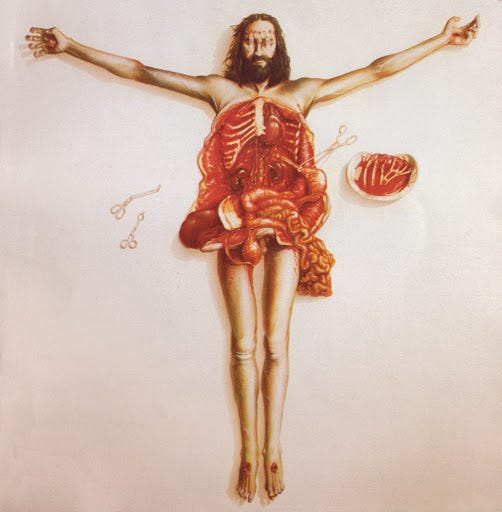
Never a unit to shy from the realms of controversy, It wasn’t long before Deicide had the preservers of purity breathing down their collective neck. The cover art, created by UK artist Trevor Brown, was described by Benton as Disturbing to the soul. This ‘disturbance’ has, in the brief time since the release of Once Upon A Cross, caused them to cancel a show. The PMRC strike again?
No. This time the problems arose in Amsterdam.
“We had a show planned on the Easter weekend,” Benton explains, “and it was cancelled because the mayor of Amsterdam saw the record advertised in a magazine. A national publication ran an article on the band, and the mayor banned the show. We got the day off, and got paid for it.” .
There is no concern from Benton as he expresses this.
“If you had time off, and you were in Amsterdam, would you be concerned?” he asks.
One factor this ‘moral majority’ seems to ignore is, of course, that the more hype they create, the more records the band sells. For Benton though, this drives his hatred even further.
“When I’m constantly being taunted, it makes me want to seek more revenge,” he snaps, “an eye for an eye.”
Rebel Razor, Sydney Street Press, 1995
Once Upon The Cross, the tide of Deicide’s new opus is not a humble one; but then Deicide have never been reputed for so-called correct attitudes. The band know where this earth is headed and they express freely these feelings in trademark three minute blasts of blasphemy.
The last three years have not produced much change in the Deicide camp, and thus the most infamous Floridian merchants of death have remained true to their roots. The band’s message, image, vision and even their song structures have retained the applied formula of their first two albums.
“Deicide means exactly what it means… and we’re going to keep attacking God until the end.”
Whether vocalist Glen Benton shares the why fix something that ain’t broke attitude of Cannibal Corpse’s Chris Barnes is uncertain, though Benton himself readily points out that Once Upon The Cross shares a greater musical relationship with the 1990 self titled debut, than with its successor, Legion.
“It’s more like the first album that the second,” croaks Benton, on the line from his home in blustery Florida, “We’re moving back towards simplicity, rather than being technical.
“Simplicity is more appealing to myself, and everybody that has been successful, has worked on this basis. If you’re just speeding up, and slowing down, the music will not flow.”
About this time last year, you were quoted as saying that you hoped to achieve a more melodic and polished edge on the new album. Have the results rung true of your prophecy?
“No, I didn’t say anything like that,” replies Benton. “I said something along the lines of the album being more flowing, with a more melodic feel to it. But still heavy. We’re keeping everything flowing; I would never say we wanted to polish, because we can’t polish what we do. We cleaned it up, and did things differently in the studio, but we never polished anything.”
So while we are in the fields of fact distortion, it also became clear that Benton’s alleged dissatisfaction with Legion was, to put it mildly, blown completely out of proportion.
“I made a comment saying that Legion sucked,” Benton recalls, “and now everybody thinks I hated it. That’s not true, I don’t hate that record. I just said that (to the band) because that’s how I wanted to get my point across at the time. As far as that album goes, the things that I did not like were that we were being rushed by the record company and that the production was not totally satisfying.”
“When we did Legion,” he continues, “we were on the verge of doing what we are right now.
“Another problem with that, was that we went straight into the studio and played. Then we tried to fix things. Of course, the more you try to fix things, the more it takes away from the sound.”
But no matter what method has been utilised to bleed their nihilistic message onto tape, their sound is defiantly their own. A difficult task in a genre that is believed by many to be almost exhausted. Benton claims that he doesn’t listen to death metal… and maybe he doesn’t.
“Nah, I don’t listen to it,” he says in all seriousness, “I really don’t. Because I play this music, I will listen to it here and there, and if it’s heavy and catchy, I can handle it. If it’s not I just don’t.
“I like originality,” he continues, “I like bands that are original. I don’t like bands that have changed guitarists ten times. Deicide has been Deicide since we started, and we’ll be Deicide until the end. If one of us were to die tomorrow, then the band would be over with. We haven’ t changed yet, we’ve been doing our own thing and setting standards by it.”
Do you think that too many bands have forgotten what death metal is about?
“We’re not playing death metal,” retorts Benton, “So, I don’t know what you’re talking about.”
So your wish would be that Deicide remained free of labels? Surely you realise that the band are continually classified as a death metal act.
“We don’t want to be known as another death metal band,” he continues, “You must realise that we are not trying to fit into that genre. We don’t want to be classified because we don’t consider what we play to be death metal; we consider it to be music. I don’t like labels… we’re just Deicide.”
In a state of America, where the volatility of the weather and the ferocity of the of the storms alone are life threatening, Deicide must take up arms for their own preservation. In a place where abortion clinic employees are being executed by fundamentalists, Deicide are natural targets. It’s a country that Benton agrees ‘will end up looking like one big ashtray’.
He assures me that Australia will see the repercussions in the form of tidal waves, so nobody will escape.
His vision of the end can be summed up in a word or two, and he believes that power over people lies in not revealing too much. Ask Benton if he thinks that people underestimate him and he’ll give you a resounding “Yes!”
Ask him about the rumoured Australian tour? He’ll tell you that Deicide are merely waiting for the right invitation.


