
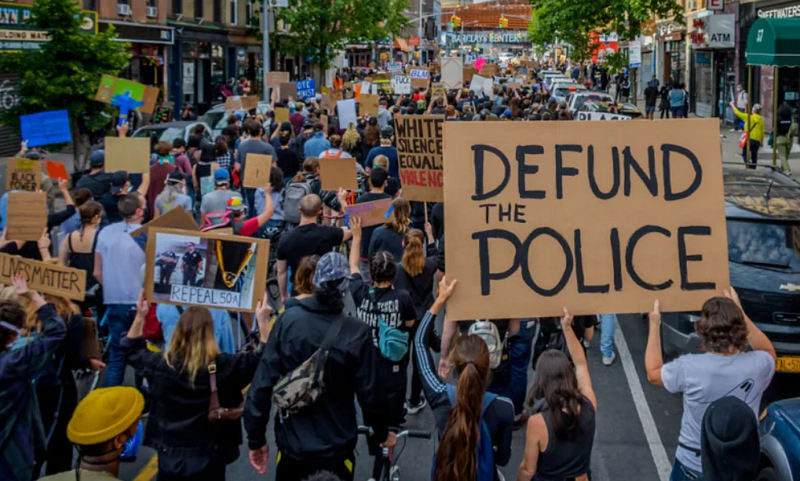
“Defund The Police:” Right IDEA, Absolutely Horrible Narrative
The re-allocation of resources and the strengthening of communities does matter, but now it’s an ideological talking point.
Good article here on the root causes of violent crime, and to jump right in, let’s do two pull-quotes. First up:
If throwing money at police and prisons made us safer, we would probably already be the safest country in the history of the world. We are not, because insufficient punishment is not the root cause of violence. And if someone is talking about how tough they are and how scared you should be, they care more about keeping you scared than keeping you safe.
Hard to argue with that as an American.
Next up:
Meanwhile, local policies that get closer to the cause are showing results. Dozens of communities are demonstrating how to ensure safety and, in many cases, save money along the way. In Austin, Texas, a 911 call from a person reporting a mental health emergency used to get directed to the police. Now, if there is no immediate danger, dispatchers have the option to transfer the call to a mental health clinician. In the first eight months after the program’s 2019 launch, 82 percent of calls that were transferred were handled without police involvement, which resulted in savings to the taxpayer of $1,642,213. By the 2021 fiscal year, the program was involved in almost 2,000 calls. In Brooklyn, young people who completed an alternative program for illegal gun possession had a 22 percent lower rearrest rate than peers who went to prison. In Olympia, Wash., a new unit of the Police Department that provides “free, confidential, and voluntary crisis response assistance” has responded to 3,108 calls since 2019, all while minimizing arrests and with zero injuries to responders.
Now, do I think these systems are perfect? No. There’s a bunch of issues:
- They can’t effectively “scale” for a big city.
- 911 operators are still underpaid (often $17/hour or less) and they might not get the crux of a situation, hence you could send a social worker to someone with a gun.
- I doubt District Attorneys want this relative to case closure rates, because cops know how to dot-Is and cross-Ts (well, somewhat), and not everyone else at a scene would always know that.
Do I think we need more Elijah McClain situations?
No. Those are bad. But none of this law enforcement work is black-and-white — although, ironically, it’s often made into a black-and-white issue in terms of skin tone — and each situation is different. That’s why some of these models, which have had good success thus far, can’t really scale.
The whole problem on the narrative side of things is that “defund” was the wrong word, because it provides an instant talking point to Tucker Carlson and other flag-planters that liberals want to end police, thus making your gated subdivision lawless and terrifying. The right word is actually “re-allocate,” but that doesn’t get as many headlines. The word “defund” fell right into The Ideology Wars.
We’ve had this problem in recent years of taking core professions and making them do 100x the things they normally had to do, while not necessarily paying them more. Some notable examples:
- Teachers
- Cops
- Nurses
- Doctors
- Judges (because no one can do anything with legislation anymore, so the courts become everything)
The last two bullets are paid pretty well, generally. The first three? Not so much. And we have shortages in all three areas. Some of it is tied to Ideology Wars, too — who would want to be a teacher if moms are going to constantly scream at you about basic curriculum decisions? Who would want to be a cop if LeBron is going to put your name and face on his Instagram when you thought you were doing right within a situation? Who wants to be a nurse if you get spit on and told COVID is a lie?
I mean, who would want to do those jobs, in reality? Just go be an influencer. (Ha.)
But the “defund” narrative is so stupid semantically. These ideas can work — and I bet most people agree that cops shouldn’t be getting dogs out of trees, and dealing with the homeless, and doing welfare checks because so many adults lack friends, and then having to chase murders and rapists. They should do those final two things, and we should reallocate some of the other work to people who would more logically do it.
It’s not a perfect system (nothing is), but that’s how we need to shift thinking.