
Deflating the Miracle of Mathematics
The hierarchy of abstractions and the usefulness of fictions and games
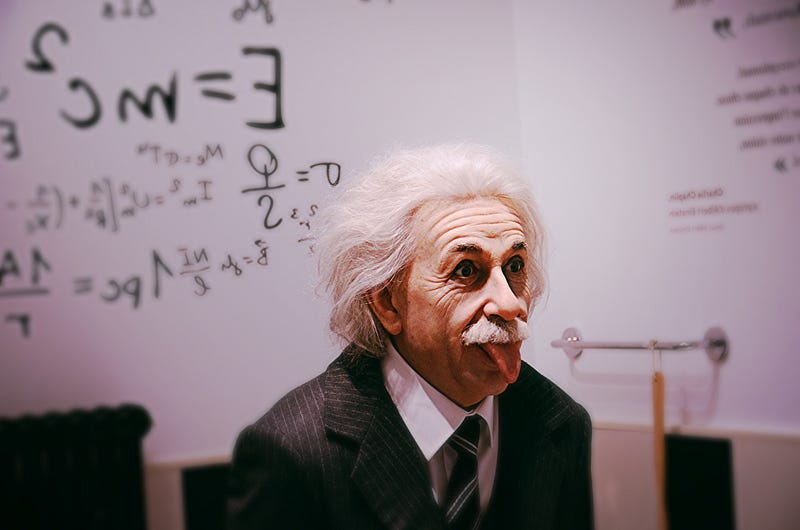
In a video interview, Paul Davies, the theoretical physicist expressed the standard scientific bafflement about the relation between mathematics and natural reality. What we see in our daily life, he said, is so complex that we might have assumed we could never make sense of it all.
But beneath that surface complexity is this extraordinarily harmonious mathematical order, and you have to work fairly hard to dig it out. So it’s buried there; one way of saying this it that it’s encrypted. We’re so used to using mathematics now to describe the world — you want to work out the trajectory of a spacecraft or figure out the properties of a laser or whatever it might be. You sit and you write down equations and people take it for granted that they work.
But really, this is truly remarkable that the human mind which has invented mathematics — we have found that that nevertheless has application to the deepest processes in nature. And they’re going on all the time all around us. We don’t just see them in daily life: you deduce them from arcane procedures such as doing weird things in laboratories where you subject matter to conditions it would not normally encounter in the outside world, and you write down lots of complicated-looking equations and manipulate those. And this is our pathway to uncovering what is going on in the universe.
But there is something going on. It’s not just that there’s a whole collection of things here, and we’re just stamp collecting: we found this and we found that, and so on. They all interconnect, so the universe is a process; it’s not just a collection of objects. It’s a process following a coherent set of rules. Ultimately, we call these rules “the laws of physics” or “the laws of nature.” And, of course, it’s one of the most profound questions we can ask: Where did those laws of nature come from, and do they have to be in the form they have?
This mystery of why mathematical science works so well goes back to the ancient Greek philosophers who discovered mathematical harmonies in music and in geometry, so they reasoned that nature amounts to a cosmos, to an ordered whole that’s flush with purpose.
Famously, Galileo said “The laws of Nature are written in the language of mathematics…the symbols are triangles, circles and other geometrical figures, without whose help it is impossible to comprehend a single word.” And the physicist Eugene Wigner wrote an influential article in 1960, called “The Unreasonable Effectiveness of Mathematics in the Natural Sciences,” which expresses the same astonishment as the above passage from Paul Davies.
The intuitive origins of arithmetic
Let’s trace how this mystery arises, by looking at a simple part of mathematics, at the arithmetical operations of addition and subtraction. What we should note first is that math begins with common experience which is modelled by concepts that are in turn labelled by words in natural languages.
We can see this by looking at the original meanings of words like “add,” “increase,” and “subtract.” “Add” comes from the Latin “addere,” meaning to put toward (ad = toward, indicating direction, tendency, or addition + dere = to put). The root idea, then, is one of allotment: something is set aside towards something else, as in the building of a heap of dirt by increasing its size with shovelled portions.
The word “increase” derives from the Latin “increscere,” meaning “to grow.” That root word gives us “crescent,” which indicates that the concept may have originated from the odd impression of the waxing and waning of the moon. Of course, the moon doesn’t really grow, but only seems to because of how different amounts of its dark side appear to us, depending on how the moon’s and the Earth’s rotations line up.
As for “subtract,” that word derives from the Latin “subtractus,” meaning to draw or to drag away from underneath, as in a case of undermining.
The point is that ordinary concepts that correspond to words in natural language, such as “add” and “subtract” are tied to concrete, often human-centered experiences of what we can do in the world or of what seems apparent from an intuitive, sometimes naïve standpoint.
But the mystery Paul Davies spoke of isn’t that the underlying natural processes conform to such commonsensical notions, as though every case of addition were comparable to a deliberate setting aside of something towards something else. What mathematicians do is formalize those intuitive concepts, abstracting as much as possible from the anthropocentric impressions and intuitions.
The technicalities of mathematics
Thus, the mathematical concept of addition is of an arithmetical operation which takes input values to a well-defined output value, and an operation is technically a function, as defined by set theory. A function is a rule for determining a range, whereby a domain is translated into its codomain. The rule can assign each element of a set X (the domain which is the set of possible inputs for the function) to exactly one of the elements of a set Y (the codomain which is the set of allowable outputs).
This formalization of the ordinary idea of addition replaces the practical experiences of putting X towards Y or of organic or celestial growth, with the technical concept of a set. That word, too, of course, has an intriguing origin in an intuitive, human experience, deriving as it does from the Latin “secta,” meaning religious sect, but later being influenced by the verb sense of “set,” which meant to sit.
If we ask, then, what separates two abstract sets or classes, such as the set of apples that can be added together and the set of their sum, we could appeal to the obsolete original sense and say that the two groups form separate “sets” in so far as those groups are comparable to the bitter squabbling of rival religious sects. Catholics and Protestants, or Sunni and Shia differ on certain principles which define their identity, so sets of apples would be distinguished by similar creedal dichotomies, of which there are naturally none in the apple world (because apples don’t fight with each other).
Of course, neither that original sense nor the concept of sitting something in its place can inform the mathematical concept of the adding of sets. There is, then, a split between natural and artificial languages which is crucial to tracing the sense of mystery as to why math works so well. The mathematical concept of a set is defined operationally. A mathematical or logical set is just something that’s needed, defined, and stipulated to perform an orderly reassignment of elements.
The mystery of math’s relevance to reality
The mystery in this simple case of arithmetic is why the universe should behave according to the addition and subtraction functions. Why is it that adding one pile of apples to another preserves a mathematical order? In other words, why are things in nature countable and thus subject to arithmetical functions?
Technically, you see, things like apples are never added or subtracted. Those are mathematical operations that apply to sets or to numbers which are only abstract pseudo-objects. Mathematical additions, subtractions, and functions on sets are all divorced from any intuitive sense of the original meaning of those words. Arithmetic is part of an artificial language that refers not to sums of apples or of anything else in nature, but to input and output values of a logical function or operation that’s performed on sets, and numbers, too, are defined by set theory.
Why, then, does the real world conform to such logical, humanly stipulated operations? Why are the patterns in nature as technically rigorous as our most abstract linguistic expressions? Why is it that when you combine two apples with two other apples, you always, necessarily have four apples in total? Why does the universe include that simple pattern, watching, as it were, every act of approximating the addition function and supplying the correct result in every instance?
Math’s cheap unfalsifiability
But perhaps there’s really no such conformity and math’s miraculous effectiveness is an illusion. Consider the difference between empirical and mathematical proof. Even Sherlock Holmes can’t prove with absolute certainty that some villain committed a crime. Evidence in the real world is always indirect and subject to multiple interpretations, such as those that are offered in a trial. If a crime is committed, someone necessarily committed it, but the proof that appeals to some evidence is inductive rather than deductive.
Yet proof in mathematics is deductive and appeals to axioms or to definitions rather than to any tentative facts. Thus, this encyclopedia article on addition says “To prove the usual properties of addition, one must first define addition for the context in question” (my emphasis). These definitions are also known as “formulations,” as in the “recursive formulation of addition” which “was developed by Dedekind as early as 1854.”
Imagine you could “prove” that Lee Harvey Oswald shot President John Kennedy, just by defining the general nature of crime and drawing inferences from that definition or from similar axioms. Imagine the Kafkaesque nightmare of being found guilty of robbing a bank because pure logic proves that since “theft” is defined as such and such, therefore you robbed the bank.
The difference, of course, is that mathematical proof is divorced from the messiness of reality. Math is therefore game-like, strictly fictional, idealistic, and even theological in its cheap necessities.
How, for example, could the operations of arithmetic be falsified? By design, the addition function doesn’t refer to anything that exists in the natural universe; rather, it posits abstract objects such as the inputs and outputs of sets, and addition itself is a rule for sorting those ideal elements. Check anywhere you like on this planet or anywhere else in nature and you’ll never find a set in the mathematical sense of that word. Nor will you find a number. Yet the addition function holds not between apples, but between numbers defined as sets.
You add apples to apples in the intuitive sense of “add,” setting aside some applies towards some others for a purpose. But that’s not the mathematical operation. The addition function applies strictly to numbers which are abstract “objects” (or fictions), and that function is stated in the artificial language of arithmetic or set theory.
Therefore, you have as much chance of falsifying the addition function as you do of showing that Darth Vader isn’t Luke Skywalker’s father. Both are merely stipulated, not posited as empirical facts.
Suppose you add two apples to two others, but a fifth apple magically appears alongside the four. Would that miracle falsify the maths of addition? No, because the five apples wouldn’t be a sum of added numbers in the strict sense defined by the language of arithmetic. The five apples would be produced by an approximation of addition together with a miraculous materialization of an apple. And that weird production would have nothing to do with the game of working with the rules of arithmetic.
Similarly, if a fan of Star Wars writes a work of fan fiction and says that Darth Vader isn’t Luke’s father, that wouldn’t alter Star Wars “canon.” The fictional canon’s rules and eventualities are arbitrary but absolute because they bind only the imagination of those who are willing to suspend their disbelief.
When fiction acts strangely as nonfiction
Thus, the mystery that perplexes physicists must be restated. What seems weird is that some fictions should prove useful in modelling nature, whereas others don’t. While the story of Harry Potter is classified as belonging to the fiction genre, the fiction or deductive game of arithmetic somehow crosses over from fiction to nonfiction.
Of course, the worlds of Harry Potter and of games like chess have loose, metaphorical relevance to the nonfictional world because they’re modelled on natural phenomena such as children’s growth into adulthood and the nature of war and politics. But there’s no systematic relevance in those cases because the details of the story are imaginary, and the moves in a game are confined to the gameboard or the playing field. Hitting a homerun in a baseball game has no bearing on anything that transpires outside the stadium (unless someone’s betting on the game’s outcome).
The external world uses fictional stories and games for entertainment, but those fictions don’t systematically model real-world events. Even if a novel’s portrait of certain characters were highly realistic, “Any similarity to actual persons, living or dead, or actual events, is purely coincidental” — as the work usually concedes for legal reasons. To be sure, we can learn about the real world by consuming high-quality fiction, but that learning process is only indirect.
By contrast, many things in nature are countable and systematically subject to the rules of arithmetic. The rules govern abstract objects, but real objects seem enjoined to approximate those abstract ideals. If Plato and Aristotle were wrong about inherent purposes in nature, why should our mathematical tools be so precise and thoroughgoing in their applicability to nature?
A hierarchy of abstractions
Indeed, there are levels of apparent abstraction to notice here. First, there’s the difference, for example, between individual apples and the property of appleness we assume they share. No two apples are exactly alike, yet we classify them all as apples. Our concepts, too, therefore, are simplifications or idealizations that model the complexity we perceive. The concept of apples abstracts from the variety and the uniqueness of each apple.
Then there’s a higher level of abstraction, as the concept of number abstracts from the distinguishing feature of each category or property. Thus, it doesn’t matter whether you’re adding apples or oranges, or dolphins or planets: if the nouns that label the categories are countable rather than mass words, the instances of the natural types are subject to the rules that govern operations on numbers.
The mystery, then, is why that hierarchy of abstractions is so useful in understanding the real world when the abstraction is at best one of our species’ evolutionary adaptations, or an intellectual game we play as lovers of fictions.
Paul Davies says that scientists seem to “decrypt” the natural order. There is an order to discover, he says; that much can be inferred from the anthropic principle since there wouldn’t be intelligent animals that could even attempt to understand a world if there were no such world in the first place, or if there were chaos rather than a world order.
But what seems awesome is the chance of our epiphany were we to invent a model that happens to decode reality. Our species evolved by chance, and our cultures, too, unfold in fits of progress and regression. So why should anything like our mathematical games or scientific theories amount to keys to reality when there’s no deity insuring any such suitability and there are no metaphysical purposes throughout nature?
Deflating the physicist’s epiphany
Such an epiphany could be largely deflated, though. Just as our concepts have mundane evolutionary, social, and psychological functions, scientific theories are guided more by their potential to empower us than by the imperatives of pure philosophy or mystical experience. This is why scientific explanations would be endless even if the strictly objective answers to our empirical questions were finite.
Scientists posit deeper and deeper laws, elements, forces, systems, processes, cycles, and conditions to explain any given phenomenon because those explananda (or theoretical paraphernalia) enable us to exploit our knowledge by undermining the higher-level phenomenon’s integrity. Even if we can’t observe the lower, theoretical level, we can’t help but posit one to understand — to stand under and potentially gain the upper hand on — what we do observe. Knowledge for clever primates like us serves our rapacious animality which is sometimes euphemistically called our “curiosity.”
The hierarchy of abstraction may thus be necessary for the projects of understanding the world and of empowering a species with that knowledge, but not for the world’s existence.
Even if life’s advent were inevitable in the universe’s evolution, that wouldn’t mean — contrary to Heidegger and to Hindus and other mystics — that life’s nature is a gateway to the reality of all nature. That would be the quintessence of an anthropocentric conceit. Learning about how our minds work or studying the workings of our imagination doesn’t afford us an unclouded window onto the cosmic verities. On the contrary, our knowledge advances as we leave behind our naïve intuitions, precisely because the wilderness is inhuman and indifferent to our preoccupations.
Perhaps mathematical games are tools that are immensely useful in organizing our knowledge of nature, and in empowering us at nature’s expense. But that doesn’t mean our empirical knowledge could ever be epiphanic or uncannily revelatory in Paul Davies’ mystical sense. Our knowledge can only be a humanization of the inhuman, and thus we obscure as much as we clarify.
Note, for instance, the human-centeredness of our concept of apples. Apples are countable because they’re holdable, as opposed to being stuff like water that would flow through our hands. Humans categorize apples in that way because our hands are crucial to how we interface with our environment, and we perceive apples as limited, three-dimensional objects because our sense organs model, simplify, and humanize the terrifying alienness of the underlying data and quantum processes.
What, then, is an apple in reality? Does that fruit conform fully to our concept of it? Suppose an extraterrestrial lands on our planet and has no concept of apples because the alien is more interested in processes than in things. What we think of as an apple the alien conceives as an extension of an apple tree which in turn extends the seed from which the tree grew. And the alien thinks of the X we call an apple as a continuum that ends in rottenness and in the planting of its seeds.
Which concept of apples is more realistic, the thing-oriented, humanistic one or the process-oriented alien one? A metaphysical verdict would be arbitrary. The better answer would be pragmatic: one mode of conception may have more powerful affordances than the other, depending on the brainpower that would process those ways of thinking and communicating.
Now, in modelling the universe, physicists employ far more complicated maths than simple arithmetic. But that only strengthens my point since the more exotic the mathematical constructs, the more arbitrary their rules and thus the less remarkable will be the correspondence between natural facts and the physicist’s mathematical tools.
If one tool proves to be irrelevant or infelicitous, the physicist can pick from an infinite variety of mathematical imaginings or can tinker with any set of axioms at will until that fictional system seems to cross over into nonfiction. To say that that crossover happens is to say the tool affords us some practical advantage in inviting us to think that what there is to know includes this other theoretical level.
Deism versus pantheism
It’s clear, though, why many physicists agree with Galileo in thinking that the laws of nature are written in the language of mathematics. Of course, technically that’s a crude deistic notion. If there were no life within the universe, there could still be a robust natural order, complete with patterns, complexifications, cosmic evolutions, and nomic relations, but there would be no natural laws. That is, there would be no formulations in an act of understanding the natural order by means of conceptions and linguistic symbols.
But that’s a quibble. What Galileo and the other physicists should mean is that the best conception of nature’s processes, systems, and cycles is mathematical. And the reason they think so is precisely because math abstracts from all subjective and parochial biases of natural language. Math seems as pitiless, exacting, and inhuman as the natural order.
Indeed, with its lack of connotations and metaphorical resonance, math’s supreme efficacy in descriptions of nature’s patterns is a testament to atheism. Those who think there’s a deity at the bottom of reality should point instead to the Bible or to some other poetic scripture as the revelation of ultimate truth.
Still, math is a language, and being as alien as nature is to our intuitions isn’t the same as being our best attempt at thinking in such an alien way. In addition to the natural facts, math expresses our thoughts and our attempt to understand, so there’s bound to be a disconnect between those facts and even our best tools. True impersonality would require the lack of any linguistic expression: natural processes just happen even if they’re unspoken or unmodelled by anyone.
Paul Davies’ image of the key that decrypts nature’s code implies a mind that wrote the code and that tries to keep it secret. The image is deistic just like Galileo’s, which isn’t surprising since Davies won the one million dollar Templeton Prize in 1995, and atheists have criticized him for blurring the line between science and religious faith. Mind you, Davies’ aim is to explain the natural laws without positing anything beyond nature, such as God or an abstract Platonic realm. But reifying the laws, or confusing laws with nomic relations is liable to set up some pseudoproblems.
In any case, I would replace the deist’s pseudo-mystery with an atheistic irony: if the natural order flows by itself, zombie-like in its lack of design and direction, every scientific explanation that disenchants the causal order simultaneously re-enchants it, deifying nature and entailing pantheism. Perhaps that’s the self-contained ultimate explanation Davies is looking for.


