
How To Create User Personas for your business?
Persona = Person + Activity

Personas are the fictional characters created based upon the user research to represent the different user types that will use the service/ product/ site. Creating personas helps to understand users, their needs, experiences, behaviors, and goals.
The User Experience outcomes the best after the personas are well-defined, well-researched and well-analyzed. The goal of personas is to create reliable and realistic representations of your key audience. Effective personas represent a major user group for your website which would give a clear picture of the user’s expectations and how likely they’re to use the site. Personas, however, fictional describe real people with backgrounds, goals, abilities, limitations, and values.
Types of Personas
Personas are more than just people; they reflect a target user’s real behavior patterns, attitudes, skillset, motivations, and goals within the product’s domain.
a) Goal-directed Personas: Objective of a goal-directed persona is to examine the process and workflow that your user would prefer to utilize to achieve their objectives. Enough research is done, now to designing for the goal
b) Role-Based Personas: An examination of the roles that our users typically play in real-life can help inform better product design decisions.
c) Engaging Personas: The idea is to create a truly 3D rendering of a user through the use of personas. The more that people engage with the person and see them as “real”; the better they are likely to consider them during design and want to serve them with the best product. These personas examine the emotions of the user, their psychology, their backgrounds and make them relevant to the task in hand.
d) Fictional Personas: The fictional persona does not emerge from user research, it emerges from the experience of the UX design team. It requires the team to make assumptions based on their past interactions with the user base and products to deliver a picture. Complimentary to Goal-Directed Personas
STEPS TO DESIGN PERSONAS
- Collect data
- Form a hypothesis
- Everyone accepts the hypothesis in a team
- Establish a final number of personas
- Describe the personas
- Prepare situations/ scenarios for your personas
- Obtain acceptance from the organization-Throughput is important
- Make ongoing adjustments- revise the descriptions regularly, update personas
Developing Personas: Best Practices
- Conduct user research
- Condense the research
- Brainstorm
- Refine the search results
- Make the results realistic
For conducting user research, the personas can be well-constructed as:
- Background research: Background research consists of the first steps to learning about the client. Researching the industry, their profile, their competitors, scrutinizing their social media is a good way to research your clients and a fantastic place to start when looking to find information
- Qualitative research: This research goes by conducting client interviews, in-person user testing, slide up surveys, and online chatting. This is the most direct contact with the subject being researched and often allows you to get the best personal judgment about what you are trying to learn
- Observational research: The core of observational research is to be able to see the outcome of an interaction with a website when a user is in their natural environment as it can show researchers what users do without guidance
- Quantitative research: General web and data analytics, event tracking, funnel reporting, and other statistics about websites that are influential in being able to put a metric to how users interact on a website
Elements of a Persona
Personas generally include the following key pieces of information:
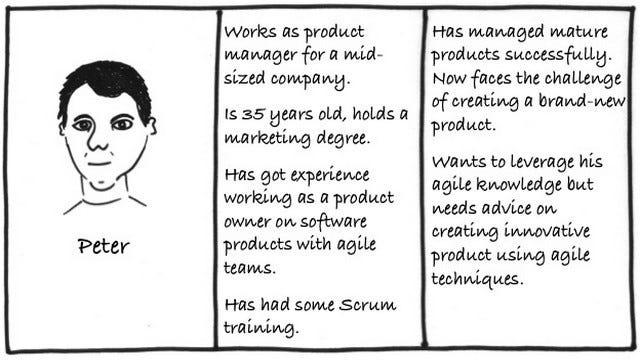
- Persona Group (Banker, Hotelier, Web Manager)
- Fictional name
- Job titles and Major Responsibilities
- Demographics (Age, Education, Ethnicity, and family status)
- The goals and tasks they are trying to complete using the site
- Their physical, social, and technological environment
- A quote that sums up what matters most to the persona as it relates to your site
- Casual pictures representing that user group
Evaluating User Personas
Evaluating Personas provide the most functional and imperative information before you start designing the User Interface or User Experience. Personas will open the user behavior, what your users want, what they need, their values, their demands, abilities, limitations, pain points, motivation, can be evaluated on the grounds of:
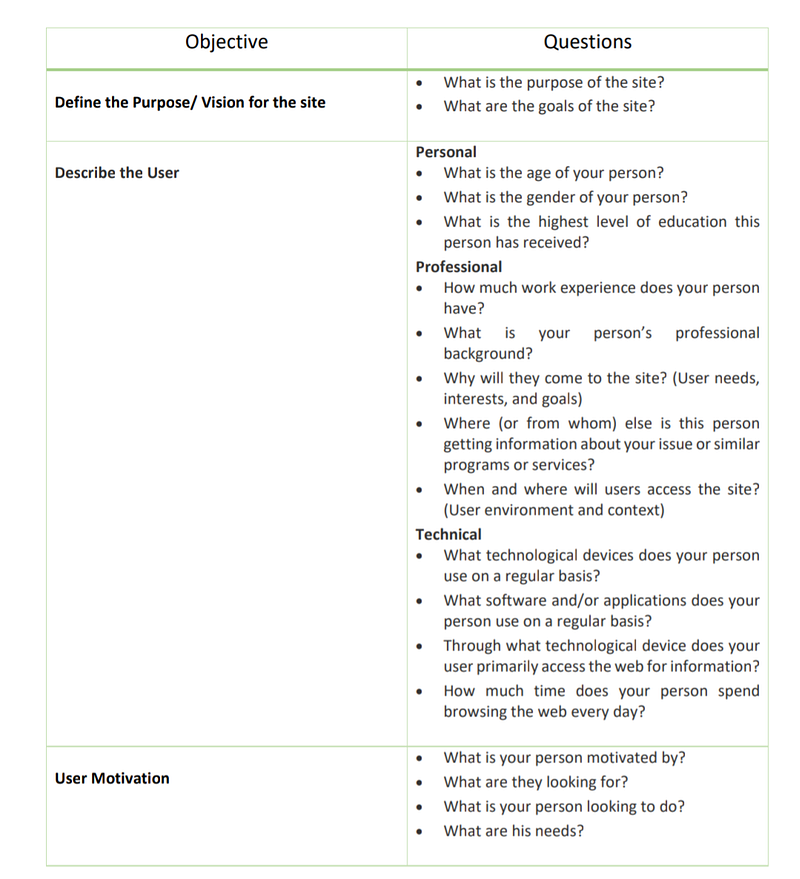
- Personal Background
- Professional Background
- User Environment
- Psychography
- End Goals
Hope this helps! Cheers!

This story is published in The Startup, Medium’s largest entrepreneurship publication followed by +428,678 people.
Subscribe to receive our top stories here.
