
Forget the “Fore.” Let’s Play!
Defining sex as the luscious marathon of give and take between lovers
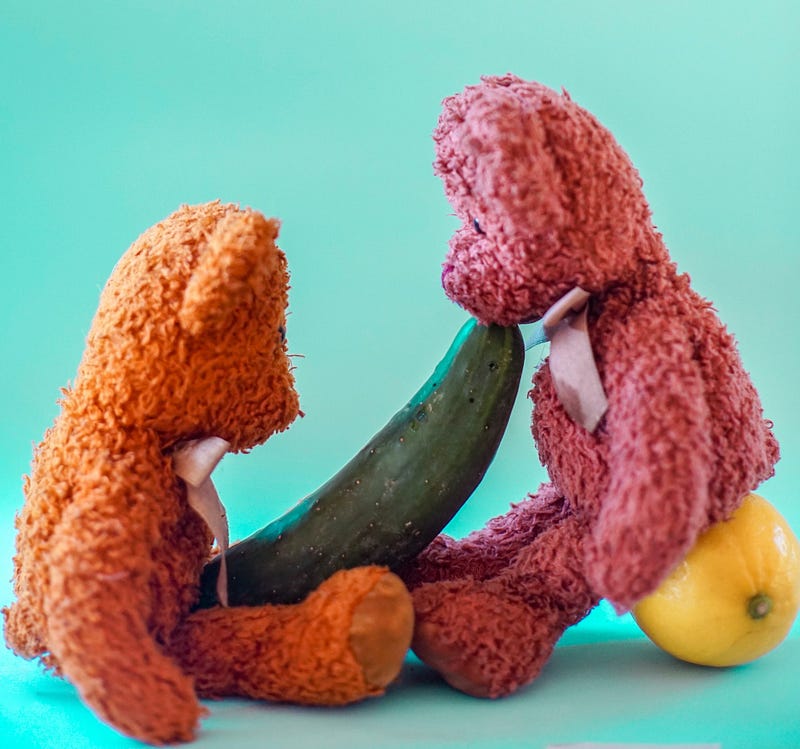
Can you remember that exhilarating moment just between childhood and adulthood, when you were engaged in wild, free play with a friend, laughing and wrestling, or chasing one another, and suddenly everything changed? Time slows down, colors brighten, and their every move becomes fascinating and wonderful.
For me, the playdate was Brian, a boy one year older than me. There we were, one moment children, and in the next, my body flushed hot and wet, my knees became weak, and I was overcome by desire for him. The laughing and the touching changed into something else entirely. I may have even orgasmed just a little, though I was far too young to know the name for that blissful bodily sensation.
To Be Human is to Play
Play is the most natural thing children do. As babies, we enter the world knowing instinctively only how to suck (nursing), grab (for holding onto mama out on the plain), and relax the anal sphincter (for excretion). As our eyes learn to focus, we come to recognize our primary care giver, then to crawl, talk and walk. After that, it’s all play.
Play is the way children explore their world, learn to distinguish between self and other, and find their way around power, authority, creativity and relationship. To be human is to play.
In many ways, as people, we would be far happier if we could allow our childlike selves to set the norms and habits of our adult lives. After all, most children have an intrinsic sense of fairness and generosity, no judgment, and the unadulterated ability to enjoy pleasure, seek comfort when in pain, make new friends, and play.
But, we don’t.
Looming between childhood and adulthood is adolescence, and the associated emergence of the ego. In adolescence, we become self-conscious, competitive, and profoundly judgmental, of ourselves most of all. It is that egocentric, pimply person who most often navigates our first sexual awakening.
Teenage sex is uncertain, stressful, and hyper-focused on penetration. It largely draws on metaphors of conquest and bases marked by territory uncovered. It’s not hot. It’s most often quick and dirty at best.
Sex as Play
What would it look like to allow our childlike selves to serve as the architects of our sex lives, rather than our teenage selves?
Children run around naked, masturbate freely, love to take baths, and take baths with friends. What if it was that part of us that set the tone for sex, rather than the self-conscious, self-centered teenagers we became?
This is how Bonobos, our closes primate relatives do it. They are wildly playful, copulate far more than is necessary for procreation, fluidly moving between partners of the same and opposite sex (Prüfer, K., Munch, K., Hellmann, I. et al. “The bonobo genome compared with the chimpanzee and human genomes” Nature (2012)).
Great sex is a luscious marathon of give-and-take between lovers, and it has far more to do with play than with penetration.
Watch how the bonobos do it, slipping parts inside of one another with ease just because it feels good. They engage in penetration of all kinds for the pleasure of it all, as they pet, stroke and generally interact in community.
(This is a fascinating synopsis of the use of sex among Bonobo clans to defuse tension and maintain social cohesion).
Saving Sex from its Sordid Past
Sadly, it is more than just the confluence of first sexual awakening and adolescence that is at fault for our over-emphasis on penetration during sex. For most of human history, sex has served two primary functions: procreation and dominance. You don’t need me to make the case that patriarchal religion has limited virtuous sex to sex for the purpose of procreation, but the link of sex with violence is just as pervasive and damaging.
Rape was an integrated and sanctioned act of war until the modern period. For example, as Sharon Block explains in her book Rape and Sexual Power in Early America, rape as a criminal act is only first attested in the United States in the 19th century, and practically speaking, meant only the violation of a white woman by a black man. By contrast, sex with female slaves by male slave owners was part and parcel of the system of US slavery, exemplified by Thomas Jefferson, architect of the US Constitution, who also fathered four children with his slave Sally Hemings, only granting them emancipation when they left the United States for Paris. Had they remained in the US, they would have remained slaves, just like their mother. The possibility of rape between married persons was only recognized in the US in 1933 and in the UK in 1992(!).
It is time to liberate sex from its dark and shady past. The key to doing so is play. Playful sex is as good for men as it is for women, as it places the mutual giving and receiving of pleasure at the center of the experience.
Defining sex as the insertion of a penis in a vagina is outdated. That kind of sex makes babies, not pleasure. The kind of sex that brings endless ecstasy, intimacy and self-discovery, is sex that is first and foremost playful.
Luckily, you’ve heard of playful sex even without reading this essay. You were just lead to believe that it was the warm-up, not the main event. It’s time to drop the “fore” from “foreplay.”
Forget the “fore.” Let’s play!
- Playful sex is curious. For small children, the world is magical because of what Buddhists call “beginner’s mind.” Small children meet every tree and shadow, every nook and cranny with a sense of wonder. Around every bend, they are ready to discover new and untold delights. This is just how we must treat the bodies of our lovers. Even if we’ve been caressing them for decades, the body is an ever-changing masterpiece. Each and every time our lover invites us to draw close, we should bring our childlike curiosity with us.
- Take turns when you play. Children know that play is only fair when we take turns. In sex as on the playground, lovers who cultivate ecstasy take turns, sometimes making pleasing their lover their only focus, and at others, lying back opening completely, ready to receive.
- Playful sex is adventurous. As Helen Keller said, “Life is either a daring adventure or nothing at all.” Nowhere is this affirmation more true than in the bedroom. Playful sex is experimental and adventurous. Long after other areas of life become predictable, sex has the ability to introduce us to sensations and parts of ourselves that we could never have imagined.
- Playful sex is messy. Like all good play, playful sex should be messy. Whipped cream, bodily fluids, playful sex is the adult version of finger-painting. Put on a smock and dive in there. You’ll never know what you’ll discover. For inspiration, here is an insanely hot description from Wistful writer of a golden shower (even I was tempted…).
- Playful sex is vulnerable. The great observer of life Sylvia Plath remarked in her journals, “And so it is that childlike sensitivity to new experiences and sensations seems to diminish in an inverse proportion to growth of technical ability. As we become polished, so do we become hardened and guilty of accepting eating, sleeping, seeing, and hearing too easily and lazily, without question. We become blunt and callous and blissfully passive as each day adds another drop to the stagnant well of our years.” Playful sex is the antidote to the stagnation she so eloquently describes. In play, we are raw and open, childlike and vitally alive.
Incredible sex is play in its purest form. Just like children, or puppies or kittens, when we humans feel loved, safe, and truly free to follow our desire, good sex emerges. We grab and lick, suck and caress our lovers, just as we might have as babies at the breast. It’s natural and it’s playful. Playful sex is not the warm-up for some other main event. It is the very life of life.